



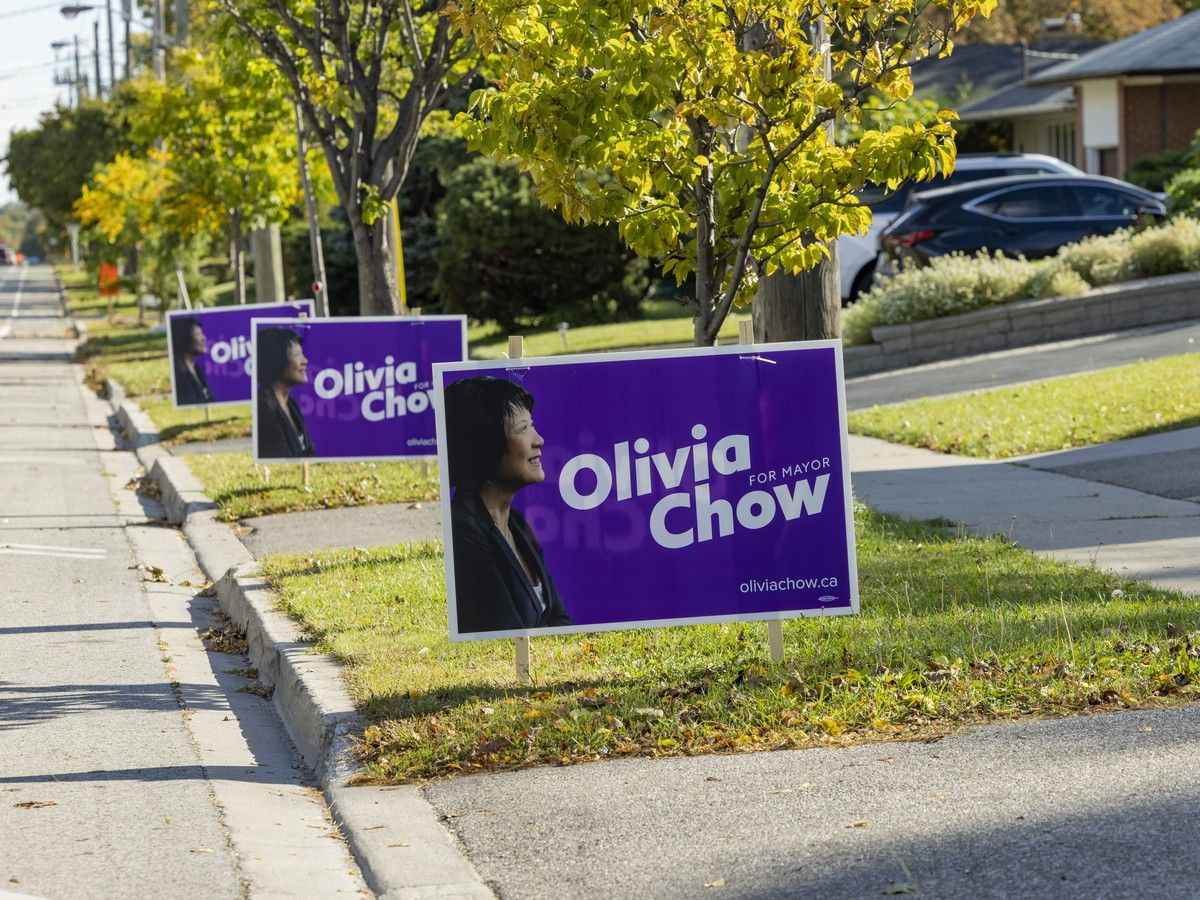
Brad Bradford is disappointed in Olivia Chow.
At the final debate of the Toronto mayoral campaign on Thursday night, a familiar pattern emerged.
Chow, the incumbent mayor, would accuse Bradford of a misdeed, either in his promises in the campaign or his actions as a city councillor. Bradford would respond with some version of “that’s not true.” Sometimes he would offer a sigh or a shake of the head as, he said, he had to correct the record. Sometimes he said Chow was spreading misinformation on issues like his proposal to create a public water utility, which she said opens the door to privatization of the city’s water supply. Sometimes he said, a little theatrically, that she was better than this. “It’s below you and it’s below the office,” he would say, lamenting what he called the incumbent mayor’s scare tactics.
And then a bell would ding on stage to note the end of the speaker’s allotted time. There were no knockout punches in the CP24/CTV News debate, but the incessant bell was the clear winner.
None of Chow’s attacks were all that unusual in a political debate, and none of it was particularly surprising in this specific contest because Chow and Bradford have sparred in that manner repeatedly by this point in their battle to lead the city.
But it is still notable that Chow finds herself, with just three days to go in the campaign, attacking Bradford’s promises and his record on council. It’s a sign of how much the race has tightened in the waning days that Chow’s pitch has changed from one that largely focused on promises to “keep building the city together” in the early days to one that spends just as much time haranguing Bradford.
She has reason to be worried. After former federal Conservative cabinet minister Chris Alexander dropped his quixotic bid to lead city hall earlier this month, public-opinion polls have narrowed as the contest turned into a two-person race. Chow, who had consistently enjoyed leads of close to 10 percentage points, has seen them all but disappear in recent weeks.
A Liaison Strategies poll released this week had Bradford (49 per cent) two points ahead of Chow (47 per cent) among decided and leaning voters. That is within the survey’s margin or error, but also a significant change from just a week earlier, when the same pollster had Chow with a five-point lead.

A Nanos poll released this week gave Chow a three-point lead, while the same firm had her with a nine-point lead in the first week of October.
And a Mainstreet Research poll from this week had a one-point lead for Bradford. That margin is again within the margin of error, but Mainstreet had Chow with an eight-point lead in September.
This is not normally how these things go in municipal politics. Name recognition tends to be significant in a system that does not officially involve party candidates, and Chow is not only the incumbent mayor, she’s a former Toronto councillor and federal MP who has been in public life for four decades.
Bradford, meanwhile, has been on city council for eight years and, when he ran in the mayoral byelection that Chow won in 2023, he finished eighth with less than two per cent of the vote. This is not someone at the head of a political juggernaut.
And yet, he has Chow very much on the defensive as the candidates make their closing arguments.
Why did her lead evaporate? It could be as simple as voters starting to pay more attention this month, especially after Alexander dropped out. But it is also true that the pair have offered quite contrasting messages. Chow says that things might have been a little rocky when she took over, but Toronto has “turned the corner” and she’s asking voters to give her more time to keep building. Bradford says that Toronto is stuck and he argues that voters didn’t get much out of the steep property-tax hikes that Chow oversaw in her first two years on the job.
Bradford has also been more of a hawk on public safety and policing, but polls have consistently said that crime is down the list of voter worries, which are topped by affordability, traffic and the lack of available housing.
Bradford’s big-ticket proposals — a property-tax freeze and a cut to the land transfer tax — are broader than Chow’s more targeted affordability measures, which include a cap on TTC fares and an expansion of a school-snack program into one that also provides lunches.
Were Bradford’s tax-cut promises enough to turn the campaign on its ear? Did Chow’s argument that the city has bounced back from a bleak stretch not ring true with enough Torontonians?
Whatever the case, she evidently knows she’s in a fight now. Chow’s closing pitch was that Bradford couldn’t be trusted to do her job. She’ll have to hope that enough voters are happy enough with the job she has done so far.
National Post