


They are rolling a dying man on a stretcher out of the Maple Hotel. He looks to be about 60 years old, unshaven, wild grey curls, filthy white socks. Electrodes are patched to a hairless chest and a monitor seismographs the agonal beatings of a beaten-down heart. The tattoo on the patient’s right forearm reads KILL TO LIVE.
“What have you got here?” I ask one of the EMTs as he sheds his antiviral poncho to reveal a crisp blue uniform beneath. “This is the Downtown Eastside,” he replies. “What do you think we’ve got?”
It is a late September morning at Canada’s most appalling intersection, the corner of High and Low. A quartet of citizens much younger than the man on the stretcher crouch smirking or slouch insensate on the pavement beneath the Maple’s marquee. Crack pipes scattered on the pavement welcome four new ambassadors to Armageddon from our nation’s deep supply of broken kids.
“Hotel” is a euphemism for the eight-storey Maple, as it is for a dozen or more other Single Room Occupancy (SRO) hellholes, many of them a century old, that define the blighted Downtown Eastside (DTES), relics of the epoch when they sequestered stevedores and lumberjacks up from the docks and down from the woods while they took their beer. The building’s windows, viewed from below, are shattered, hanging loose, missing completely, or smeared with vile graffiti. But on one sill, I see flowers.
Steps away from the youths on the pavement, our grizzled patient lies unconscious on the gurney. Now he is levitated into the ambulance that will hurtle the pale shell of yet another once-young, once-virile, once-dreaming soul to triage, lights ablaze and sirens screaming.
Across East Hastings Street, over by the Carnegie Community Centre, the honey locusts are turning gold and crows are arguing in the branches. A flitting wind is chilly off the harbour; the end of yachting season’s drawing nigh. I should have brought a warmer jacket.
Looking north, up the alley that runs west of Main Street and east of the blighted Maple Hotel, I can see Grouse Mountain’s silhouette against a pallid autumn sky.
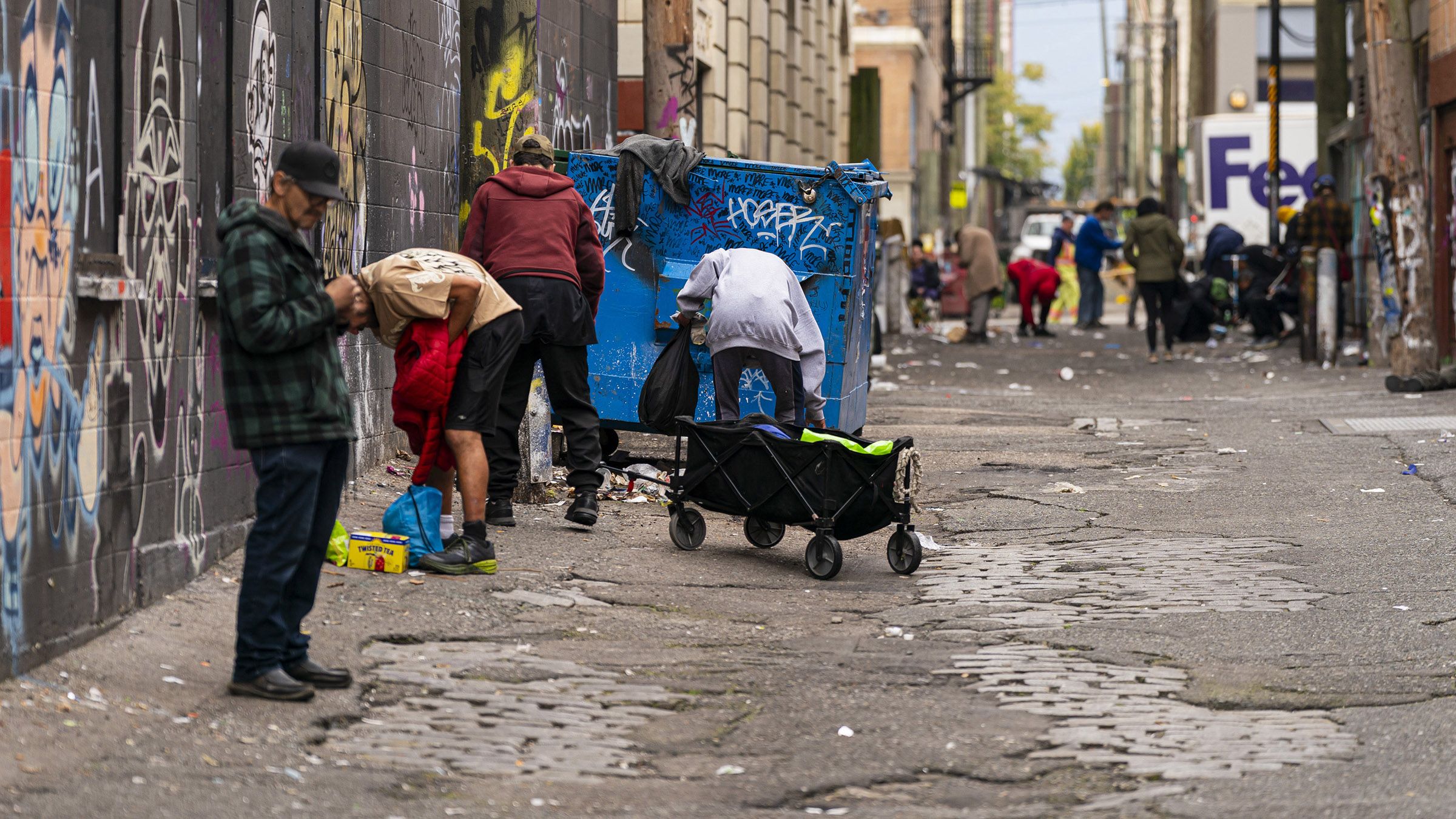
Between the ancient but still-thrumming Carnegie, with its spiral stairway and its stained-glass effigies of Shakespeare and Milton and Spenser and its generous cafeteria and its take-no-crap security staff, and a seemingly abandoned office building that once was The Molson Bank, there is a narrow alley whose asphalt is smeared and slippery with breakfast cereal, urine and puke. In that little laneway are at least 30 reeling, half-alive drug users and their comrades and their sweethearts and their murderers.
In a doorway, some mother’s daughter, not yet 20, is crawling through a pond of spilled and spoiled buttermilk, feeling for a book of matches.
Another woman fumbles with a kit containing Naloxone, the antidote to some, but not all, of the poisons that are sold and consumed on our libertine streets while we walk around, look away, and step over. (What we do to ourselves with needles requires more needles to assuage.)
“My damn legs, my damn legs!” one man is wailing, and he rolls up threadbare cuffs to expose half a dozen open, dripping, bloody sores the size of playing cards.
Nearly all the other addicts in the alley are silent, clustered in pairs and trios, high as jets, deaf as trees, and mute as clouds. Many are folded forward at the waist like the letter L, staring down at the filthy ground, defying gravity, eyes vacant, lost in space.
I remember Wilfred Owen’s rendering of the British Army, 1917:
Bent double, like old beggars under sacks
Knock-kneed, coughing like hags, we cursed through sludge,
Men marched asleep. Many had lost their boots,
But limped on, blood-shod. All went lame; all blind;
But the addicts on the Western Front of Canada’s half-assed war on deadly drugs are merely displaying what toxicologists call the Opioid Flexional Phenotype — the “fentanyl fold” — not Great War poetry. And that screaming man’s necrotic lesions are a common side-effect of Xylazine, an animal tranquillizer often cut with fentanyl to prolong the high.
(Consider this: more Canadians have lost their lives to overdoses of opioids in the past 10 years than were killed in combat in the First World War, 18,000 in British Columbia alone since 2016.)
Explore further with me, come by another shocked and gawking tourist. Walk a block or two in any direction along the wide avenues and tight back streets of the Downtown Eastside — up toward Cordova and Powell, down toward Pender and Chinatown — and there must be a thousand more derelict users on the sidewalks: initiates and old-timers, locals and come-from-aways, sisters and brothers, Britons and Blacks and Dene, motionless and shuffling, vomiting and shitting, dealing and being dealt life’s losing hand in one of the most blessed and bounteous countries in the world. And countless more up in the fetid SROs, doing whatever they do.
Six more ambulances and fire wagons are idling within half a block of the crucifix of Hastings and Main streets in Vancouver, B.C. They will not idle for long.
“Bring out your dead!” they used to cry in the Middle Ages, but in plague time at Hastings and Main, the dead and the dying are already in the open air.
Still, the CIBC and the TD Bank at Main and Pender are open, they still are having rock concerts at the Rickshaw Theatre, they are whisking omelettes in the Ovaltine Café, there are hushed and studious readers in the library inside the Carnegie Community Centre, and the big Route 16 bus still careers along Hastings toward the city’s prosperous and cultured core. In Chinatown, tonight’s full moon will bring the Mid-Autumn Festival.
This is Vancouver 40 years after Expo 86, 16 years after the Olympic Winter Games, three months after the FIFA World Cup, under the yellow trees.
The cancer is not only here, but here is worse. It is not just this season, but decades of decay and misery. And meanwhile, in fear and revulsion, pity and heartbreak, anger and avoidance, commitment and indifference, the city carries on.
* * *
“Toronto reporter discovers Vancouver has a drug problem,” someone out this way is bound to sneer, but this is not my first go-round on the Downtown Eastside. Back in 1988, I wrote and fronted a CBC documentary that we centred at the Carnegie and at an SRO on Powell Street — the Lucky Lodge. It was a place that, when you opened the front door, smelled like corpses, if you know that smell.
I remember interviewing a guy named Wilson at a vocational-training centre and Wilson telling the camera that “I am sick and tired of being sick and tired of being sick in the gutter.” But our subjects four decades ago were — or we chose to portray them as — harmless drunkards, a bunch of stumbling B.C. Barney Gumbles, no danger to the larger fabric of the city’s life. This was 30 years after fentanyl first was synthesized in a Belgian laboratory, but still decades before it would become the most commonly used artificial opioid in North America, soon to be broadcast by Chinese chemists and Mexican mules to our sidewalks and schoolyards and tenements and tents.
The doc was a hit. And the Lucky Lodge still is in business in 2026, even after a police sweep in 2005 resulted in dozens of arrests for “widespread drug dealing, deplorable conditions and welfare fraud.” However, The Tyee, a local news website, reported in August that long-term residents are under constant pressure — and offered bribes — to melt away so that management might replace them with students at jacked-up rents.
* * *
Around the corner from the Lucky now, a brace of brawny, tawny dogs — Nala and Bo.
Reining them, stroking them, barking at them when they leap to sniff a stranger, is a man who calls himself India. He says that he grew up in Montreal, that his parents came to Canada from Trinidad, that he played basketball and hockey in high school, that he has four children — somewhere — and that he slept on the sidewalk last night, propped against a brick wall, blanketed by the beasts.
“It’s a choice,” he says of his current circumstance. And again: “It’s a choice.”
We look around at a breathtaking panoply of desperation that stretches as far as the eye can see.
“I don’t see myself any different from them,” India says. “I’m still human. They’re still human.”
“Do you think that most of Vancouver cares about this?” I wonder.
“They probably care about cleaning up the streets,” he answers. “Some people care about the people, they want all of them to get better. Some people just want all of this to be gone.”
“That’s not a bad wish,” I suggest, “to want your city to be clean.”
“No, it’s not,” India agrees. And he says that his moribund neighbours “look more scary than they are — they are very nice people.”
“They would give you their last dollar,” he says. If they had a dollar.
“What would help them?” I ask. “What ends this?”
“There could be a lot more jobs, a lot more places to stay for people on the streets. To get a place, some people wait years. I know somebody that waited 11 years. Some people don’t want a place and some people actually do.”
“Would you go for treatment if they came around to take you?” I ask.
“I don’t need treatment,” says the man with the dogs.
* * *
When they vote for their mayor and council on Saturday, Oct. 17, Vancouverites also will be presented with a non-binding plebiscite (from the Latin plebiscitum, “the common people’s choice”) that purports to create a path toward cleansing the clients and clearing the catacomb at the crossroads of Hastings and Main.
The current mayor, who is running for re-election, is a Hong Kong immigrant’s son named Ken Sim, a father of four and the first Chinese to win high office in a city that has welcomed thousands of Chinese families and trillions of their renminbi in recent decades. Sim first gained the mayoralty in 2022 by unseating the incumbent with 51 per cent of the vote.
If you accept the premise that the heart-rending ruin of the Downtown Eastside began in earnest when a thousand SRO rooms were emptied or uprated to clear the grounds for Expo 86, then Sim is the eighth man to own the crisis. (Vancouver has had an Olympic Games, a World’s Fair, a World Cup, an NBA team — briefly — and two Stanley Cup riots, but never a Cup parade or a lady mayor.)
Early in his (first) term, Sim ordered the obliteration of hundreds of tents and hardened structures that were blocking traffic and commerce on East Hastings, and the removal of dozens of stolen propane tanks that were only a Bic away from blowing the addicts’ entire acreage to Kingdom Come. (Hundreds might have died at once instead of one at a time.) This purge was successful — Vancouver’s unhoused now repose under hospital blankets and garbage bags in lieu of canvas and plywood.
The plebiscite is a pointed (and to his opponents, pointless) manoeuvre by Sim to get the public to formally ratify his get-somewhat-tough approach to the Downtown Eastsiders and the other desperadoes who have spread larceny and loathing across Vancouver’s more moneyed ‘hoods.
The referendum here will ask:
Are you in favour of the City of Vancouver strengthening its laws to forbid open-air hard drug (heroin, meth, fentanyl, and crack) use in public spaces?
And: Should the City of Vancouver formally ask the Province of BC to convert portions of the old St. Paul’s Hospital, or another similar site, into a secure medical facility that provides acute voluntary and 100-plus involuntary care beds for individuals posing a serious risk to themselves or others due to severe substance use and mental health disorders?
“It’s a cynical election move,” said one of Sim’s opponents on the October ballot, Coun. Pete Fry of the Greens. (He the son of Hedy Fry, the longest-serving female MP in Canadian history, currently serving her eleventh term in faraway Ottawa.)
“I see this as nothing more than a cheap political distraction,” echoed Vancouver Liberals mayoral candidate Kareem Allam, who used to be Sim’s chief of staff at $150,067 a year.
On a drippy Friday, I meet Mayor Sim at his campaign headquarters. We talk about the referendum and the necrosis at his city’s core and the very real possibility that — given the potency of fentanyl and the even more addictive drugs that are coming onstream as you skim this — Vancouver’s Downtown Eastside may be the harbinger of even more unspeakable and unpreventable tragedies that all of our cities will face.
“What I can tell you,” the mayor says, “is that everything that we’ve done in the past obviously hasn’t worked. And so what we have done with the tools that we have, which is basically policing and reacting after the fact, is we’ve made massive investments in policing, Vancouver Fire and Rescue Services, and a whole bunch of things to stabilize that neighbourhood.”
Sim congratulates himself for the sanitation surge of 2023 and blames the current disorder on the provincial government of Premier David Eby, who — not to be left out — just called a snap election for Oct. 24.
“We’ve been working hard with the province,” Sim says. “We’ve got them to change their ideology, because they weren’t even into involuntary care a couple of years ago. Now the push is to get them to live up to their commitment.”
“That’s IF ‘they’ are still the same ‘they’ a month from now,” I remind him. (One poll I saw while I was in Vancouver showed Eby’s New Democrats trailing the Conservative Party of British Columbia, 43 per cent to 35. But the election still was a month away.)
“Well, you know what, that’s a great point,” the mayor responds.
“Do you think most Vancouverites care what happens to those few hundred or few thousand on East Hastings street?” I ask. “Most people never go down there.”
“I think when they do see it, they do feel it and they do care,” the mayor replies. “But it doesn’t matter where you live, it presents itself in other forms.
“Cars are getting broken into. Bikes are getting stolen. Shops are getting shoplifted. It’s happening throughout our city, and people feel it.
“The street disorder, someone defecating on the sidewalk or someone shooting up hard drugs in a public doorway. These affect people.”
I head back to Ground Zero, where a phalanx of police officers are slow-walking their daily beat along the highway to hell.
“The mayor wants you to ticket these people and take their drugs away,“ I mention to one of the officers. (Sim proposes that the fine for possession be zero dollars and zero cents; the goal is to identify and catalogue users for treatment later on.) “We can’t arrest our way out of this,” the constable responds.
* * *
The online reviews of the Airbnb one block from Hastings and Main that shelters me for the weekend may unnerve someone who might consider coming here to verify that what I am describing is real.
Just got harrased (sic) by couple homeless that were in the outside corner something no one can manage but the place is flawless amazing …
One thing to be aware of is that there are quite a few homeless people in the area. We never had any issues ourselves, but it’s something potential guests may want to keep in mind …
There is homelessness but I don’t consider that to be the fault of a host …
The surrounding neighbourhood did have many unhoused individuals, but they did not bother us …
Just down the street from the condo is the good old New Town Bakery. This is a magnet for travelling gourmands and glad-handing politicians — Ken Sim’s photo is on the wall, alongside those of Prime Minister Mark Carney and various provincial poobahs — and a throwback to the time when you chose a café for flavour and conversation, not just for a plastic bag of grub from a courier on an e-bike.
Susanna Ng, who owns the New Town, came here from Hong Kong in 1972, before Margaret Thatcher colluded with Deng Xiaoping to hand five million free people back to the Pekingese Communists without a single cannonball being fired by the famous Noonday Gun at Causeway Bay. (Not that the Iron Lady had a choice, with Deng controlling the city’s water supply, not to mention his two-million-man army.) It was that smirking betrayal that triggered so many wealthy Hong Kongers to invest in the beautiful city of Wen Ge Hua beyond the sea.
Vancouver gave the fleeing Chinese the freedom to prosper and study and dream. It gave Susanna Ng the liberty to make steamed pork buns and sesame rice balls, seven days a week, 12 hours a day for 40 years. She has watched her little slice of Wen Ge Hua shamble into woe and sadness, one stolen bao and pitiable wastrel at a time.
“Before, our block was very clean,” she tells me one morning over dried-fish congee and tea. “Before, it didn’t bother me that much because they kept on the north side of Pender Street or on Hastings. But now they are spreading.”
“You talk about these people like they’re COVID,” I snap back. “Like they are bacteria.”
“The government should do something like putting them into some rehab centres and help them to have their feet back on the ground again,” she says.
Perhaps, I suggest, they all should be sent, as they would have been in Chairman Mao’s China, up to Fort St. James or 100 Mile House to perform the manual reform-through-labour called lao gai.
“China is a very civilized place now,” Susanna says. “And rich, too.”
“Do most people in Vancouver care about Pender Street and Hastings Street?”
“I don’t think so,” she replies. “They don’t come down here. Particularly my daughter; she won’t come here. Only we in this area suffer it.
“A few years ago, a few of them were very aggressive. They came in here. They grabbed customers’ food, grabbed customers’ phones from the table. I was really upset.”
“What happened to them?”
“What happened to them? Nothing. And I guess some of them passed away.”
“Can this be a great city and a great country if this exists and we tolerate it?” I ask.
“Canada is still a great country,” Ms. Ng answers. “Vancouver is a nice place. I’m proud of this city. But I’m also ashamed of it, because the city is getting worse. We have to do something with the drugs.
“We don’t see this in Hong Kong, in China. Here, no punishment. There’s no punishment.
“Here,” says the doyenne of Pender Street, “too much freedom.”
* * *
Send in the bulldozers. Send in the cops. Send in the doctors.
Once a year, send in the clowns.
The advent of autumn signals more than rain and chill at Hastings and Main. For one man from the capital of Mexico — a megalopolis that is no stranger to tearful woe and sprawling poverty — it heralds the coming of The Day of the Dead, the funniest day of the year.
Gerardo Ávila came to Vancouver to perform at Expo 86 — I saw him bounce around on his pogo stick on the fair’s final day. Like the Carnegie Community Centre and the Ovaltine Café, he’s still here, still clowning.
Every year on Nov. 1, the Día de los muertos, he parades with a marching band along East Hastings Street, and he sets up an ofrenda in a storefront and invites the mourners of Vancouver to display photographs of their beloved and their lost.
“After my wife passed away, I put on a death mask and I danced for hours before the altar,” Ávila tells me. “And one woman got up and danced with me and then others were dancing, even the people all bent over, and they were so happy.
“These people are struggling, right? It’s sad. But there is humanity there. And on this one day, it is so wonderful to see people laughing or having fun. Those people don’t have much to laugh about. But when I dance with the music, and I invite everybody to dance, you have beautiful things happen.
“There are many people there, but not for just one reason. You must not assume. Some people could be just sick. I have found people who tell me, ‘My wife just left me and I’m sleeping here. I have nothing.’ But they are not drunk or not on drugs. And then you get the heavy drugs, too.”
“How does this end?” I wonder. On the Downtown Eastside, it is always the day of the dead and dying.
“People with money can get into a place where they can get off the drug,” the jester answers, “but the poor people, how can they do it? It’s a big, big problem. I don’t know how to fix it. I am not in politics. I am a clown.”
* * *
On a bulletin board in the vestibule of the library in the Carnegie Community Centre , anguished posters give names to a few of the faceless thousand on the streets outside.
HELP FIND DEZIRAE JEANNETE BERCIER
Age: 21 Height: 5’7” Weight: Approximately 80 lbs.
TRAVELED FROM WINNIPEG, MANITOBA TO VANCOUVER AFTER ANOTHER PERSON PURCHASED HER PLANE TICKET
Her family has had no communication with her since approximately July 19, 2026
– – – – – –
MISSING
Toni Leigh Ann O’Keefe
Hair: Brown Eyes: Green Height: 5’4”
Other features: Missing Front Tooth
– – – – – –
MISSING
SEAN ANTHONY KISCH
WE HAVE TRIED TO FIND YOU, BUT EACH DOOR WE OPEN IS CLOSED
YOU ARE WORTHY
PLEASE CALL SOMEONE. PLEASE HAVE THE COURAGE.
YOU ARE SADLY MISSED
Back at the Airbnb, I take a deep breath and dial the number printed on each family’s appeal.
My first two calls are not answered.
Then Sophie Kisch picks up the phone in Lethbridge, Alta.
“All the posters I sent out, I didn’t get any response at all, and I sent a LOT of posters,” she says.
“Everyone I reached out to, I got no help at all.
“The police said, ‘He is an adult’ and they would not tell me anything.
“I’m sure there are many, many other families in the same situation.
“Sean was very, very, very sick.
“We got down there, but he was in a coma.
“He died at St. Paul’s Hospital. Sean died on April twelfth.”
* * *
The woman behind the front desk at the Carnegie is a Dënesųłı̨né from the Cold Lake First Nations of Alberta named Deanna Piché.
“The priest gave us that name,” she says.
Deanna Piché has a smile for everyone; the few who survive the streets of Vancouver often are like that — grateful daily and respectful deeply of those still trapped in the quicksand of addiction and hopelessness.
“When I moved to B.C. 13 years ago,” she says, “I assumed everybody drank. I grew up watching my parents drink, my cousins, my grandparents. I just thought it was normal. I thought everybody drank around their kids. So when I moved out here, I was still in my alcoholism. And there were the drugs, too.”
“What got you off the street?” I ask her.
“I was a mother,” she replies. “I had something to live for.” Today, at 40, she lives for four children whose ages range from 13 to 21.
Deanna and I walk into the alley between the library and the old Molson Bank. The laneway, as always, is a garden of horrors that would take a Bosch or a Bruegel to paint. She says that terrifying new drugs — a zoo-animal sedative called “rhinoceros tranq” and the synthetic opioid cychlorphine — already have arrived at Hastings and Main. We may be only at the beginning of the plague.
“These are my people,” Deanna says. “A lot of them have seen me at my worst. I love them, and I tell them that I love them, and I am real with them, and they say that they love me.”
“What ends this?” I ask her. “Does love end it? Does Jesus end it? Or does it just go on like this for another 40 years?”
“Do you want my God’s honest opinion?” Deanna asks in Death’s alleyway, and I tell her that I do.
“I believe we are in Hell,” she says, “and we all go from here to Heaven.”
Main image: The alleys in Vancouver’s Downtown Eastside are a breathtaking panoply of desperation that stretches as far as the eye can see. On Oct. 17, Vancouverites will vote in a non-binding plebiscite about whether to strengthen laws forbidding open-air use of hard drugs. Photo by Rich Lam/National Post