


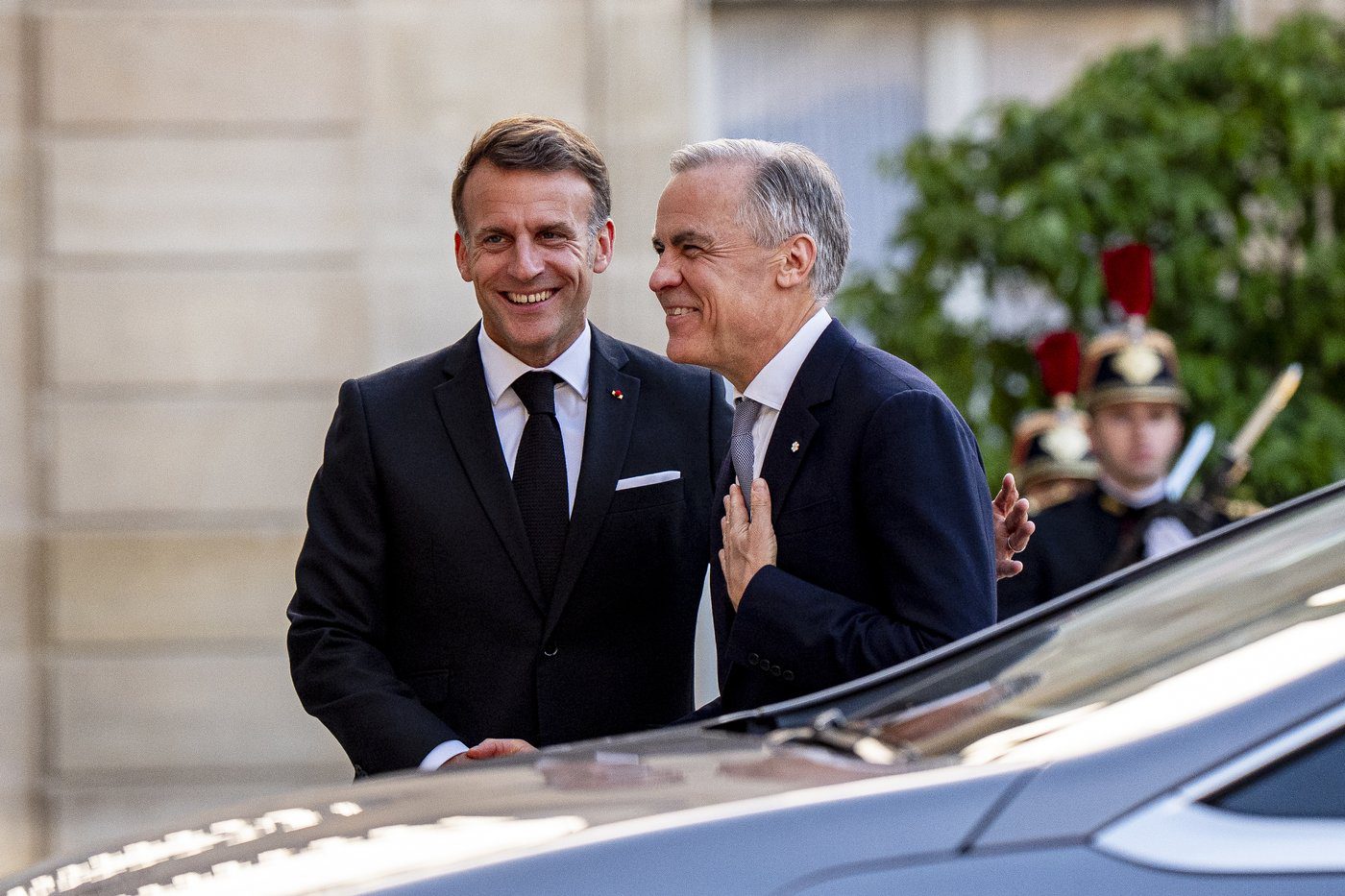
OTTAWA — Prime Minister Mark Carney and French President Emmanuel Macron are holding a symbolic meeting on an archipelago 20 kilometres off the southern coast of Newfoundland on Sunday, in what both countries say is a show of unity and mutual respect.
The two leaders will hold a working lunch and attend a wreath-laying ceremony in Saint-Pierre-et-Miquelon, a French territory which just barely beats out Greenland as the geographically closest European territory to Canada.
The meeting comes as Canada and the European Union are in talks to create a tighter alliance amid ongoing animosity with the United States and President Donald Trump.
“In a world characterized by a return to power politics, geopolitical tensions and new dependencies, France and Canada share a common ambition: to work together — and with all countries that share these values — to strengthen their capacity to make decisions and act independently,” a spokesperson for Macron’s office said in an email.
The email said France and Canada “share the same values of freedom, democracy, rule of law and respect for national sovereignty.”
Macron was scheduled to be on the islands from Sept. 19 to 21, ahead of his trip to New York City for the UN General Assembly next week. Carney, who will also travel to New York, will join Macon on Saint-Pierre for a few hours on Sunday.
Macron’s office said Carney will become the first Canadian prime minister to have an official visit to Saint-Pierre-et-Miquelon. Macron is the first French president to visit in more than a decade.
For Carney, it’s another chance to showcase Canada’s growing ties with Europe, just days after he visited the European Parliament.
On Wednesday, European Commission President Ursula von der Leyen said she wants Canada to become the first “associate member” of the European Union.
In her state of the union speech to the European Parliament, she said the two sides must “urgently reimagine” their partnership and move beyond a free-trade agreement to bring the relationship to the “highest level possible.”
Carney addressed the Parliament in Strasbourg, France, on Thursday, saying he welcomed von der Leyen’s ambitions for Canadian partnership.
Carney said while the name and nature of the new arrangement have yet to be determined, the partnership will go up for debate and a vote in Parliament. He said he’s interested in expanding a number of ties, including opportunities for young people, and an integrated market for financial services.
Canada and Europe already have a free trade deal — though it has not been ratified by all EU members — and last year Canada became the only non-European member of the EU’s new defence procurement program.
Carney signalled a desire to become closer to Europe immediately after becoming prime minister in March 2025, when he travelled to meet Macron in Paris, and King Charles in London, within days of being sworn in.
Diya Jiang, a researcher at McGill University at the University of Calgary, said Carney’s visit to Saint-Pierre-et-Miquelon reflects that vision.
“I also think the location of it in itself is symbolic. It is right off the coast of Newfoundland,” she said. “Canada geographically is far away from Europe but this shows … that actually we are closer than you think.”
The Prime Minister’s Office said in a news release that, during the visit, Carney and Macron will discuss “deepening the Canada-France partnership” in sectors such as aerospace, energy and critical minerals. They’re also expected to discuss advanced technologies in quantum science, satellites and supercomputing.
An official from Macron’s office who briefed reporters Thursday said the leaders’ meeting will be an opportunity to promote regional co-operation on fishing, transport, the transit of travellers, university exchanges and trade.
In addition to a working lunch, Carney and Macron will attend a wreath-laying ceremony at a memorial for Free France volunteers. In December 1941, Free French forces peacefully liberated the archipelago from the control of the Vichy regime, which aided Nazi Germany during the Second World War.
This report by The Canadian Press was first published Sept. 19, 2026.
— With files from Nick Murray
Catherine Morrison, The Canadian Press

