


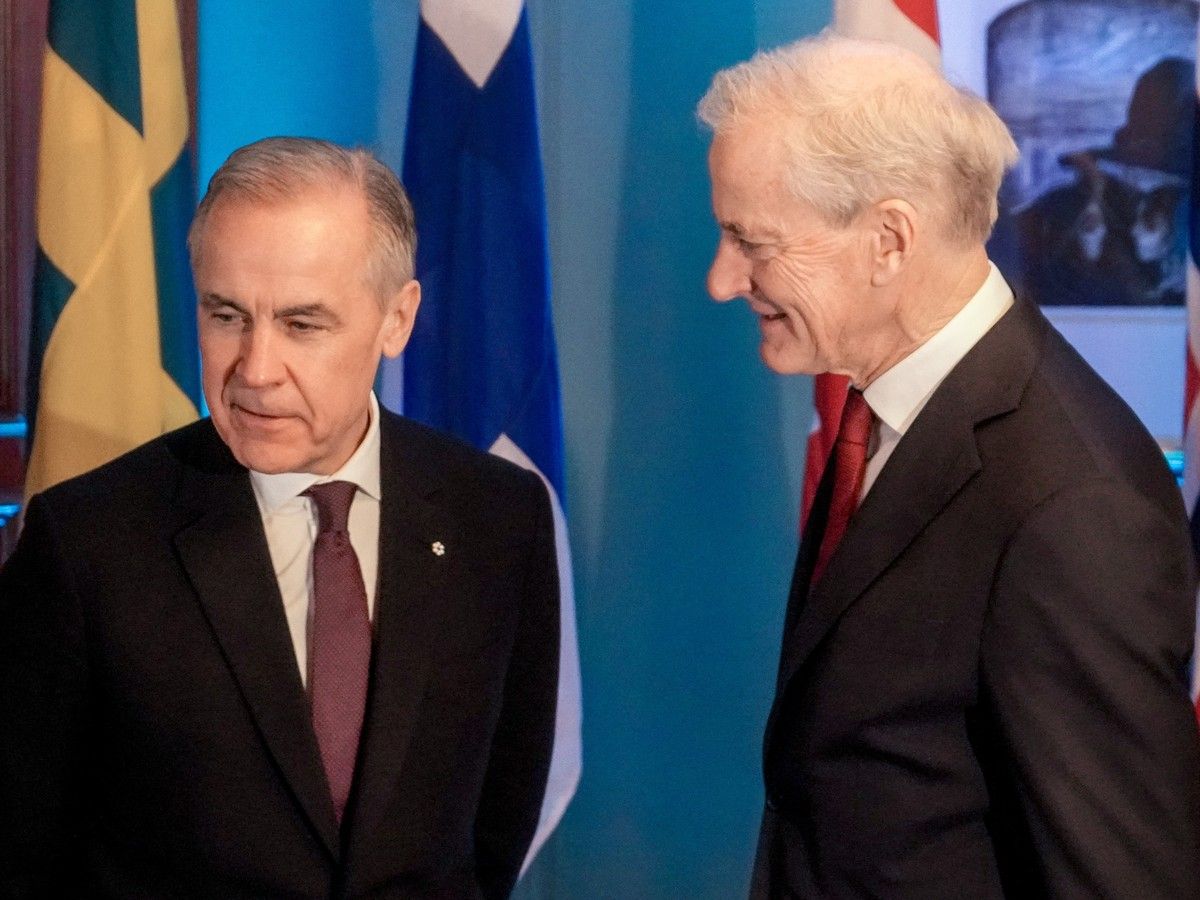
When Norway’s prime minister, Jonas Gahr Støre, meets with Prime Minister Mark Carney in Ottawa next week, the subject of farmed salmon will be high on the agenda.
The reason is that Norwegian companies have significant investments in Canada that are at risk because of federal government policies that Carney inherited from Justin Trudeau .
In 2024, the Liberal government said that would extend existing operating licences on the West Coast for five years before forcing producers to take all open net salmon farms out of the water by the end of June 2029.
The decision was a death sentence for an industry that employs thousands of people, sustains impoverished First Nations communities up and down the coast, and acts as B.C.’s largest agricultural export earner.
The ban was imposed in response to the demands of environmental activists who said farmed salmon were hurting wild sockeye salmon numbers, even though the evidence from the Canadian Scientific Advisory Secretariat , which provides advice to the Department of Fisheries and Oceans, was that the risk of pathogen transmission from salmon farms was “minimal.”
Regardless, the government said that producers had to bring their operations on land, a fallacious option, given the water, power and capital requirements to build contained tanks.
For communities including the Ehattesaht First Nation on Vancouver Island’s west coast, the news was devastating. It had just signed a benefit agreement with Grieg Seafood of Norway that saw it take a 30 per cent equity position in a proposed $300 million post-smolt contained facility that would have grown the salmon on land for a year before putting them in the water.
Grieg’s operations in Canada and northern Norway were bought for around $1 billion late last year by another Norwegian company, Cermaq, which is now lobbying for Ottawa to reverse the ban that has frozen its investment plans. If the government fails to reconsider, it faces compensation claims from Cermaq and another Norwegian firm, Mowi, as well as from impacted First Nations.
Canada is now in the ridiculous position of having the same ocean capacity as Norway but production of just 50,000 tonnes of salmon a year, compared to Norway’s 1.7 million tonnes.
What’s worse is that B.C. production has declined 45 per cent because of the ban and we are now importing $765 million of farmed salmon a year from abroad, including from China.
“We are simply sending jobs and economic value to other countries while we diminish our own food independence and security,” said Tim Kennedy, president of the Canadian Aquaculture Industry Alliance.
The upside for a prime minister looking for investment is that reversing the ban and granting extended licences would unleash a flood of new capital into the industry.
Cermaq officials have recently said that around $1 billion of capital investment planned for Canada has gone elsewhere because of political uncertainty.
The good news is that the industry has plans in place to rebuild capacity to around 90,000 tonnes a year within 10 years, at a capital cost of around $1 billion, and then to grow capacity to 180,000 tonnes, with a projected capital requirement of a further $3 billion.
Carney would have plenty of cover for prioritizing the economic interests of fragile First Nations communities such as the Kitasoo Xai’xais in the heart of the Great Bear Rainforest, where aquaculture accounts for more than half of revenues and the bulk of employment.
The open-net ban was based on an extremely dubious foundation, given the DFO’s own scientists had said there was a minimal risk to wild salmon. That finding has been challenged time and again over concerns about lack of impartiality and transparency, in large measure because the DFO has the dual mandate of protecting wild fish and promoting aquaculture.
Yet, despite criticism from the auditor general (2018), an independent expert panel (2018), the parliamentary fisheries committee (2023), a peer-reviewed academic critique in the Canadian Journal of Fisheries and Aquatic Sciences (2023), and a report by the First Nations’ Leadership Council (2023), the “minimal risk” recommendation from the Canadian Scientific Advisory Secretariat has not been overturned.
The evidence and the science simply do not support a policy that has halved domestic production on the West Coast, while doubling the volume of fish imported from countries such as China.
The existing plan is a staggering level of economic self-sabotage, and it should be reversed.
National Post

