


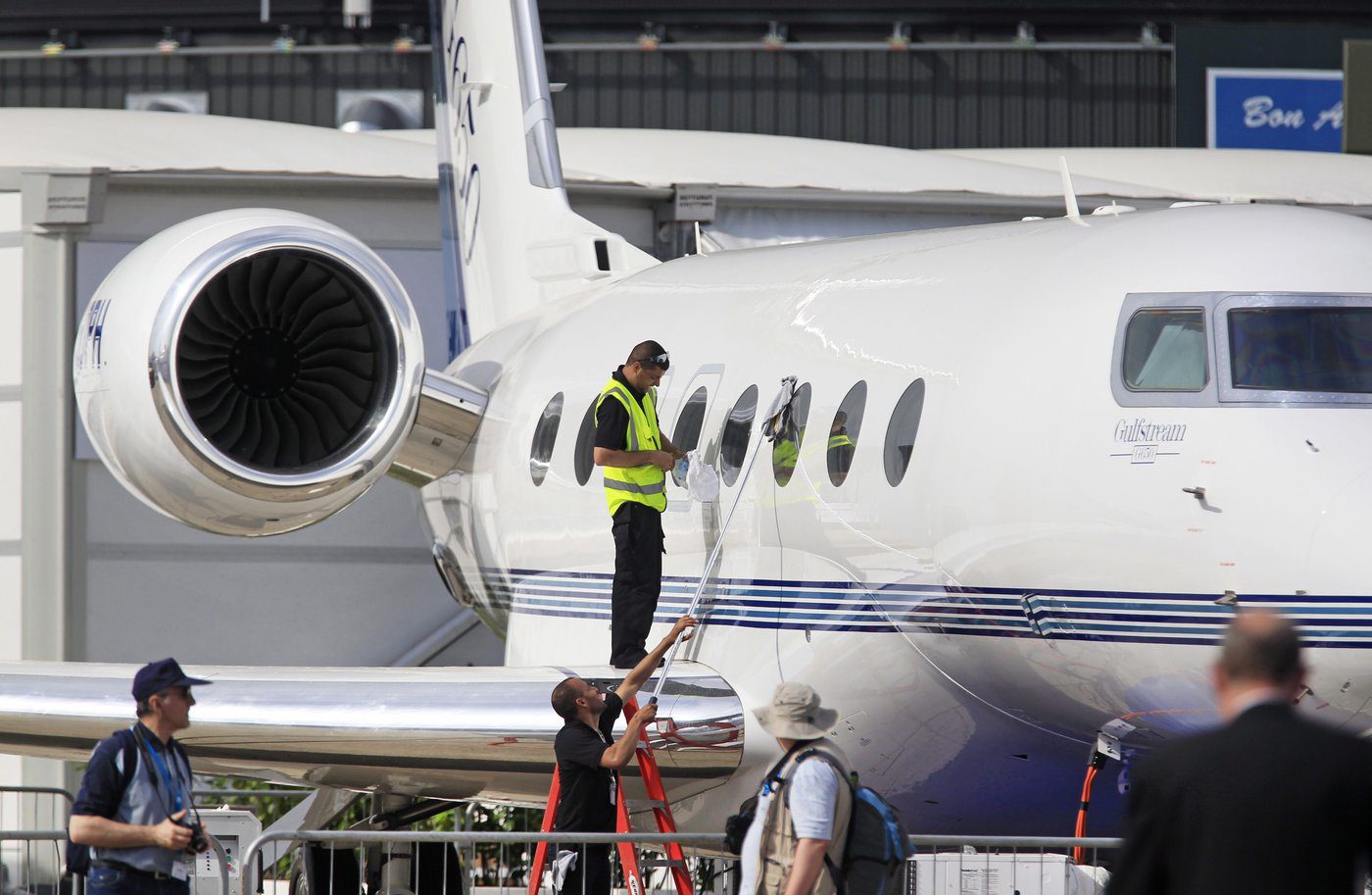
Days after trade talks between Canada and the United States collapsed last month, U.S. President Donald Trump posted a series of claims about the countries’ trade relationship on the Truth Social platform. Among them was the statement that Canada had not certified Gulfstream jets for 10 years because it wanted its Canadian competitor to have full access to the domestic market. However, aviation experts who dispute the claim say separate certification processes in the two countries explain why different standards and practices are applied.
THE CLAIM
In a post shared on Aug. 25, Trump claimed that Canada delayed certifying Gulfstream’s latest jet models because it wanted to maintain full market access for its own aircraft sector.
“For 10 years they wouldn’t certify Gulfstream Jets, until I got involved. They wanted 100% of the market for Gulfstream’s Canadian competitor,” he said.
In another post from Trump’s Truth Social account on Sept. 7, he continued to push this claim, specifically calling out Montreal-based plane maker Bombardier.
“NO MORE SELLING BOMBARDIER IN THE UNITED STATES! Their products aren’t good enough! Over 50% of their revenue comes from the United States — They live off American Buyers, American Companies, American Airports, and American Service — All while Canada blocks our GREAT American Banks, and Companies, throughout the U.S.A. They even blocked Gulfstream Aerospace from doing business in Canada — Completely unjust and unfair!” he wrote.
THE FACTS
John Gradek, who teaches aviation management at McGill University, disputed Trump’s claim of protectionism, saying Transport Canada has a rigorous certification process that explains the delays.
The federal agency responsible for certifying airplanes in Canada approved Gulfstream’s G500, G600, G700 and G800 models in February.
But before that, Gradek said, Transport Canada told Gulfstream it was concerned the fuel systems on the latest jet models could be vulnerable to freezing in frigid environments and at certain altitudes.
“The issue with the Gulfstream that ripples from the 500, 600, 700, and 800 models has always been fuel freeze; it has always been cold-weather operations,” Gradek said in an interview on Aug. 31.
Transport Canada did not directly respond when asked whether Trump’s claim that Gulfstream certification was delayed to protect Bombardier was true. A spokesperson said in an emailed statement that it regularly reviews all foreign and domestic aircraft and parts to ensure they meet the department’s requirements and can operate in Canada’s climate.
Gradek said Canada’s certification process has taken longer in recent years, partly because of retirements and transfers of staff, but also because of tightened regulations that followed the fatal Boeing 737 Max crashes in 2018 and 2019. The FAA-approved 737 Max had been essentially rubber-stamped by Canadian aviation authorities, he said, but since the crashes, “We basically want to go through it like a fine-tooth comb.”
The Gulfstream G500 was certified by the U.S Federal Aviation Administration in 2018, and the G600 got its FAA certification a year later. Certification for the G700 and G800 came in 2024 and 2025.
In the past, Gradek notes, Transport Canada would “rubber-stamp” U.S.-made airplanes that were certified by the FAA, but that didn’t happen in this case. Gradek said FAA certification had been gained through an exemption order under the aviation body’s fuel-icing certification rule, which allowed Gulfstream to certify its jets first and address the icing issue later.
Transport Canada hesitated to follow suit.
Gradek said that changed after Trump announced plans on his Truth Social account in January to decertify all Canadian-made airplanes and impose a 50 per cent tariff on any sold in the United States. Transport Canada approved the jets’ certifications the following month.
When Transport Minister Steven MacKinnon spoke with reporters about the approvals on Feb. 24, he pushed back on suggestions that political pressure from the Trump administration influenced the approval.
Transport Canada said in an email that it is standard practice among the world’s major aviation authorities to validate foreign aircraft that are certified in their own countries to ensure the aircraft meet the requirements for Canadian certification. The validation process provides “an independent review focused on safety and public interest,” it said.
Gradek noted this longtime practice helps streamline what could be a lengthy evaluation process.
“Certification can take years because, if you’re bringing new technology and new stuff onboard airplanes. They have to be tested, they have to be flown by inspectors, they have to go through the myriad of validations of safety and operational reliability,” he said.
Ross Aimer, CEO of Aero Consulting, said the FAA regularly tests everything on an airplane, running it through a range of scenarios and environments.
“They fly thousands of hours and replicate stuff that you may have, like takeoffs, stalls and all kinds of other problems that could possibly happen on an airplane,” he said.
However, Aimer noted the FAA took a closer look at its certification process after the 737 Max crashes — specifically the ability of some manufacturers to examine and certify their own planes. The FAA suspended that practice for the 737 Max in 2019.
Before the FAA’s creation in 1958, the industry had been granted increasing government responsibilities to examine, test and certify their own airplanes with government-appointed examiners drawn from — and sometimes referred by — the private sector.
In 2005, the FAA allowed manufacturers to oversee portions of their own of certification process with strict oversight under a provision known as the Organization Designation Authorization.
Aimer says that gave manufacturers increased influence over their own certification process, with minimal oversight from the government.
“With the publicity as a result of those crashes of the Max airplanes, people were demanding to know what kind of airplane they were flying on, and if they heard it was a Max, then they refused to fly on it. So, that kind of pressure even got the politicians involved,” Aimer said.
SOURCES
Trump’s post about Canada not certifying Gulfstream jets to protect Canadian competitor’s full market access posted to Truth Social Aug. 25, 2026 (archived)
Trump’s post about banning Bombardier from U.S. market posted to Truth Social Sept. 7, 2026 (archived)
Catherine Morrison. Transport Canada certifies Gulfstream G500 and G600 jets. The Canadian Press website. Feb. 20, 2026. (archived)
Christopher Reynolds. Canada green-lights latest Gulfstream business jets after Trump tariff threat. The Canadian Press website. Feb. 24, 2026. (archived)
Trump’s post about imposing tariffs and decertifying Canadian-made airplanes in U.S. posted to Truth Social Jan. 29, 2026 (archived)
Allison Lampert and David Shepardson. Transport Canada certifies Gulfstream G700 and G800 jets after Trump spat. Reuters website. Feb. 24, 2026. (archived)
Delegation and Designee Background. May 5, 2016. Federal Aviation Administration website. Sept. 10, 2026 (archived)
Establishment of Organization Designation Authorization Program. Oct. 11, 2005. Federal Aviation Administration website. Sept. 10, 2026 (archived)
How Does the FAA Certify Aircraft? July 22, 2025. Federal Aviation Administration website. Sept. 7, 2026 (archived)
ABOUT CANADIAN PRESS FACT CHECKS
You can find out more about The Canadian Press here and about Canadian Press fact checks here. To reach our fact-checking team with any tips, corrections or comments, please email us at cpfactcheck@thecanadianpress.com.
Timon Johnson, The Canadian Press

