


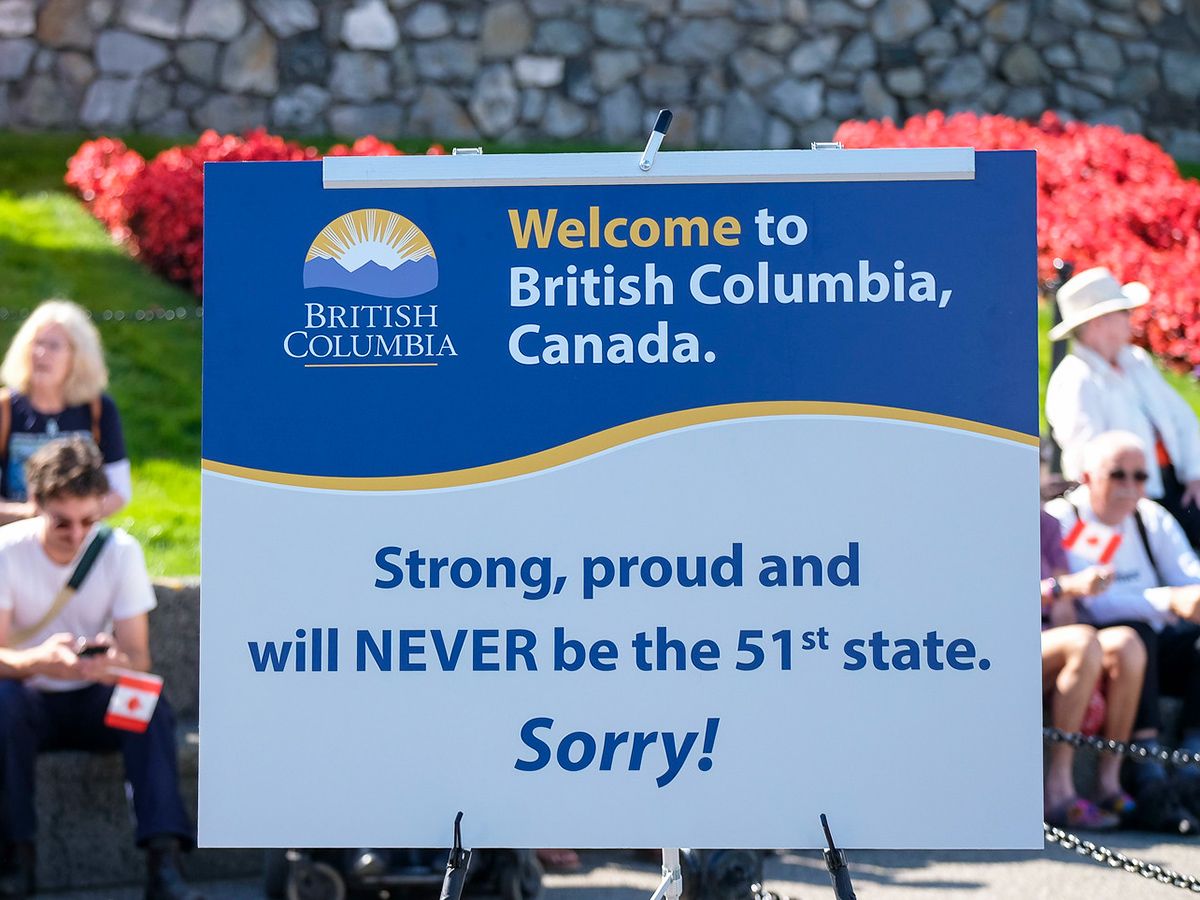
In Canada’s second official instance of sign-based retaliation against the United States, the Province of B.C. is installing notices at its border crossings informing travellers that they are entering territory that is “NEVER the 51st state.”
The signs were unveiled at a Wednesday press conference to coincide with the coming-into-force of 639 Canadian counter-tariffs targeting the U.S.
“Strong, proud and will NEVER be the 51 st state. Sorry!” read one of the new border sign;s.
A second one contained six graphic icons, one of which bore the message “Never 51 st State.” The others were “Watch for Moose,” “Don’t Litter,” “60MPH=100KPH,” “Respect Fire Bans,” and “Kindness ≠ Weakness.”
The last message was accompanied by an image of a raised black fist against an icon of a heart.
“They carry a message that reflects the spirit of this moment,” said B.C. Premier David Eby, wearing a red flannel shirt. He called it the “single most Canadian piece of clothing I own.”
The signs, he said, were a “uniquely Canadian message. It’s confident, good-humoured and it’s unmistakably clear.”
The exact placement of the signs wasn’t specified, but B.C. has 19 land border crossings with the U.S., including three with Alaska. The province also has six airports with scheduled service to U.S. destinations, as well as multiple marine ports of entry.
The current welcome at both international and provincial crossings is a sign bearing the official B.C. logo and the slogan “Best Place on Earth” – many of which were installed in anticipation of the 2010 Vancouver Olympics.
The new signs were unveiled at a ceremony held just in front of the B.C. Parliament Buildings, in an area of the Victoria Inner Harbour frequented by U.S. tourists; the B.C. capital being a common port of call for Alaskan cruises.
Eby’s speech was preceded by a performance by OGR-Scintilla, a rapper clad in a hockey jersey and trapper hat.
He performed the song Party in Canada, which includes the lines “can’t wait for another snow day” and “eh eh eh, it’s a party in Canada, eh.”
Despite the lighthearted tone of the press conference, Eby did say he anticipated damage from the trade war, and that he didn’t see any immediate end to it.
“There is no getting around the fact that people will lose their jobs and businesses will close on both sides of the border,” he said.
Eby also referenced the 25 th anniversary of the Sept. 11 attacks on Friday, saying despite all the “bad behaviour” of U.S. President Donald Trump, that if a similar tragedy were to occur, he still believed Canadians would “step up” to help in the same way as in 2001.
The new signs are one of several measures that Eby’s government has taken to signal its displeasure with U.S. policy, after Trump began levying punitive tariffs against Canada in early 2025.
In March of that year, Eby ordered the removal of all U.S. liquor from provincially run BC Liquor stores. As recently as June, he said there was “no chance in hell” he would reverse the decision.

The B.C. Parliament Buildings in Victoria were also draped with a large Canadian flag over the front entrance, in addition to a Canadian flag flying from a nearby flagpole.
The new border signs follow on a similar sign-based initiative in Ontario, where Premier Doug Ford unveiled a billboard in Winona, Ont., carrying the message “Lake Ontario now and always” in both English and French.
The sign was a direct response to an executive order by Trump mandating that official U.S. government maps now demarcate Lake Ontario as Lake America.
“I can’t remember what it cost, I think it was $25,000,” Ford told reporters soon after the unveiling.
As with Eby, Ford also ordered the removal of U.S. liquor from the province’s LCBO stores. Although, according to a July investigation by CBC News, the liquor remains in Ontario inventories, where it has incurred $8 million in storage fees.