



There has been no greater gift to the Liberal Party’s powerful pro-Beijing comprador caste than U.S. President Donald Trump’s exasperating bellicosity and exhausting trade-relations vandalism. Even after nearly a decade of scandals involving China’s Uyghur slave camps, its “hostage diplomacy,” mass espionage, intellectual property theft, forced corporate co-ventures and clandestine election-interference operations, by this summer the Pew Research Centre found that Canadians had come to view China more favorably than the United States.
You could say the American president can be thanked for that.
In the crude calculus of political advantage, by the time China’s former favorite Justin Trudeau was obliged to walk the plank and resign as prime minister in January last year, a deep reservoir of favorable ratings had become available to any Canadian politician who could be convincingly prescribed as a therapeutic remedy to the pestilence of Trumpism. No matter what your own promiscuous record in Xi Jinping’s corporate circles might be, you can get away with almost anything.
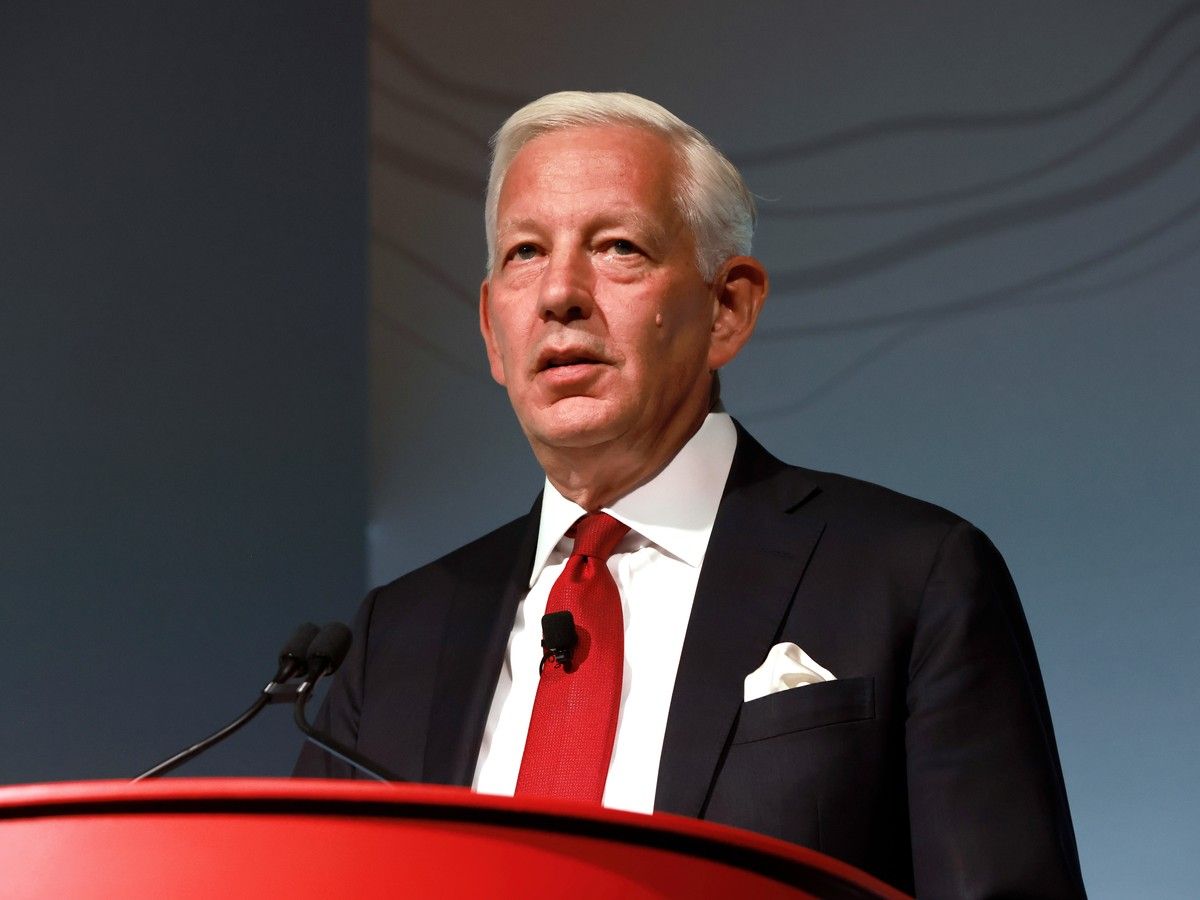
If there is a better explanation for Prime Minister Mark Carney’s choice of Dominic Barton as the Liberals’ spirit guide in their “new world order” project to radically expand foreign direct investment in Canada and pull the country out of the American economic orbit, it is not immediately obvious.
In a surprise move this week, Carney named Barton as the new board chair of a reconfigured Invest in Canada initiative, which will be hosting a Davos-like summit bringing together “the world’s largest investors, including top CEOs, entrepreneurs, and prominent global business leaders” in Toronto later this month. There’s no evidence that any distinction will be drawn between foreign direct investment from democracies and dirty money from torture states.
A key element in the Invest in Canada mandate is to double Canadian exports to non-American markets over the next decade. The project itself was one of the key proposals that arose a decade ago from Barton’s time as chair of Justin Trudeau’s inaugural Advisory Council on Economic Growth, an operation within Bill Morneau’s finance ministry run by McKinsey and Company, the multinational management consultancy Barton was serving at the time as global managing partner.
Another proposal from Barton’s council that was adopted by the Trudeau government: the catastrophic idea of doubling immigration to 500,000 people annually by 2025. It isn’t entirely clear that the Carney government has abandoned the “demographic deficit” thinking of its predecessors.
Barton came to the inner chambers of the Trudeau government after bringing McKinsey’s heft to Trudeau’s bid for the Liberal Party leadership in 2012. Trudeau’s manifesto proposed that deepening trade relationships with China would “build middle-class wealth in Canada.” As for Beijing’s convention-defying trade practices: “China, for one, sets its own rules and will continue to do so because it can. China has a game plan. There is nothing inherently sinister about that.”
There was no rationale involving Trumpist vulgarity available to the Liberals back then, and as it turned out there’s quite a lot that’s proved to be sinister about Beijing’s own rules. Its “game plan” has involved hollowing out western economies by flooding markets with its subsidized industrial overproduction, financing Vladimir Putin’s war on Ukraine, funding the Islamic Revolutionary Guard Corps by the purchase of 90 per cent of Iran’s oil via the Khomeinists’ sanctions-evading “ghost fleet” and ensnaring developing countries in its Belt and Road debt traps.
As recently as four years ago, the folly of the Trudeau-Barton approach to foreign trade was so obvious that Ottawa had shifted to enthusiastically following U.S. president Joe Biden’s lead by rapidly reducing Canada’s exposure to Chinese economic strongarming. “What we want is certainly a decoupling: certainly from China,” Industry Minister Francois-Philippe Champagne said at the time.
But by January of this year it was back to the Trudeau-Barton approach and to the opposite of decoupling when Prime Minister Carney struck a multi-faceted trade, law enforcement and cultural “strategic partnership” with Beijing, declaring his embrace of China’s “new world order.” It’s not certain that the current American president can be blamed for this. Barton’s Advisory Council on Economic Growth was succeeded by the Liberals’ Leaders’ Task Force on Economic Growth, which Mark Carney took over as chair in 2024, and here we are.
Barton is best known to most Canadians as the ambassador to China from 2019 to 2021, and for his McKinsey and Company having unaccountably ended up with more than $200 million in rules-flouting federal contracts after Trudeau came to office in 2015. Barton had been picked as ambassador to replace John McCallum, the hapless former Liberal cabinet minister and China enthusiast who had to be fired by Chrystia Freeland, who was foreign affairs minister at the time.
McCallum had more or less taken the side of Huawei chief financial officer Meng Wanzhou during her house detention in Vancouver while the courts deliberated on a U.S. Justice Department sanctions-evasion warrant for her arrest. Michael Kovrig and Michael Spavor were held hostage in China for the duration — 1,019 days.
But elsewhere, and especially in the United States, Barton is known for having doubled McKinsey’s annual earnings to $10 billion during his decade as the firm’s global managing director by means that are an indelicate subject in Liberal circles. McKinsey’s notoriety didn’t come just from its lucrative habit of providing business services to the legions of kleptocrats and strongmen from the United Nations’ torture-state bloc, which has been growing in number, in power and influence for the past 25 years.
That phenomenon all by itself goes a long way to explain the collapse of the “rules-based international order,” and it preceded Trumpism. The story is set out meticulously by the New York Times investigative reporters Walt Bogdanich and Michael Forsyth in their book When McKinsey Comes To Town: The Hidden Influence of the World’s Most Powerful Consulting Firm.
During Barton’s years as the firm’s Global Managing Partner from 2009 to 2018, McKinsey’s consultants had also embedded themselves at the senior levels of almost all of the world’s largest corporations, playing their part in raising the income of a typical CEO from 20 times a worker’s wages to 300 times as much. It’s another story that helps explain the rise of Trumpism, and it’s well told in the Atlantic magazine’s How McKinsey Destroyed the Middle Class.
During Barton’s time at the top of the company, and during his term as the firm’s Asia chair from 2004 to 2009, while he was based in Shanghai, McKinsey’s client list came to include 26 of Beijing’s 96 state-owned enterprises — weapons manufacturers, agri-food empires, telecommunications giants, oil companies and steel companies.
Meanwhile, during his years in the executive suite of Brookfield Asset Management from 2020 to 2025, Carney went out of his way to praise Xi Jinping. During his several visits to China, he congratulated the regime for its application of Artificial Intelligence technologies. Brookfield owns millions of square metres of Chinese real estate and holds sensitive investments in Chinese state-owned enterprises.
Back in 2025, during the federal election campaign, Charles Burton, the eminent China scholar and senior fellow with the China-focused thinktank Sinopsis, based in Prague, raised an interesting point. “I’m really wondering whether, if Carney becomes the prime minister, it’ll be like if Dominic Barton became the prime minister,” Burton told me. “I worry that ultimately, Carney’s plan is to out-Barton Dominic Barton.”
National Post

