



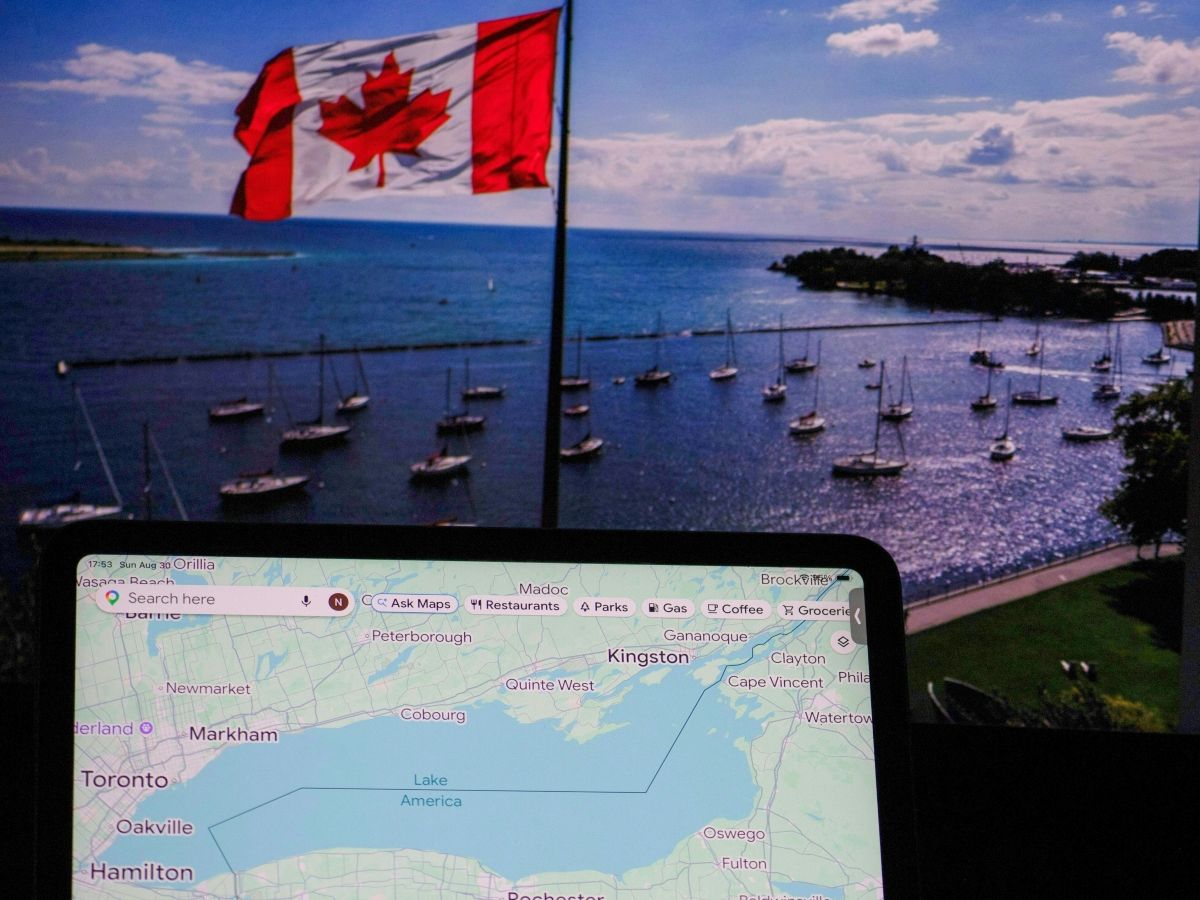
Over the weekend, Ontario Premier Doug Ford stood in front of a sign declaring Lake Ontario “Now and Always.” Within about a day, however, Hydro One, Metrolinx, Infrastructure Ontario and the LCBO had all labelled the body of water as “Lake America” on their own websites. So did Loblaws.
No Canadian official decided that. Nobody was lobbied, and nothing was conceded. The Ontario government had bought a mapping service, and the mapping service changed the lake’s name.
Here is how this came to be. President Donald Trump signed an executive order claiming the United States holds most of the volume of Lake Ontario and bears responsibility for its security, economic activity and environmental stewardship; the order renames the lake to “Lake America.” The U.S. Geographic Names Information Service made the change on the American register. Google resolves place names from official government registers, so Google Maps followed. Ontario’s agencies draw their maps straight from Google, so their websites followed, too.
Metrolinx fixed it by switching the map off .
Sit with that. A provincial transit agency’s only available remedy, on a service it pays for, was to stop using the service. Hydro One said the problem originates with a third-party mapping service and that it is working with its vendor. That word is exactly right, and it is most of the story.
The name of a lake is the least of it. The same pipe that carried “Lake America” onto a Hydro One outage map carries boundaries, jurisdictions, municipal limits and service areas onto the screens of utilities, transit systems, insurers and retailers across this country; whoever supplies the register supplies all of it.
The map that mislabelled a lake on a quiet weekend is the same map a utility runs during an ice storm, when an outage layer is how crews and customers find each other. Metrolinx could switch a station map off on a Sunday. Hydro One cannot switch off its outage map in January. A dependency you escape only by shutting the service down is not one you can afford in an emergency.
Any board would ask management what happens if a vendor changes something in the middle of a crisis. Crown agencies should answer this question long before such a storm hits.
None of this is novel. When the Gulf of Mexico became the Gulf of America, Google made the change within days , Apple the following day, Microsoft after that. MapQuest did not, and nothing happened to MapQuest. Compliance was a commercial choice, not a legal duty.
Now, the part that should sting: Canada has kept its own register of official place names since 1897, through what is currently named the Geographical Names Board of Canada . Natural Resources Canada maintains the database , roughly 350,000 approved names, published as open data and refreshed weekly. It is free. It contains Lake Ontario.
Ontario’s agencies were reading Washington’s register instead, and they were paying an American company for the privilege.
Google’s arrangement makes this look better than it is. Users in the United States see “Lake America,” users in Canada see Lake Ontario, and everyone else sees both. For a Canadian holding a phone, that is a real accommodation. It did nothing for the LCBO’s store locator. A Canadian looking at an Ontario government website was shown the American name anyway, and how a purchased service is configured is the purchaser’s business.
Ottawa, to its credit, asked the right question about a different purchase last year. In a procurement notice for “sovereign public cloud capability,” Shared Services Canada invited potential cloud suppliers to explain whether federal data could stay inside Canada, and whether providers were subject to foreign laws reaching that data without Canada’s consent. A question about a purchase, put before signing.
The 2026 National Trade Estimate Report by the U.S. trade representative lists that question among barriers to American trade in Canada, under the heading “Sovereign Cloud Initiative.”
Two governments, two purchasing decisions. Ottawa asked what its supplier would do, and Washington put the question on a list of trade barriers. Ontario did not ask, and got “Lake America.”
None of this calls for a new regulator, a new agency or a levy on anyone. Canadian governments spend billions every year on software and services, and every dollar of it moves under a contract. A contract can name the register that governs, say where the data sits, and set what a vendor owes a customer in notice before changing something that customer publishes under its own logo. Governments are buyers, and buyers set terms.
The premier’s instinct was sound. But a sign is a statement of intent and a procurement clause is a statement of fact. Ontario agreed to let somebody else decide how its maps were labelled long before it commissioned the sign.
Canada has kept its register of place names since 1897. We should start reading from it.
National Post
Barry Appleton is the interim director of the Balsillie Legal Advisory Centre at the Balsillie School of International Affairs, adjunct professor at Wilfrid Laurier University, managing partner of Appleton & Associates International Lawyers LP, and a co-director of the Center for International Law at New York Law School. He is the author of Navigating NAFTA.