



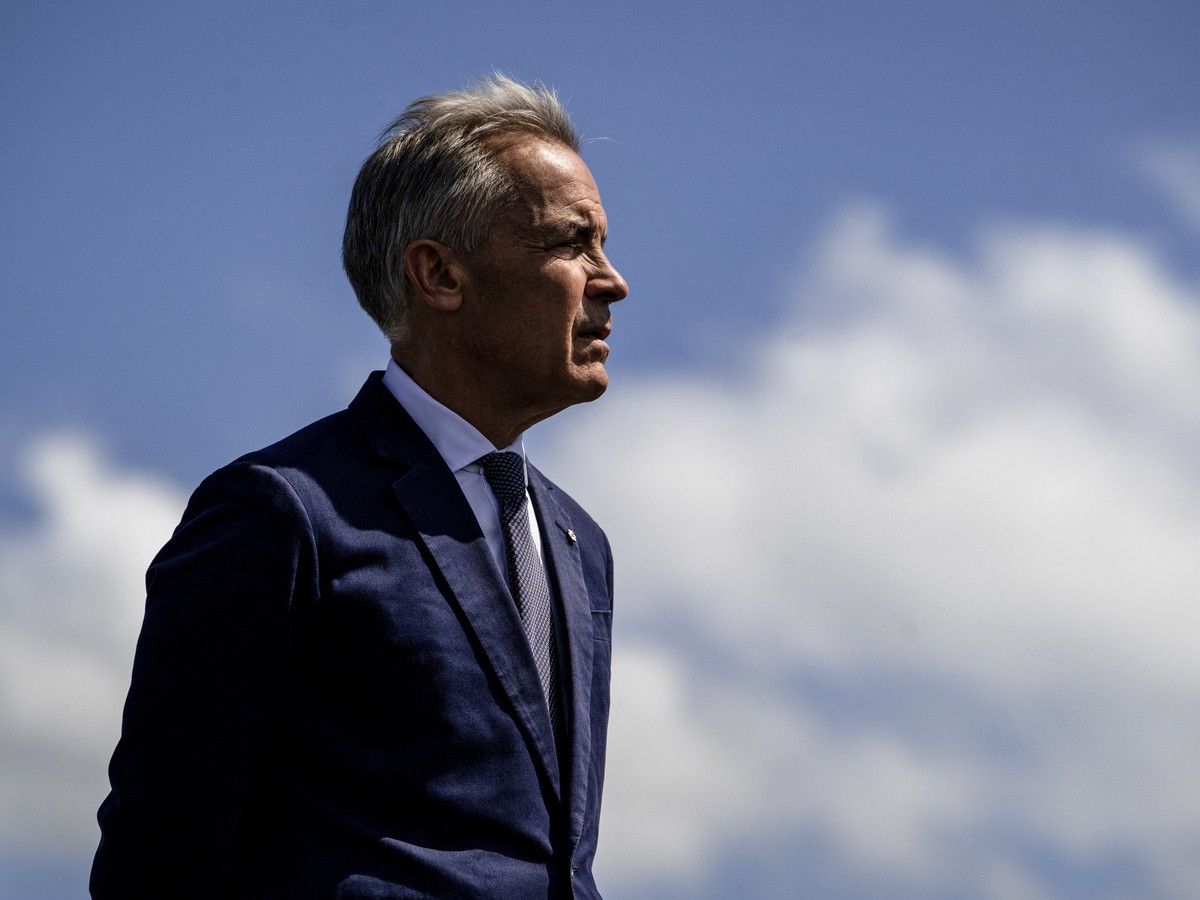
A week ago, in a spirited, resolute and bombastic press conference, Prime Minister Mark Carney framed the tariff war with the U.S. as nothing less than the survival of Canada.
Carney was determined to “protect Canadian sovereignty,” maintain our “independence and sovereignty,” and “not compromise our sovereignty.”
“The new U.S. tariffs are designed to hurt us and divide us,” he said.
But a week later the prime minister’s belligerent rhetoric is looking increasingly like political theatre. And it is a show where the script has been shared with his ministers.
“We cannot accept what they have offered and we will not give what they have asked,” said Carney on that Saturday.
By Monday, ministers were on board.
“They asked too much of Canada and offered too little in return,” said Finance Minister François-Philippe Champagne.
“We will not accept a bad deal which asks too much of Canada and offers too little in return,” said Industry Minister Mélanie Joly.
It is unfortunate that the Liberal government is still refusing to reveal exactly what the U.S. was asking and why Canada felt unable to accept.
What we do know is that of the three examples that Carney cited on that Saturday as being a threat to our sovereignty one has been settled, and may never have been an issue, and we largely appear to agree on a second.
The third issue, tariff levels on medium and heavy-duty trucks is an outstanding irritant and a large one. The potential economic harm to Ontario especially is such that it is likely to have always been a red line for Canada.
But tariffs on trucks isn’t a sovereignty issue, it’s a trade one and best dealt with at the negotiating table.
Carney told Canadians, “We are masters of our destiny.” Fine, but we are not masters of the U.S. and if they want to impose tariffs, it may be unreasonable, unfair, uneconomic and ultimately disastrous, but that’s what a sovereign nation can do.
However, framing tariffs on trucks as an existential threat to Canada was never going to be enough for Liberals. Arguing over 25 per cent tariffs on medium and heavy trucks is a legitimate aim for trade negotiators but lacks the drama needed by a fiery prime minister to fire up Canada.
A week ago, a steadfast Carney warned that “American was trying to break us so they can own us and I promised that would never, never happen.”
If the backdrop to that was tariffs on trucks, then Carney might have been accused of being less Churchillian and more Shakespearean.
Hence, Carney introduced two other factors: the risk to our language and culture as well as our ability to make trade deals with other countries.
These are things to rile up the masses.
“We cannot control the storm that blows in from Washington,” said Carney beginning his press conference. And he concluded it with, “Canadians don’t submit to the weather, we thrive in it. We don’t wait to see which way the wind is blowing or surrender to the waves to be storm tossed by events. We set our own course. We make our own weather.”
It was all remarkably stirring, but in the days to come would be revealed as hokum.
The risk to “our language, our culture, our sovereignty” was about discoverability rules, it was about whether streaming services should have to be subject to the abysmal CanCon requirements. The U.S. wasn’t particularly happy with discoverability but was never going to war over it, said U.S. Trade Representative Jamieson Greer.
Whatever the U.S.’s previous position, Canada-U.S. Trade Minister Dominic LeBlanc appeared delighted it was now a non-issue.
So, the danger to our “language and culture” is not an issue now and wasn’t much of one before. More a storm in a teacup, really.
As for trading with other nations, it appears the U.S. — as part of a Canadian desire for Fortress North America — wanted to align tariffs in certain sectors like steel and aluminum. The purpose was to prevent a third country dumping cheap steel/aluminum in one country — say Canada — which would then make its way to the U.S.
It’s a position Carney appears to agrees with as long as it’s part of a “comprehensive deal.”
It’s the kind of issue that is hammered out between trade negotiators, is detailed on page 143 of the trade agreement, is read by trade lawyers in trade magazines and never actually worries the average Canadian.
In light of these revelations, why aren’t we back at the bargaining table?
Janice Charette, Canada’s chief U.S. trade negotiator, told the CBC that “pens are down, but the door is open.”
It was Carney’s decision to call off the trade talks and presumably he could push for them to restart. That he isn’t making that call speaks to other political motives: is he burnishing his tough guy credentials? Awaiting to see the outcome of the U.S. midterm elections? Gambling on the anger of U.S. states to convince Donald Trump of the error of his ways?
Whatever Carney’s motives, he is playing a bold, dangerous and ambitious game.
National Post

