



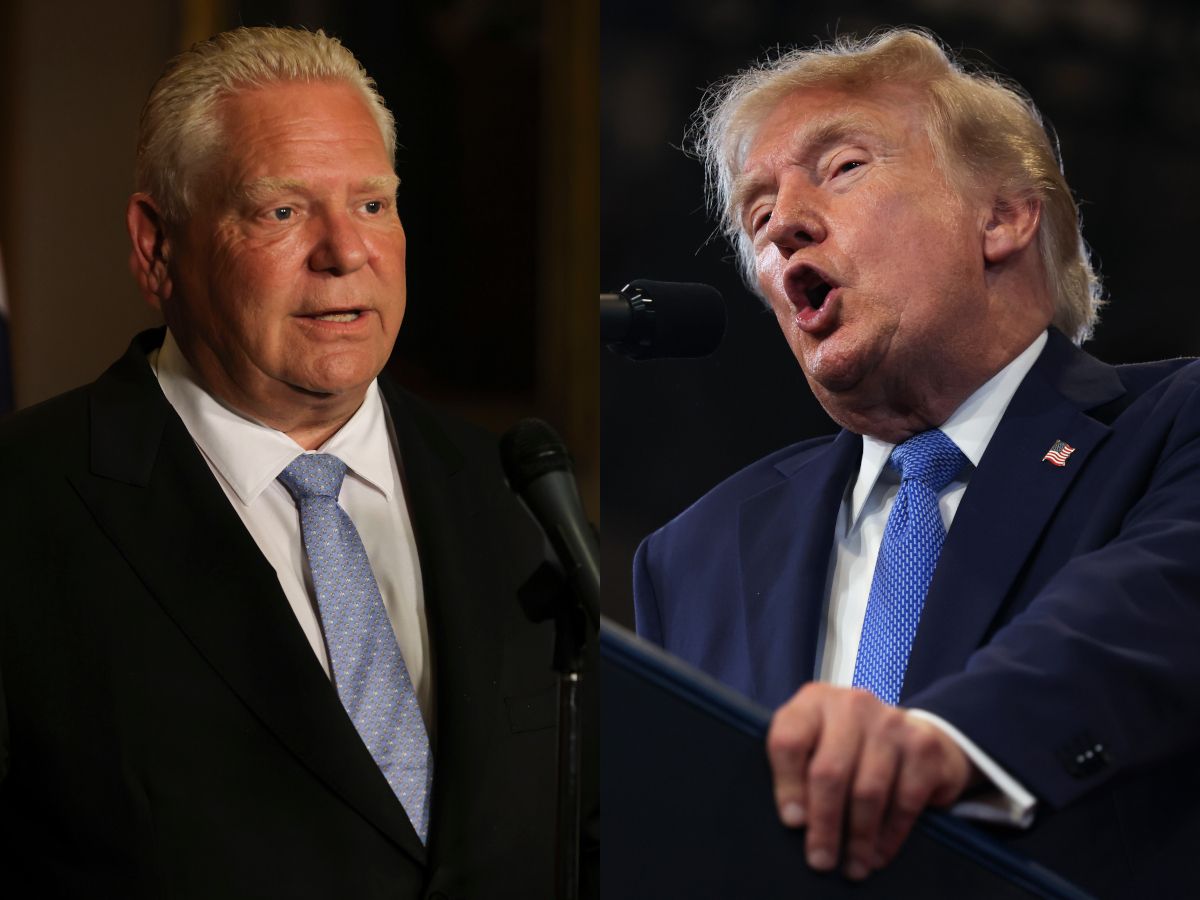
Last year, both Mark Carney and Doug Ford campaigned on being the best candidate to take on U.S. President Donald Trump, but until the prime minister abruptly walked away from trade talks on Friday, only Ontario’s premier had the spine to stand up to the bully next door. His suggestions for how to deal with the current crisis should not be dismissed.
Scrolling through Trump’s Truth Social feed this week is like drunkenly stumbling through an alternate universe. One will find talk of his “very good relationship with Kim Jong Un, of North Korea,” alongside ad hominem attacks against Ford (“the less charismatic, intelligent, and overall unimpressive brother of the late, great, Rob Ford”); photos of him and Kim putting on their best dictator faces with maps showing Lake Ontario renamed “Lake America.”
Clearly, Ontario’s sometimes boisterous leader has gotten under the president’s skin. But while the war of words between Queen’s Park and the White House won’t move the needle on trade, Ford’s proposed retaliatory measures almost certainly will.
Ford said on Monday that following the imposition of 50 per cent tariffs on $29 billion worth of Canadian goods, “nothing should be off the table,” including taxing or limiting the export of oil, electricity and critical minerals. This is a strategy that’s been employed before and has succeeded in getting the Trump administration’s attention.
In early 2025, in response to the first round of tariffs, Ford instituted a 25 per cent surcharge on electricity exports to the U.S. The premier eventually backed down after Trump threatened additional tariffs and the administration invited him to a meeting in Washington, D.C., which Ford saw as an “olive branch.”
That was a miscalculation on Ford’s part, as a similar trade war that Trump precipitated with China around the same time was blunted due to Chinese President Xi Jinping’s refusal to cave to American pressure. Not only did China respond to Trump’s initial 10 per cent tariff by escalating its own levies on U.S. goods to a high of 125 per cent , it placed export restrictions on a bunch of rare earth elements , which American industry relies on.
Trump responded by de-escalating the trade war, and has been walking on eggshells around President Xi ever since. Even his latest round of sanctions against Iran, which the administration dubbed “Economic D-Day,” noticeably excluded major measures directed at China, despite its Communist government single-handedly keeping Iran’s terrorist regime afloat by buying most of its oil.
Trump claims that “we don’t need Canada,” but this — like his made up stat that Canada does “95 per cent of their business with the U.S., with us, the exact opposite” — is BS. The U.S. relies on Canada for half its aluminum , which is essential for producing cars, appliances and other goods.
America also imports around four-million barrels of Canadian oil a day. In 2024, Canada accounted for 62 per cent of U.S. crude imports, according to the American Petroleum Institute. Not only does this help fuel the American economy, it is purchased at a steep discount compared to European Brent and American West Texas Intermediate (WTI) crude.
At the very least, raising the cost of Western Canadian Select oil so it cannot be purchased by Americans for less than the WTI spot price would serve to put inflationary pressure on U.S. consumers, while providing little incentive for customers to seek alternate suppliers in the short term.
More than 20 U.S. states also rely on Canadian electricity, importing $3.3 billion worth last year alone. While some, like New York and Washington, are blue states that are already opposed to Trump’s policies, some, such as Michigan, are swing states with a number of tight races in the upcoming midterm elections. Others, including North Dakota, voted for Trump in 2024 and have Republican governors.
The reality is that there are two primary means of forcing the administration to back down from its trade war: legal measures, such as court cases or legislative changes, and political pressure.
Earlier this year, the U.S. Supreme Court invalidated some of Trump’s tariffs, but the administration keeps finding novel legal means of achieving its ends. While Canada should support any challenges to the current tariffs in any way it can, they will take time to wind through the courts and there is no guarantee of success.
Likewise, while Congress could take back its sole constitutional authority to “ lay and collect ” tariffs, Democrats are unlikely to make enough gains in the midterms for such efforts to succeed, especially given their preoccupation with hating capitalists and Jews.
But public pressure can go a long way, and many American voters are furious that Trump has been unable to make good on his promise to curb Biden-era inflation, largely due to his tariffs and war with Iran. Increasing the price of energy, electricity and other commodities will further fuel inflation, putting pressure not only on the president, but also on his fellow Republicans and business leaders to do something about it.
This, I might add, is also why the Ford government’s Ronald Reagan ad was so effective at raising the ire of the administration: it served to remind Republicans that they used to be the party of free trade, which is a net benefit to the entire country.
Such measures will, of course, come at a cost to Canadians. Our failure to build pipelines to the coast and LNG export terminals means there’s largely nowhere for Canadian energy to go other than south, and we may quickly run out of storage space if we decide to hang onto our reserves. Likewise, imposing export taxes on raw materials and import taxes on finished goods that aren’t produced at home will raise the cost of living for Canadians.
But it also opens new opportunities for Canadian provinces to buy domestic energy supplies and businesses to find new suppliers and export opportunities elsewhere. Either way, the hope should be that any retaliatory measures are short-lived, lasting only as long as the Americans continue to violate our free-trade agreement.
None of this is optimal. If I had my way, Canada would remove all trade barriers on its allies and invite the Americans to join in on a new era of global free trade. But one cannot win a fight without throwing a punch. Trump started this trade war and it’s up to us to show him that any perceived benefits are not worth the costs.
National Post
jkline@postmedia.com
Twitter.com/accessd

