



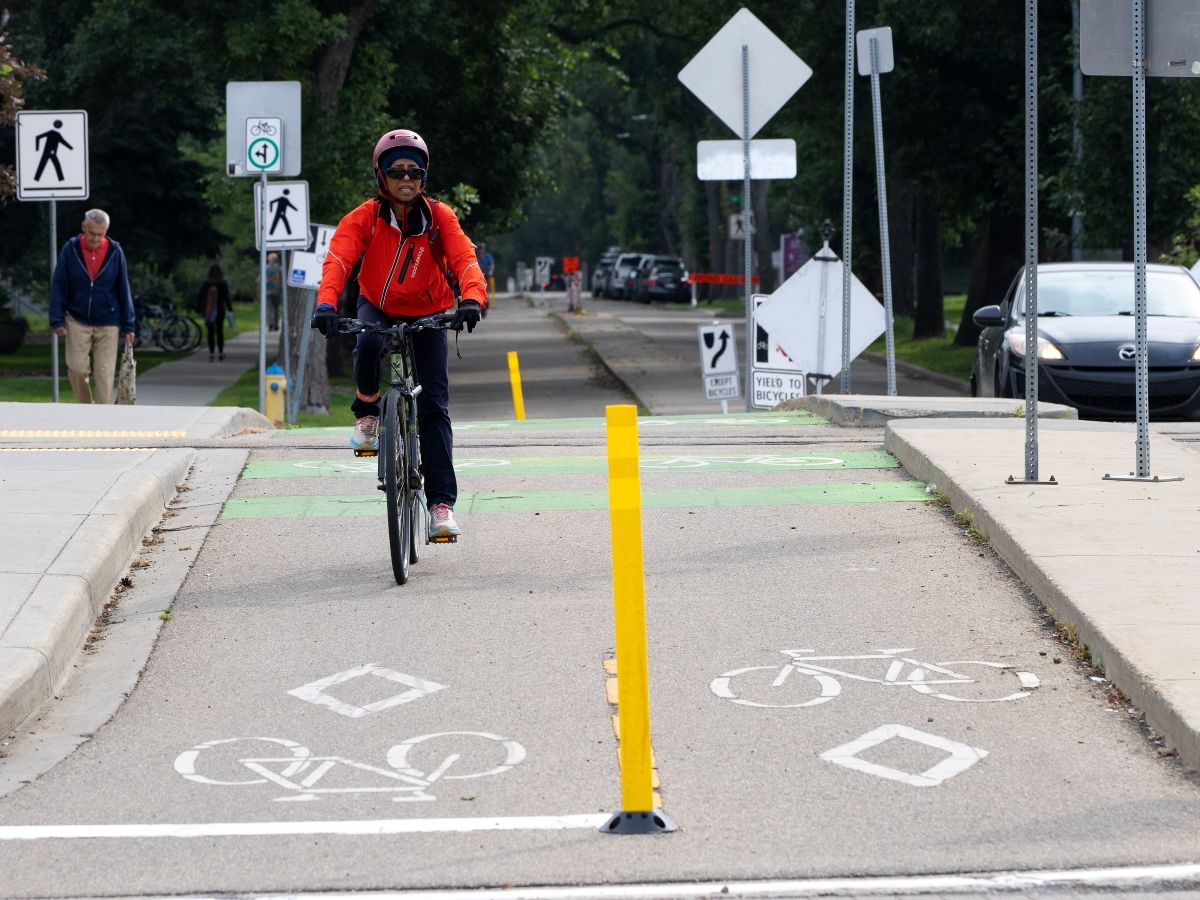
On Friday, the Ontario Court of Appeal ruled that there was no Charter right to bike lanes — and delivered an utter spanking to the judge below their rank who said otherwise. Not only was it a victory for those who prefer car to bike, it was a victory for democracy.
Before the case was overturned, it stood for the principle that elected policymakers had to submit to “expert” evidence on matters of mere traffic planning to avoid breaching the Charter rights of the masses. Justice Paul Schabas of the Ontario Superior Court arrived at this conclusion last year in hearing out the advocacy group Cycle Toronto, which had complained about the Ontario government’s plan to remove a bike lane along a major thoroughfare downtown.
While there wasn’t a positive duty on governments to create bike lanes, went the Schabas’ logic, there was a duty to justify the removal of any existing bike lane with evidence satisfactory to the court. His scheme entombed all roads and traffic policy in thick constitutional armour.
Cycle Toronto’s central expert witness, engineering professor Shoshanna Saxe of the University of Toronto, was key in convincing Schabas that the potential harm caused to cyclists by removing the bike lanes was so severe that it constituted a violation of Canadians’ Charter rights. On the other side of the equation was the government, which did not produce its own math on how much harm the bike lane removal would cause and to whom.
Schabas concluded — erroneously — that he had no choice but to give Toronto’s bike lanes the armour of constitutional protection. The appeal court above was not so easily fooled. Writing for the three-judge court, Justice Grant Huscroft issued a firm reminder that “Judicial review under the Charter is not an occasion for courts to comment on or critique policy or political decisions.” He said that Schabas further erred by binding present governments to the policies of past governments.
It was an example of the system working as intended. In examining the cyclists’ pleas with a magnifying glass, Schabas lost sight of his own role in the bigger picture and was corrected for it. And there will be knock-on effects elsewhere: Alberta is preparing legislation that will give the provincial government a framework to order the removal of nuisance city bike lanes. The Schabas ruling was certain to be used as ammunition for cyclist advocates out west; the Schabas takedown, which will be far more persuasive to the courts, is a firm defence to bike lane removal.
The means by which the Toronto cyclists got their initial victory in court are still cause for concern, however. Schabas relied heavily on the cyclists’ expert witness, Saxe, in trying to understand traffic congestion. Saxe’s view was that “investing in cycling infrastructure is one of the most powerful tools available to reduce congestion,” while removing it would make congestion worse long-term. She was a proponent of a theory called “induced demand,” which asserts that building more car capacity creates more drivers.
Induced demand is the grand unifying theory of urbanists, who usually believe in turn that removing car lanes is a simple way of reducing drivers. Commuters, goes the idea, will naturally switch to bikes and buses if car infrastructure is taken away. These people do not take into account the fact that bikes are particularly vulnerable to theft. Nor do they think too hard about winter. Nor do they dwell much on the fact that few people want to spend two hours on buses full of riff-raff to get to work. And perhaps most critically, they ignore the fact that North America has more space and money than the cycling paradise of Europe, which drives a natural tendency towards car infrastructure.
Saxe’s day job is to promote exactly those kinds of urbanist policy stances. In 2020, she was made a Canada Research Chair in Sustainable Infrastructure. This is a federally funded position that comes with money and prestige. The chairs have been around for decades at this point, but within the last 10 years the Liberals have repurposed the program as a vessel for diversity hiring in academia.
The Liberals have also infused the program with funding to create a multitude of prestigious postings on topics that just so happen to advance the government agenda. There are still meritorious academics studying serious topics working as Canada Research Chairs, but there are many others who didn’t have to fully compete for their roles thanks to diversity quotas, and whose work focuses on “Sustainability Governance and Innovation,” “Citizenship, Social Justice and Ethno-Racialization,” “Inclusivity and Active Ageing,” “Reimagining Capitalism,” “Critical Disability Studies,” “History of Health and Social Justice,” “Gender, Race, and Inclusive Politics,” and “Urban Sexualities.”
It was during the bike lanes court battle that we saw the precise purpose of dumping money into bogus new frontiers in the Canada Research Chairs program. Progressive policy now has a front line of full-time defenders with the prestige of academia and the punch of a well-funded Liberal think tank. Saxe’s golden aura of an expert could be used to tactically blind the court, and it worked on Schabas.
This is a common use of this new crop of Canada Research Chairs. They appear as non-partisan experts advancing the objectively correct position on contentious subjects — whether in media, the academic world, or in court. Their expert status gives allied decision-makers the cover needed to side with whatever the progressive side wants. It happens all the time.
Earlier this year, for example, Federal Court Justice Avvy Yao-Yao Go ruled in favour of a group of RCMP officers who alleged they were victims of systemic racism on thin evidence. They had lost at the Canadian Human Rights Tribunal, but Go decided that they deserved a redo, in part because the tribunal didn’t give enough weight to the RCMP officers’ expert witness, Kanika Samuels-Wortley . Samuels-Wortley is the Canada Research Chair in Systemic Racism, Technology and Criminal Justice, an inherently activist role. Justice Go is an aggressive DEI advocate; of course she’d shred the tribunal below her for not hearing out an academic ally.
The Ontario Court of Appeal, at least, didn’t fall for the new-generation Canada Research Chairs charm or use it as cover to push the law to the left. Justice Huscroft identified that “Saxe clearly favours bicycles,” and put proper caveats on her urbanist theory of induced demand. Whatever her expert credentials, her explaining theory of traffic forces was just a prediction model, and even if it predicted correctly, it certainly shouldn’t attract constitutional protection.
“The principles of fundamental justice neither require nor permit courts to countermand rational policy choices legitimately made by the government and legislature, regardless of the preferences of academic experts,” wrote Huscroft.
True experts have their uses. It’s a mark of an advanced, thriving society to have safe surgeries, spaceworthy astronauts, trustworthy historians and engineers capable of building massive bridges that withstand earthquakes. There should be a healthy respect for this — not blind adherence so extreme that policy activists with fancy grants can render elections useless. The highest court in Ontario knew exactly where to strike that balance; let it be a lesson to the country’s less rigorous judges.
National Post

