



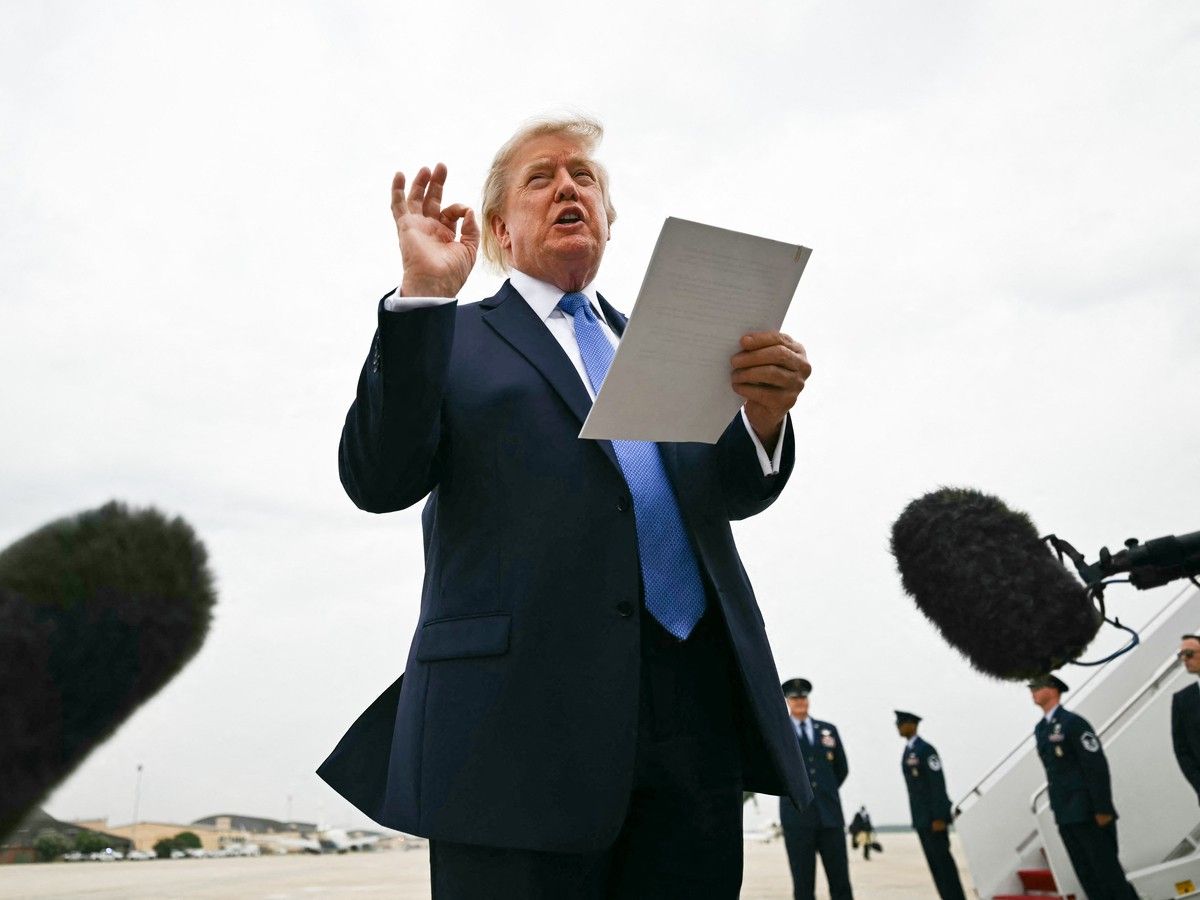
WASHINGTON, D.C. — With Canada and the United States engaged in tense trade negotiations over tariffs , and U.S. President Donald Trump’s team signalling that it wants annual reviews rather than a renewal of the Canada-U.S.-Mexico Agreement (CUSMA), National Post reached out to former International Trade Minister Ed Fast for his view on the current state of Canada-U.S. trade relations and the ongoing talks.
Fast served under Prime Minister Stephen Harper from 2011 to 2015, helping negotiate major agreements, including CETA, the Canada-South Korea deal, and the Trans-Pacific Partnership. He argues that Canada should seek a broader continental bargain — encompassing trade, critical-mineral supply, energy and defence — rather than negotiate CUSMA in isolation.
Why should Canada pursue a “grand bargain” with the United States rather than a narrow CUSMA review? And how can Canada move the Trump administration toward a broader bargain?
Ed Fast: The reason Canada should be broadening out the negotiation with the United States is because of the asymmetry in our economic partnership. The U.S. economy is 10 times the size of our own, and any tariff war we get into is going to hurt us more than it hurts the United States.
Within the narrow confines of CUSMA, Canada has very few, if any, bargaining chips. Where our strengths and assets lie is within the broader continental relationship. If we broaden it out to provide assurance of supply and broaden it out to address the continental national-security implications of our relationship, suddenly, Canada has assets at the table that we can use to push back against some of the more unreasonable requests coming from the Americans.
If we make a compelling case that there are many areas, especially on assured supply — things like nuclear uranium, critical minerals, energy, oil and gas, electricity grids, potash and food security — there is a compelling case to be made that, notwithstanding Donald Trump’s protestations to the contrary, the United States would benefit significantly from broadening out a trade negotiation to include the totality of our relationship, including assured supply of commodities that matter most to the American economy.
Eighty per cent of American potash imports come from Canada.
What would Canada need in return for putting energy, critical minerals and continental defence on the table?
We would need a legally binding and enforceable agreement that tariff-free trade among the CUSMA partners will continue. That is the trade-off.
Many of the commodities that Canada could provide assurance for are covered under CUSMA. The challenge is that there are no provisions within CUSMA that provide assurance of supply. When we’re talking about issues like energy, food security, potash, and critical minerals, the actual trade in those commodities is addressed within CUSMA; the assured supply that the United States needs is not. We have an opportunity to broaden out the discussion to perhaps discuss assured supply.
How do you assess the Carney government’s approach to negotiations so far?
My concern is this: every time we have made concessions so far — for example, with the digital services tax — it has not provided us with any additional concessions from the United States. Each concession we make results in additional demands from the United States, and that’s the nature of negotiating with Donald Trump.
He is a zero-sum type of guy who believes that he has to win and his negotiating partner has to lose. Understanding that mentality should help inform our negotiating position at the table.
What concerns you about the potential Section 338 tariffs?
I’m not an insider in those negotiations, so I wouldn’t presume to know what’s happening inside those discussions.
I can say the Section 338 tariffs represent a special challenge because Section 338 actually delegates authority to the president himself, so it becomes more difficult to challenge those tariffs.
What deeply concerns me is the fact that the 338 tariffs actually are coming out of the Smoot-Hawley Act, or the U.S. Tariff Act of 1930. Those Smoot-Hawley tariffs exacerbated the Great Depression in the 1930s. We are reliving history and failing to learn the lessons of history.
The irony is that Trump’s Section 338 tariffs appear to be premised upon Canada’s own retaliatory tariffs. So the question I have is: have we actually provided a pretext for the legitimate use of these tariff powers that have never before been used by the United States? Have we unwittingly strengthened Donald Trump’s hand by actually retaliating?
I understand the urge to retaliate, but when we retaliate, we are less capable of absorbing the additional retaliation that comes back from the United States simply because of the asymmetry of our relative economies.
What should Canada’s overall strategy be?
We need to bring the United States to the table in an environment where we appeal to Donald Trump’s baser instincts to want to have these big deals that he can boast about.
Let’s talk about a much larger continental bargain that brings in assurance of supply for the critical commodities the United States needs, brings into the discussion continental security issues, and brings into the discussion our defence spending and our commitment to robust continental security.
The suggestion that we can somehow pivot away from the United States in terms of our trade relationship, somehow diversify by pivoting away from the U.S., is hopelessly naive. The United States will always be our largest trade partner. We have to have that front and centre in our discussions with the U.S.
We should ask for the restoration of the original bargain we have, which is CUSMA or NAFTA. But we should also be prepared to make commercially meaningful concessions where the U.S. has some legitimate complaints. We should not negotiate CUSMA in isolation. We need to broaden out this discussion to talk about continental economic security.
What American demands should Canada resist?
I would resist perpetual annual review (of CUSMA). That affects so much uncertainty in our investment environment. Annual reviews are poisonous to Canada’s investment interests.
When companies are making 15-, 20-, 25-year commitments, if their access to the U.S. market comes up for renegotiation every 12 months, they’re not going to make those investments.
Finally, I would subordinate retaliation to a broader negotiating strategy. Don’t give in to our emotional instinct to retaliate. Negotiate with an understanding that this is an asymmetrical relationship, and that we have to be very clever, very tactical, very focused on Canada’s long-term interests.
How could Canada persuade Washington to stop imposing Section 232 tariffs against Canadian products?
One of the things that would move the United States towards eliminating those tariffs and not using them again against Canada is if our broader outcome includes very clear provisions that help address American security concerns.
Obviously, continental defence, including ballistic missile defence, would be one of the things that should at least be part of the discussion. The second issue would have to be how do we address Chinese transshipment, where the Chinese use Canada as a backdoor for shipping subsidized goods, non-free-market goods into the U.S. marketplace.
Those are things that start to reorient the discussion towards something that I believe the United States would welcome. We’d have to be serious about addressing those issues. I think that could reframe the discussion back to a broader one about our continental relationship and continental security writ large.
Is it unhelpful for Canada to try to negotiate away one-off tariff threats?
When we negotiate with the United States on one-off issues, on one-off tariff discussions, I think we should be aware of the fact that no matter what agreement we come to with the United States, there’s no assurance that the United States will actually honour that agreement right now.
Donald Trump has made it very clear that he’s willing to break American commitments to free trade. That’s why it’s critically important that any broader agreement, any resolution to our trade relationship with the U.S., include truly enforceable provisions that ensure that the agreement will not be breached by either party.
I would bake in a critical role for Congress to be involved in any revisiting of whatever agreement comes out of these discussions, to make sure that it’s not simply one person in the Oval Office that makes the decision to walk away from our agreements.
What would meaningful enforcement look like?
Getting Congress involved would be by far the most effective way of ensuring that tariffs aren’t reimposed on a whim of one person. Thirty-six U.S. states have Canada as their number one trading partner. Can you imagine the senators and representatives from those states, the governors of those states, how they would react if there was a suggestion that the U.S. retreat from a free-trade agreement between our two countries?
The second way we could improve enforceability is to have snapback provisions, where Canada would have the ability to impose punitive measures in a way that is immediate and doesn’t require any special appeal mechanisms, and that those measures are baked right into our free-trade agreement.
Our existing agreement does not have clauses that trigger congressional decision-making in terms of retreat from the provisions of our trade agreement. If we’re going to move ahead with an agreement, we need to bake in very clear enforceability provisions that make it much less likely that a future president could walk away from this agreement without having very good reasons for doing so.
The pretext of national security (for imposing the 232 tariffs) should be much more limited than it is being applied right now. Canada is not a national-security threat to the United States, except if you define that very, very broadly.
How do you assess the government’s defence-spending commitments?
I’ve been much happier with Mr. Carney’s commitments on defence spending than I was of Justin Trudeau’s commitments — which actually didn’t exist.
For 10 years we did nothing to make our defence spending more robust, and now we’ve been forced to do so by the United States. I think a mea culpa is appropriate — a very clear mea culpa that we neglected our critical defence spending for too long, and that we’re now committed to actually beating the targets that NATO set and going beyond those to recognize that the global threats have simply become more acute and require additional commitments on defence spending.
When I look at some of the European nations, countries like Poland, for example, that are on the front lines of a fight against tyranny, I think Canada can do much better. In the process, by doing much better, I think we have a better opportunity to secure a lasting and durable, fair, reasonable free-trade agreement with the United States.
What should Canada seek on procurement and investment certainty?
Public procurement and government procurement have been a constant source of friction between Canada and the United States, where the deck has typically been stacked against Canadian companies.
If we really want to have a fully integrated North American marketplace with robust supply chains that deliver the highest level of efficiency when it comes to trade and value, we have to ensure that government procurement is one of those areas that truly is free and open and transparent.
How should the softwood lumber dispute be handled?
The softwood lumber dispute was effectively initially resolved through the Harper government outside of NAFTA and continues to be an irritant that has largely been outside of CUSMA negotiations.
We have made very clear that those kinds of issues should be brought into the broader negotiation of our continental partnership. Absolutely, the softwood lumber dispute needs to be resolved as part of this ongoing negotiation.
When I hear rumours coming out of Ottawa and Washington that somehow there’s an agreement that they’re going to put to the president (early next week), it’s not going to be an agreement. It might be broad outlines of what a future framework agreement could look like. I just can’t understand how the fairly short period they’ve had to negotiate these issues would result in anything that looks like a comprehensive outcome.
Whatever they’re talking about putting to the president will be a very sketchy framework that would provide the basis for further negotiations. I hope that framework includes, for the most part, the totality of our bilateral relationship.
Should Canada make concessions on dairy supply management?
Canada has Bill C-202, which now has the force of law, which says that Canada will not put dairy on the table, or anything under supply management, in its future negotiations for free-trade agreements.
In my mind, we’re not going to come out of this negotiation well without making some concessions on this. I do not believe that the United States actually is demanding that Canada get rid of its supply-management system. There are very strong, sound reasons for Canada maintaining that system.
But the United States has rightfully pointed at situations where the way supply management has been administered in Canada has violated, if not the letter, certainly the spirit of CUSMA. It’s reasonable, I think, for Canadians to expect that there will be some refinement of how our dairy quotas are administered. I think that should be negotiable notwithstanding Bill C-202.
What about provincial restrictions on American alcohol?
That’s somewhat more complicated because it surely implicates the provinces. Some of the provinces have made it very clear that unless they see a deal coming out of these negotiations that they are happy with, they will not be putting American booze back on the shelves.
I don’t think that’s an unreasonable position for our provinces to take because that issue, in my mind, is clearly within provincial jurisdiction. Any government is going to have to make sure that the provinces remain at the table as a broader trade outcome is negotiated.
If you’re going to have free trade, you’re going to have to include booze, but that’s going to have to be done within the context of a challenging federal-provincial environment where the provinces rightfully demand that they be at the table when these issues are being discussed.
I would not put alcohol back on the table unless there is significant progress being made within the negotiations. We’ve seen how this plays out: put something on the table, the Americans say thank you, they pocket it. Now they come up with new demands. This is a never-ending process of Canada conceding and the Americans demanding.
Why are rolling CUSMA reviews dangerous for Canadian business?
These one-year reviews — which, by the way, don’t terminate CUSMA — and the five-year reviews are provisions that were incorporated when CUSMA was originally negotiated.
The expectation from Canada was that the agreement would be enforceable and could not result in spurious tariffs based on very questionable premises rooted in legislation that in some cases goes back to the 1930s. That expectation has not been borne out.
We have to go in there clear-eyed, understanding that one-year renewals inject profound uncertainty into Canada’s investment environment. It will undermine Canada’s ability to ensure the prosperity of Canadians.
What we don’t want to see is a hollowing out of our own economy when the Americans are insisting that we dramatically ramp up defence spending. If we don’t have the fiscal capacity that is supported by a robust economy, robust investment and a robust trade environment, we’ll never be able to actually fund the defence spending that the Americans are demanding.
On the one hand, they’re demanding these massive increases in defence spending; on the other hand, bit by bit, they’re undermining our ability to grow our fiscal capacity to fund that defence spending. That’s the irony of it.
What is your bottom line for Canada?
Canada should be willing to modernize CUSMA substantially and willing to address some of the legitimate concerns that the U.S. has regarding the issues we’ve already talked about: Chinese transshipment, economic security, alcohol, dairy, chicken and egg administration.
But in return, we should be asking for the United States to restore tariff-free treatment for CUSMA-originating goods and remove all those sectoral and Section 338 tariffs.
I would change the negotiation from “What must Canada surrender to maintain access to the American market?” to “What bargain does the United States need from Canada to secure the North American continent?”
If we reframe the discussion as I’ve suggested, I think our prospects for a better outcome for Canada — one that serves Canada’s national interest writ large — are much better.
National Post
Our website is the place for the latest breaking news, exclusive scoops, longreads and provocative commentary. Please bookmark nationalpost.com and sign up for our newsletters here.

