



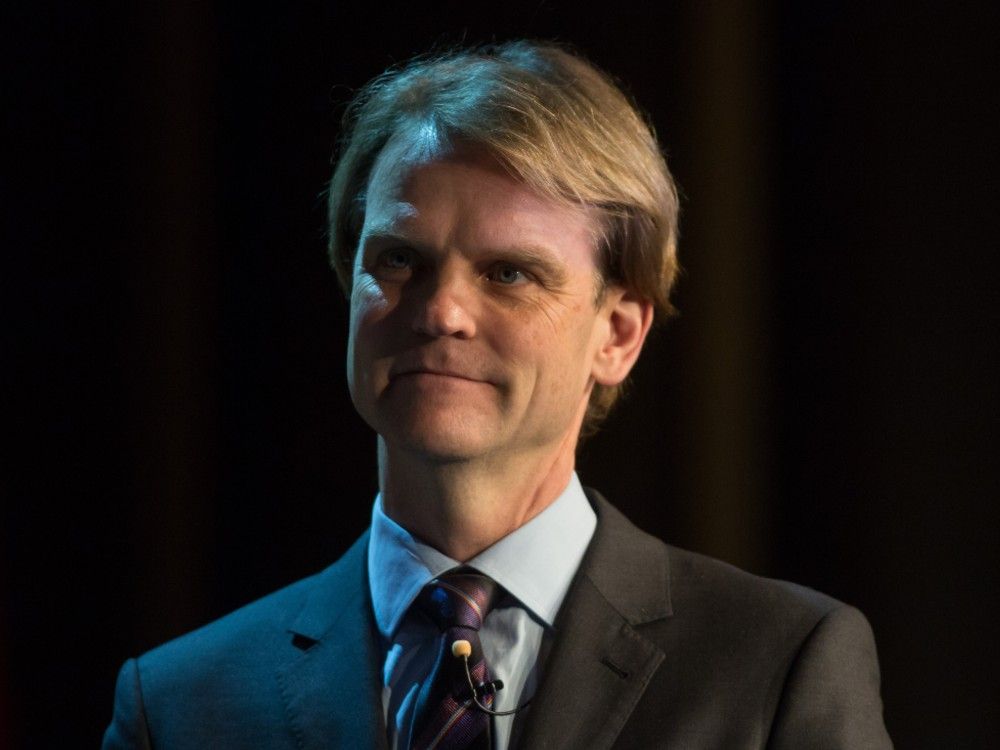
The race to become Toronto’s next mayor is welcoming a late and potentially game-breaking candidate in former Conservative federal cabinet minister and long-time diplomat Chris Alexander.
The 57-year-old, once Canada’s ambassador to Afghanistan (2003-2005) and an immigration minister under former Prime Minister Stephen Harper, had been rumoured to be considering a run and informally launched his bid with a campaign website on Tuesday night.
“I’m running because Toronto has been standing still for three years,” it reads.
“A city with this much talent, strength and potential should not be under-performing. We need to work together to make Toronto better — the best it can be.”
Alexander formally registered his candidacy this morning at City Hall, making him the 33rd person seeking the mayor’s job.
While the field is crowded, polling indicates that, until now, the electorate has focused on two candidates — incumbent Mayor Olivia Chow and Beaches–East-York Councillor Brad Bradford seeking to usurp her.
A poll conducted last week and released after Alexander’s announcement showed Chow leading by eight points among decided and leaning voters.
“Among all voters, Chow is at 39 per cent, Bradford is at 33 per cent, someone else is at eight per cent, and 20 per cent are undecided,” according to a Liaison Strategies Toronto Pulse survey of 1,000 Torontonians between July 24-26.

Before hitting New City Hall on Wednesday, Alexander visited NewsTalk 1010 and said he entered the race because he feels his experience can help the GTA tackle its “big, complex problems.”
“Ontario and Canada are trying to adapt to new circumstances. We need someone who can help Toronto adapt,” he said.
Priorities listed on his website include increasing housing supply for young Canadians and immigrants, easing congestion, improving public safety, containing municipal costs and bolstering the city’s competitiveness as a place to invest and create jobs.
His platform also pitches a “well-designed network of protected curb-separated bike lanes,” which he told NewsTalk is a “pro-commuter move.”
“Put bike lanes in streets where there’s enough road, where there isn’t car traffic that’s going to overwhelm them and make things dangerous,” he said, likening the idea to bike-friendly Copenhagen’s latest best practices.
“We have enough space in the city to have safe bike lanes that don’t disrupt traffic.”
Asked about Alexander at an unrelated press conference Wednesday, Chow said she’s focused on city matters now and will turn her attention to the election after Labour Day, as reported by CP24.
Bradford’s campaign spokesperson, in a statement to National Post, said: “Anyone can put their name on a ballot.”
Two days before it had been formalized, ABC Toronto, a not-for-profit political advocacy group, posited that Alexander’s could end up playing spoiler in Chow vs. Bradford.
“This isn’t a three-way race. It’s a gift to Olivia Chow,” they posted to X on Monday.
#NEW: Chris Alexander has no path to victory.
The same politician who pushed the disgraceful “barbaric cultural practices” snitch line is now flirting with a mayoral run, despite an ABC Toronto poll showing him at just 3%. This isn’t a three-way race. It’s a gift to Olivia Chow.… pic.twitter.com/CJM91NlbHm— A Better City (ABC) Toronto (@abctoronto_) July 27, 2026
Alexander dismissed the suggestion on NewsTalk.
“Votes are not artifacts to be moved around on a board by strategists,” he said. “Votes need to be earned.”
A Torontonian born in 1968, Alexander attended Oriole Park Public School and University of Toronto Schools before completing higher learning at McGill and Balliol College in Oxford.
He then embarked on an 18-year diplomatic career starting with a six-year posting at the Canadian embassy in Russia where he witnessed the global superpower “experiment with democracy and a market economy, as well as the reality of corruption, financial crisis and two bloody wars in Chechnya,” according to the campaign website.
He also met Russian President Vladimir Putin when the former KGB agent was the deputy mayor of St. Petersburg and, likely due to Alexander’s fluency in Russian, he later served as the world leader’s liaison officer at the 2002 G8 summit in Alberta. (As evidenced by his posts on X, nowadays he staunchly opposes Russia’s illegal war on Ukraine.)
He was appointed the Canadian Ambassador to Afghanistan a year later, a role he held until 2005, after which he became a deputy special representative of the United Nations Secretary-General for Afghanistan for four years, returning to Canada in 2009.
He unseated federal Liberal MP Mark Holland to capture the Ajax—Pickering riding in 2011, became parliamentary secretary for national defence for two years and was named immigration minister in 2003.
Alexander faced criticism in 2015 over his department’s handling of the Syrian refugee crisis and he ultimately bore the brunt of public anger over the heartbreaking photograph of a three-year-old Syrian boy who drowned trying to cross to Europe in a human smuggler’s boat. After it emerged that the boy’s family had wanted to come to Canada, Alexander suspended his re-election campaign and returned to Ottawa to deal with the fallout.
A month later, he came under fire after announcing an RCMP tipline to report “barbaric cultural practices” against girls and women.
Speaking to reporters outside council chambers on Monday, Bradford said “like a lot of Torontonians,” he’d never heard of Alexander and had to look him up. Upon learning of the tipline, which he called “deeply hurtful,” he said that anyone who harbours such views is “unfit” for the mayor’s office.
Alexander failed to win-relection in 2015 and finished a distant 11th to Andrew Scheer in the 2017 race for Conservative Party of Canada leader.
Since then, he’s been an executive, strategic advisor and corporate director in Toronto, lived in Kenya for a time and returned to Canada in 2022.
In 2024, he accused Postmedia defence journalist David Pugliese of being a longtime Russian spy using documents that a forensic analysis later revealed to be bad forgeries.
He’s married to Yale-educated Dutch national Hedvig Christine Alexander — a former officer in Denmark’s Army Reserve who worked with the UN in Kabul during Alexander’s time as ambassador in Afghanistan. They have three children: Selma, Elisabeth and Julius, all under 18.
Our website is the place for the latest breaking news, exclusive scoops, longreads and provocative commentary. Please bookmark nationalpost.com and sign up for our newsletters here.