


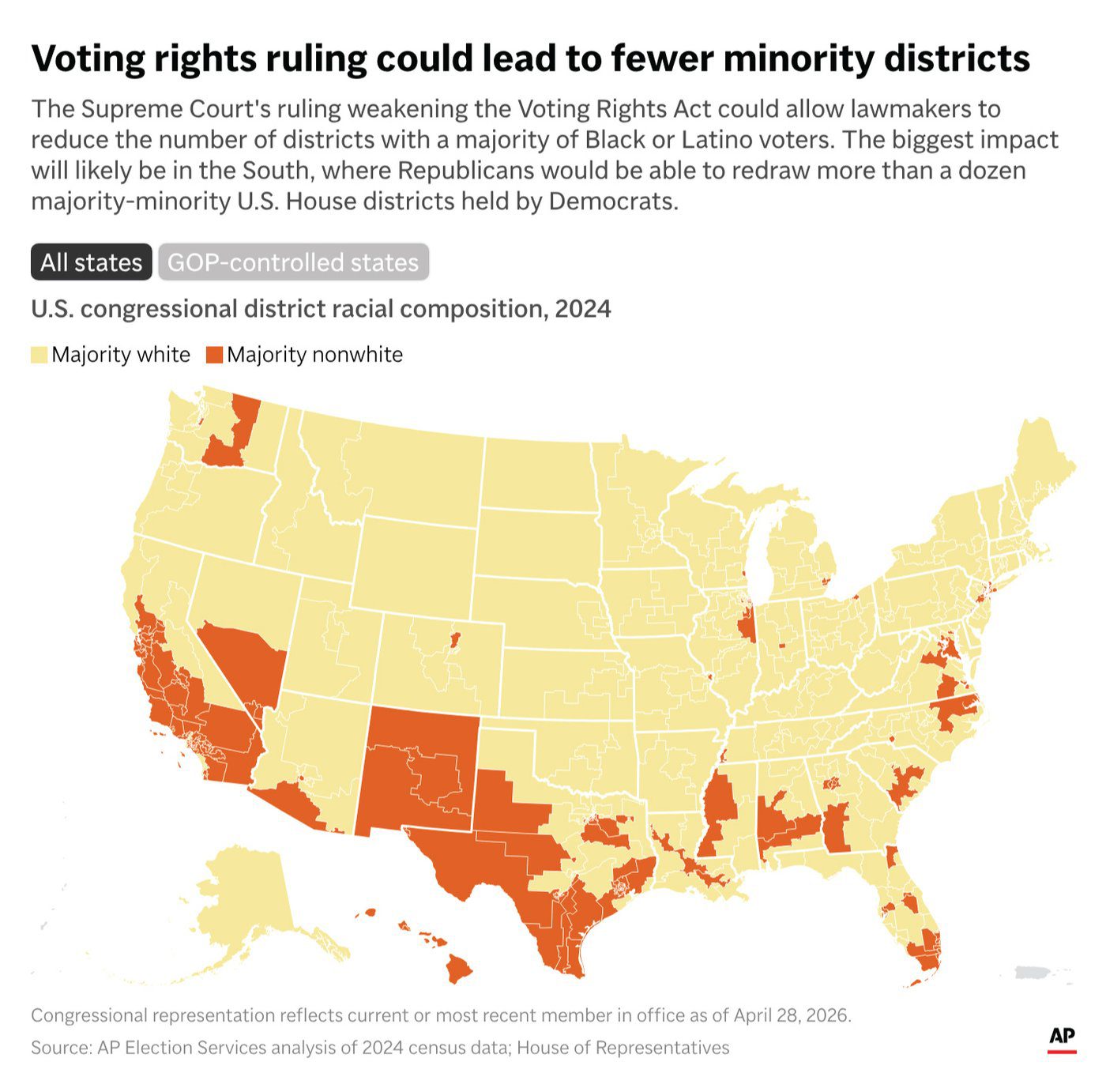
The Supreme Court has weakened a key tool of the Voting Rights Act that has helped root out racial discrimination in voting for more than half a century in a case concerning a Black majority congressional district in Louisiana.
The court’s conservative majority found that the district, represented by Democrat Cleo Fields, relied too heavily on race. Chief Justice John Roberts had described the district as a “snake” that stretches more than 200 miles (320 kilometers) to link parts of the Shreveport, Alexandria, Lafayette and Baton Rouge areas.
It’s unclear how much is left of the provision, known as Section 2, but the ruling could open the door for Republican-led states to eliminate Black and Latino electoral districts that tend to favor Democrats and affect the balance of power in Congress. President Donald Trump has already touched off a nationwide redistricting battle to boost Republican chances.
The plaintiffs had argued that Louisiana’s second Black-majority congressional district, drawn to correct a previously discriminatory map, has an unconstitutional racial basis and did not follow the standards for drawing a district, including compactness.
Here’s the latest:
Florida is pressing ahead with redistricting votes after the Supreme Court decision
The Florida Senate reversed itself and took a brief break so senators could review the decision and talk with attorneys. But the Republican-dominated chamber is still expected to vote later Wednesday to approve a GOP gerrymander of the state’s congressional districts.
House Republicans have not broken to consider implications of the Louisiana case in their arguments, despite the Democratic majority’s urging.
The current Florida congressional map gave Republicans a 20-8 advantage in the 2024 election. Gov. Ron DeSantis’ proposal is designed to push that to as much as 24-4 in November.
▶ Read more about redistricting in Florida
Things to know about the Voting Rights Act
The 1965 voting rights law was the centerpiece legislation of the Civil Rights Movement. It succeeded in opening the ballot box to Black Americans and reducing persistent discrimination in voting.
Nearly 70 of the 435 congressional districts are protected by Section 2, election law expert Nicholas Stephanopoulos has estimated.
▶ Read more on what the Voting Rights Act did
Justice Elena Kagan wrote for the three liberal judges
“The consequences are likely to be far-reaching and grave. Today’s decision renders Section 2 all but a dead letter,” Kagan stated in dissent.
The court split 6-3
Justice Samuel Alito, writing for the six conservatives, said the Louisiana district at the heart of the case “is an unconstitutional gerrymander.”
Roberts, the chief justice, described the district as a “snake” that stretches more than 200 miles (320 kilometers) to link parts of the Shreveport, Alexandria, Lafayette and Baton Rouge areas.
Redistricting is also being debated in Florida
The court’s decision was released as Florida legislators debated a proposed redraw of the state’s congressional lines, submitted by Republican Gov. Ron DeSantis and intended to give the GOP a chance at as much as a 24-4 advantage in the state’s U.S. House delegation.
Senate Democrats urged the Republican supermajority to delay debate to at least offer lawmakers a chance to read the decision and consult attorneys on how it might affect DeSantis’ proposal. Florida Senate Republicans refused.
Legal experts are still poring over the decision
The AP contacted multiple law professors and redistricting attorneys in the minutes after the decision came out who said they were still reading the decision so did not yet know its full implications.
The Associated Press

