


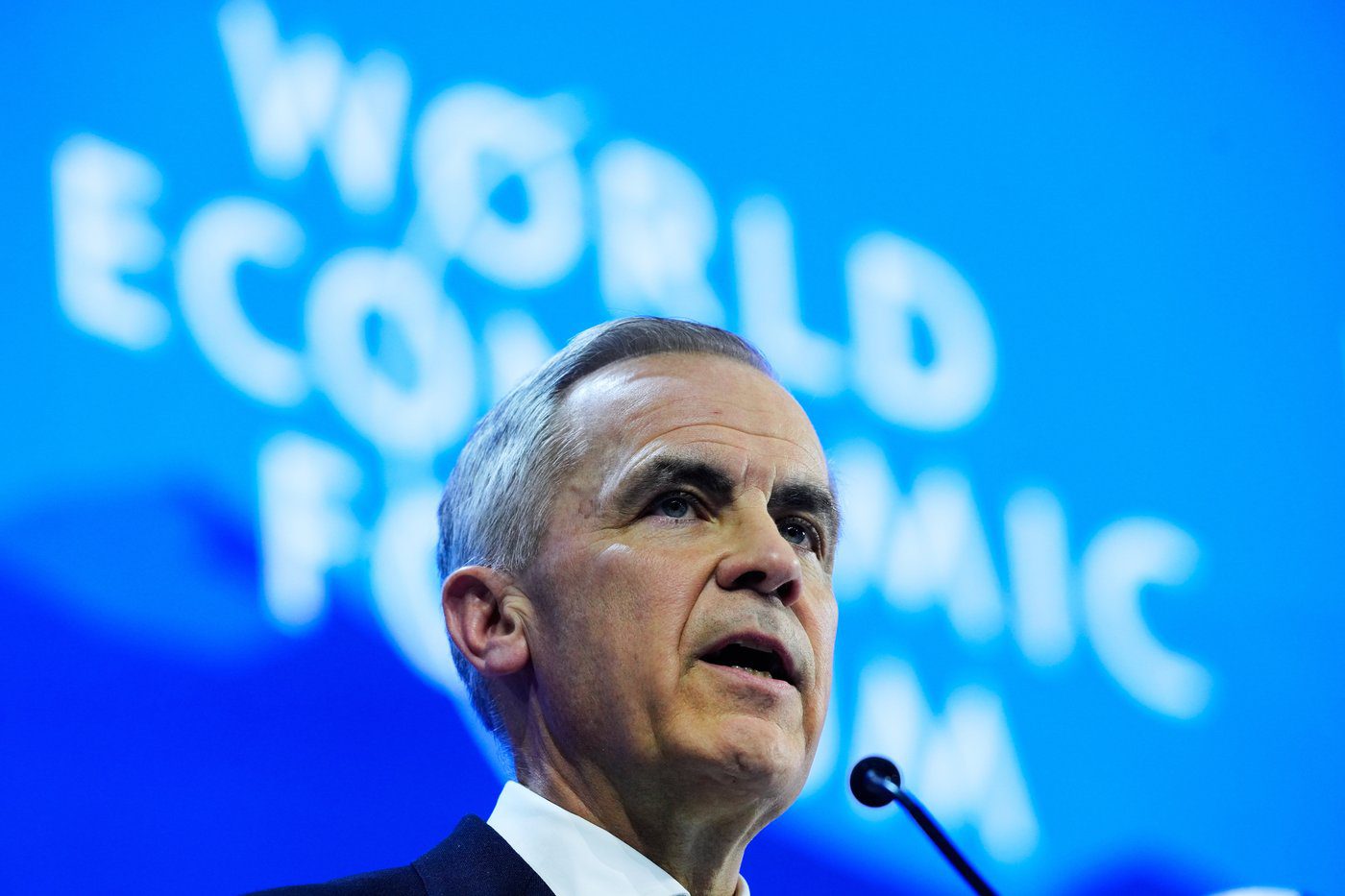
While everyone has been swooning over prime minister Mark Carney’s big speech at the World Economic Forum in Davos, there was perhaps an even more important speech from Ukrainian president Volodymyr Zelenskyy that happened on Thursday. In some ways, it complements some of the themes that Carney argued around the end of the international rules-based order, but unlike Carney, it had a much greater sense of urgency, and the kind of concrete solution that Carney’s lacked in his assertion that the system was over and not to be lamented in its passing. As the western world tries to reorient itself away from the United States in its newly belligerent state, a great deal of new leadership is required in order to make that transition, and while we have some people asserting that Carney is playing that role, I have serious reservations about giving him that kind of credit.
To many, Carney’s words were necessary in calling out the fact that there was an inherent deception in the rules-based order in that there was always an exception to those rules granted to the US as the dominant power in the post-war era, because they had the might, both economically and militarily, but also because they were essentially the guarantor for the rules that everyone else was being held to. This was true, but at the same time, the way in which Carney framed this contained a dangerously problematic framing device. By invoking Czech dissident Václav Havel’s story about shopkeepers taking down their signs about “Workers of the World Unite” in order to stop performing the rituals that the communist leaders demanded of them, Carney has managed to subvert that message. According to former diplomat Michael Kovrig, “It blurs the difference between democratic hypocrisy and totalitarian coercion, and it invites the interpretation that liberal order itself has been a quasi-ideological fraud, which for all its many flaws, it has not been.”
Carney’s speech also contains elements of hypocrisy, particularly if you add the Davos speech up with the one he delivered in Quebec City on Thursday afternoon, where he extolled Canada’s virtues of plurality and that we had built a country in spite of the differences of our founding peoples. Meanwhile, he just returned from signing a “strategic partnership” with China, which is a regime that is currently genociding its Uyghur ethic minority population, per a vote that the House of Commons held last year. Likewise, as Carney touts that his plan will create thousands of “good-paying union jobs,” that same Chinese regime engages in forced labour, while Qatar, with whom he signed another “strategic investment” agreement, also practices slave labour (and has no women’s or LGBTQ+ rights). It’s hard to claim that you want to build alliances with like-minded countries when your two most recent examples are anything but. Carney also called out appeasement to bullies, like the American regime, while he has ordered appeasement measures continually for the past six months, such as the cancellation of the Digital Services Tax in exchange for more talks with the US, which eventually broke down over the next perceived slight.
The other problem with Carney’s particular speech is that in saying that the rules-based order is dead, while calling on the middle and smaller powers to ally themselves through various networks of interest-based agreements, he doesn’t really offer anything about how exactly they are to go about it, and how they are to come up with common rules that they can rally around. This was in contrast to a speech that former prime minister Justin Trudeau gave earlier in the day at Davos, where he correctly pointed out that in this age of the rules-based order breaking down that it was important for countries to rally around international law and their allies in order to get through the current crisis, and Trudeau was right. Abandoning the rules and international institutions just because the Americans are abandoning them doesn’t make sense because only chaos will result. Instead, those existing organizations need to adapt as quickly as possible—and that will be a tall order for some of those institutions and alliances, like NATO, where American capabilities are at the very heart.
This is where Zelenskyy’s speech was much more cutting, and indeed scathing. In calling out the hesitation of European countries to act because they were waiting for either the US to take the lead, or for the situations to resolve themselves, they are merely prolonging the crisis, as well as the war in Ukraine. The whole premise of NATO is based on the belief that the Americans will put themselves on the line for European interests, including the nuclear deterrence shield, but that belief is no longer sound. That is why he is calling for greater unity in Europe, and in particular a united European military force, because they can no longer count on the Americans to come to their aid, so they need to do it for themselves and they need to do it now. While Carney’s speech meandered into canned lines and back-patting about the actions he’s taken to date (many of which actually undermine the vision he laid out), Zelenskyy was much mor cutting. “Europe loves to discuss the future but avoids taking action today—action that defines what kind of future we will have. That is the problem,” Zelenskyy said. Those actions need to include things like freeing up the frozen Russian assets for Ukraine to use, actually enforcing sanctions on countries supplying Russia with the technology to build its drones, and those countries buying Russian oil by way of its “shadow fleet” of tankers.
Carney’s track record has also been a lot of talk and not a lot of action, made worse by the fact that the current minority parliament means he has barely passed any legislation to date. As much as everyone is falling all over themselves to congratulate Carney, I do think that Zelenskyy is the one real speech worth listening to, and really taking in what he had to say because there are some hard truths in there. There is a lot of work that Canada and its allies need to do right away to protect themselves from the American hegemon, and it won’t happen if we just pat ourselves on the back for one speech, and insist that making cynical “strategic partnerships” that betray the very values we’re extolling as we tell ourselves how great we are, will solve any problems.