


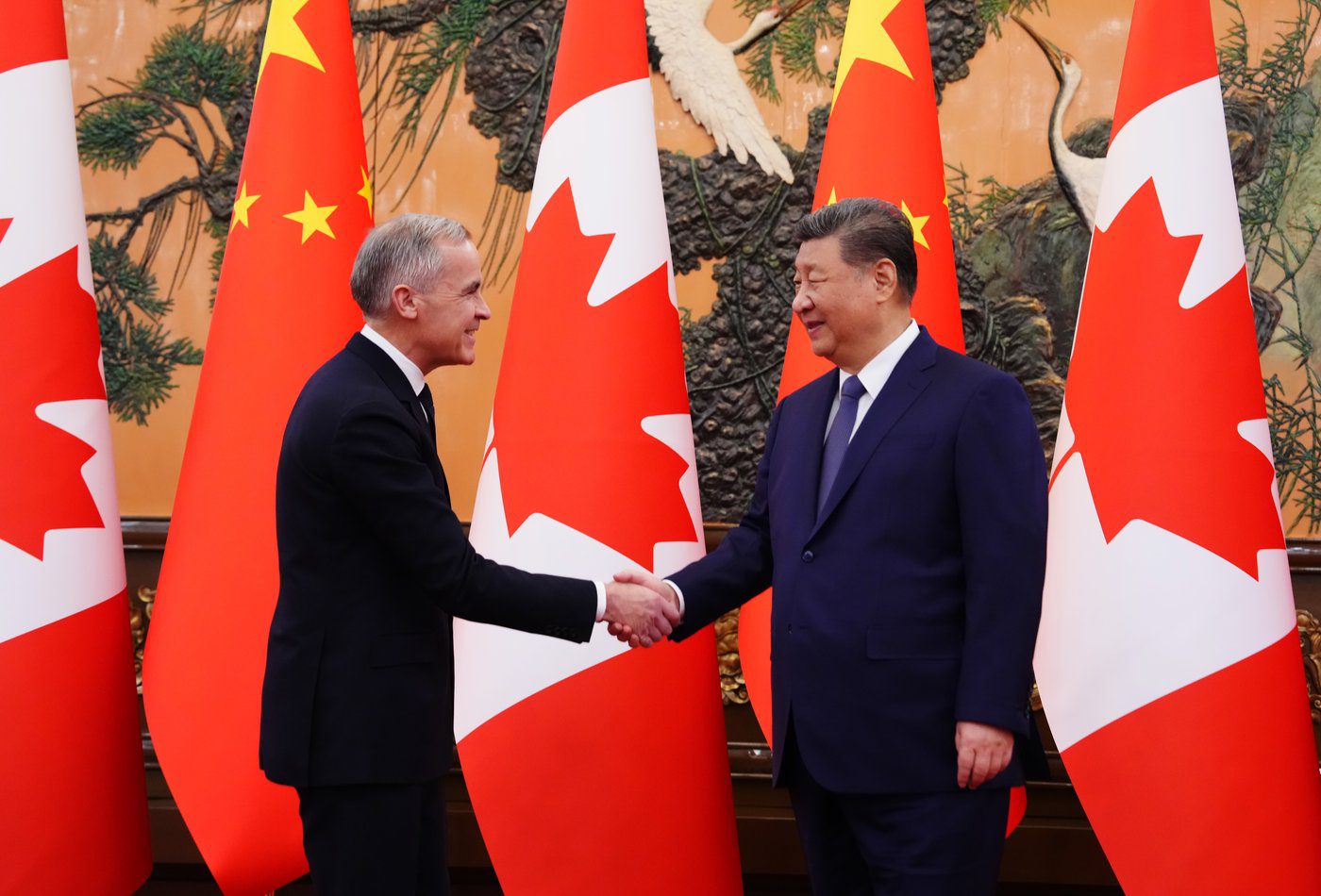
Prime minister Mark Carney’s world tour of authoritarian countries to make deals with should be starting to get pretty uncomfortable. It was a little over a year ago that our Parliament voted unanimously to declare that China was committing a genocide against the Uyghur people, but did that come up last week, when Carney and Xi Jinping put on a dog-and-pony show about signing all kinds of (non-binding) agreements, culminating in the “strategic partnership” about allowing Chinese electric vehicles into our market in exchange for them dropping tariffs on canola, seafood and pork? Of course not. Nor was the fact that we had a full public inquiry into foreign interference into our elections, and China was named as a key player. From there, Carney flew to Doha, Qatar, where they engage in slave labour, and things like women’s or LGBTQ+ rights simply do not exist in that country. But Carney attracted “strategic investment” from that authoritarian regime. He’s been invited to India in the coming weeks, where again, nothing is being said about agents of the Indian government credibly being accused of contracting murders on our soil. I’m sure that’ll be another “strategic partnership” too.
Setting aside the fact that in our haste to increasingly decouple from the failed democracy to the south of us, we are suddenly eager to do more business with countries who are either full-on authoritarian states, or whose democracies are also floundering in the face of increasingly authoritarian leaders. Carney has tried to pitch this as “value-based realism,” but I’m not sure where the value is in this supposed realism. He claims he’s on the hunt for “like-minded countries” to form new coalitions with, but I’m not seeing the like-minded in China, India, or Qatar—quite the opposite, in fact. It’s hard to even consider this pragmatic, considering that countries like China and India have been hostile to our interests, and have been engaged in interference and trans-national repression on our soil, and falling all over ourselves to deepen economic ties with these markets feels like we are rewarding them for their bad actions.
Carney insists that this is about ensuring global free trade as the US steps back from a leadership position in ensuring it operates through the rules-based international order.
“What’s happening at pace and at scale is that a number of the multilateral relationships, institutions, rules-based systems are being eroded by various decisions of various countries, the United States included,” Carney said in Doha. “And the consequence of that is that there’s a reduction in freer trade, much more trade is tariff-based or otherwise restricted, and there is virtually no, with all due respect to those who are trying to push it, but virtually no multilateral progress in these areas.”
Carney says that Canada and like-minded countries are trying to make progress through “plurilateral deals,” such as trade between different trading blocs like the European Union and the Trans-Pacific Partnership, but again, I fail to see how China fits into this because it doesn’t engage in free trade, and it doesn’t engage in fair trade, so I fail to see how these kinds of “strategic partnerships” he keeps signing are advancing the cause of freer trade. It doesn’t make sense, other than for Carney to just once again insist that we trust him—something that is harder to do after he outright broke his word to Elizabeth May after securing her vote on the budget.
But as Carney flatters and sweet-talks these authoritarian regimes—and he’s invited the Emir of Qatar to Ottawa in the spring—and puts all of this effort into making deals with countries that are neither democracies, nor countries that engage in the rule of law, you can pretty much watch as all of the goodwill from our decades of engaging in soft power are evaporating around us. As a middle power, and one that has tried to insist that we’re the global nice guy (even though our record is not exactly spotless), this nevertheless gives the distinct impression that Carney no longer cares about Canada’s leadership on democracy, on human rights, on empowering women, on protecting vulnerable minorities, and that he is strictly interested in transactional relationships with terrible regimes. And I’m not going to pretend that our soft power influence didn’t have its own problems—we certainly have had a problem following through on a number of our commitments (because under Justin Trudeau, nine times out of ten, the announcement and not the implementation was the policy). But in this period when the destruction of USAID is leaving massive capacity gaps in international assistance, we are also pulling back when we should instead be doing more. We could give ourselves more influence internationally if we stepped up and took more of a leadership role in the vacuum that USAID has left behind, rather than let Russia and China fill it, but again, Carney seems incapable of understanding the impact of his decision to simply cut aid instead of leaning in to do more.
I get that he likes to justify this with his line about needing to deal with the world as it is and not as we’d like it to be, but unless we actively do something to make the world a better place, dealing with it “as it is” means that it’s only going to get worse. We just wind up cynically convincing ourselves that being “pragmatic” and “realistic” means giving up on trying to improve things, and in we wind up being incredibly self-involved in the process because it’s all about our bottom line instead of realizing that soft power can give us more influence that we could possibly try to obtain in some kind of hard-power scenario that, which, as a middle power, we could never actually achieve. But apparently nobody wants to have this conversation, and we are letting our reputation, whether deserved or not, go up in smoke because Carney’s CEO-brain hasn’t figured out that there are other ways to exert influence than just with flashing dollars around. Building trust and relationships with people who deserve that trust could go a long way to helping us build a better world and bring other countries along with us, but if we keep on this current path, we are only going to hurtle toward dystopia.

