


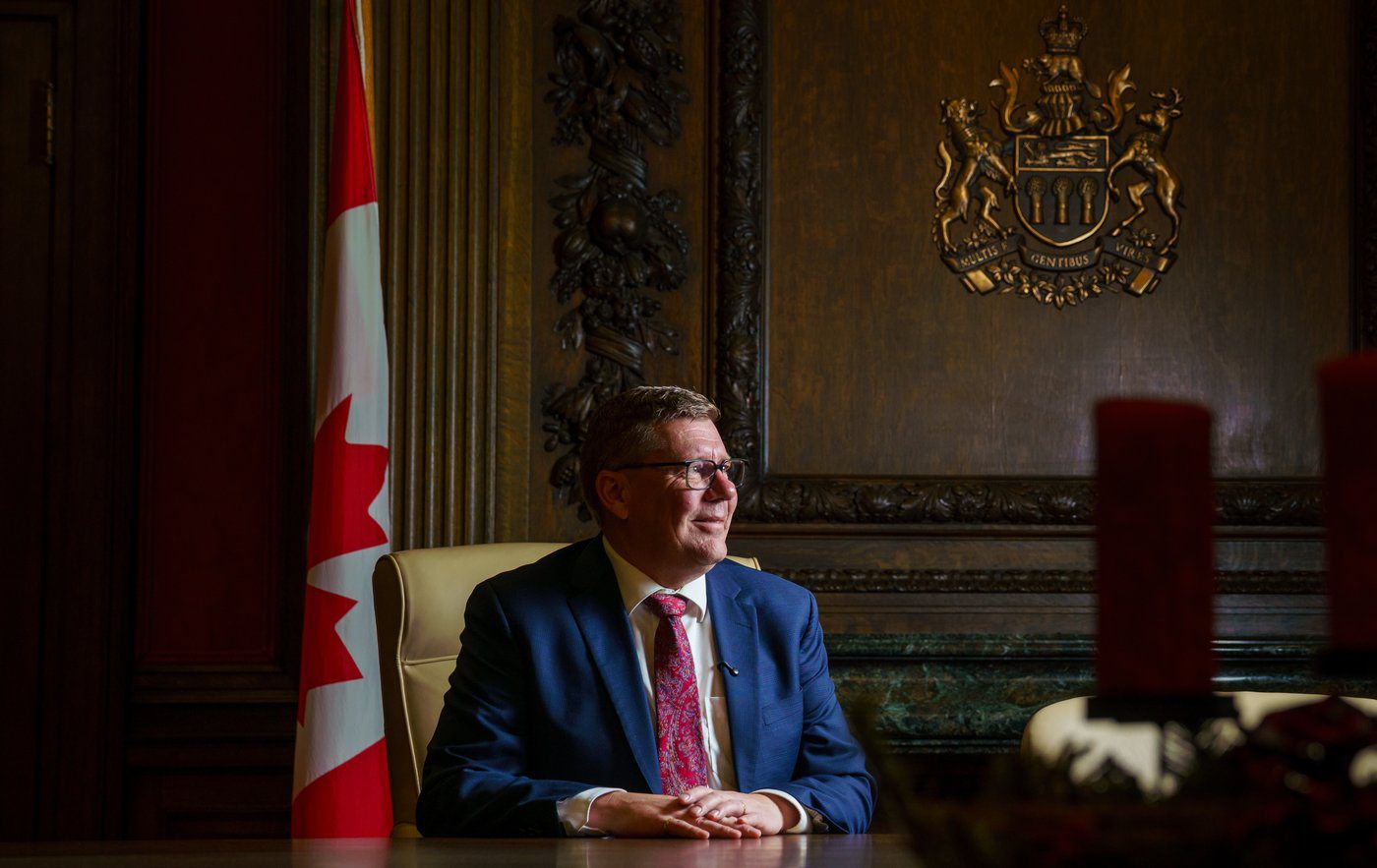
REGINA — Saskatchewan Premier Scott began the year with a smaller crew of mostly newbies, pledging to do better on everything from health care and education to balancing budgets.
By spring, he had more issues to contend with.
The province was hit by a double whammy of tariffs from the United States and China in March, leaving Saskatchewan in what the premier calls tempestuous waters.
He’s hoping the storm won’t last long, he said in a year-end interview with The Canadian Press.
“In the short term, I’d say the waters are choppy, not just for the Saskatchewan economy, but also the Canadian economy,” he said.
“I think the word of the year is uncertainty.”
It has put his province in a position of having to make tough budgetary decisions next year, Moe said. He declined to provide further details on what those choices could be.
“If we can’t improve the revenue line, you have to change the expense line,” he said. “Any deficit is not acceptable, and we need to work towards bringing our budget … into balance.”
Moe said most of Canada’s immediate economic problems can be traced back to U.S. President Donald Trump.
Trump has imposed levies as high as 50 per cent on some products, while others remain duty-free under the current trade agreement.
Trump has also threatened tariffs on Canadian fertilizer, which could harm the potash industry in Saskatchewan, the world’s largest producer.
Moe has urged people “take a breath” over Trump’s threats and not take the president’s words literally.
Saskatchewan also won’t stop the flow of potash to the U.S., or apply an export tax, as a way to retaliate, Moe said.
“I just don’t see that any of the counter-tariff, export-tariff discussion as being conducive to Canada getting to the end goal, which is to have that free and fair trade not only with the U.S., but other countries as well,” he said.
Meanwhile, China’s tariffs on canola products have already taken a toll, as exports of the crop have dramatically fallen. India has also slapped levies on Canadian yellow peas.
Moe said his job is to use his contacts and work with Ottawa to smooth out the various trade issues.
“Hopefully sooner rather than later,” he said.
It has been over a year since Moe’s Saskatchewan Party won its fifth-straight majority government in October 2024. His team came out smaller and with less legislature experience. The governing party has no seats in Regina and only one in Saskatoon.
The losses lit a fire under the premier to refocus on issues affecting the major cities, including overcapacity hospitals, crowded school classrooms and deteriorating safety with increasing drug addictions and homelessness.
Moe said his government will do more listening and less talking.
“Rather than imposing policy and telling people how that policy or legislation is going to work, we need to do better in consulting individuals,” he said.
He pointed to recent legislation that, in rare cases, would force those with drug addictions to receive treatment. The province introduced the bill this month and is to consult with the public on it into the new year, he said.
The premier added that he wishes his government had built more treatment beds sooner, but it’s working as fast as it can.
“The consequences of having these poisonous substances in our communities are pretty dire,” he said. “It’s killing our family and friends all too often.”
On health care, Moe said his government is hiring more staff, building additional urgent care centres and adding nurse practitioners to the system.
In education, the province has earmarked additional money for classroom supports, including trying out separate specialized rooms for children with behavioural issues.
For Opposition NDP Leader Carla Beck, the measures in health care and education are needed but come too late for a government that she argues has been slow at the wheel for the past 18 years.
“That’s how you find yourself from going to first to last in so many key sectors, (like) education, health care and also spending their way into a projected $40-billion debt now,” she said in an interview.
“We’ve not seen an urgency to make sure that there are supports available all the way from kids in school to people who are voluntarily reaching out to get into detox.”
Moe’s government had initially projected a $12-million surplus in its budget this year but is now forecasting a $427-million deficit with hundreds of millions of dollars to pay the interest on debt.
“The Toronto bankers are going to have a good Christmas, but unfortunately it’s Saskatchewan people who are struggling just to put food on the table who are picking up the tab,” Beck said.
New Democrats have also criticized Moe’s government for being ill-prepared to handle wildfires that destroyed half the village of Denare Beach in the summer.
In the fall, Moe apologized for not visiting the community sooner. He also promised a third-party review into the disaster but declined to hold a public inquiry that residents demanded.
On the economy, Beck said Moe has been lax on pushing hard for the province’s interests. She cited a decision by Nutrien Ltd. to build a new terminal in the U.S., not Canada.
Moe said it would have been ideal for the company to choose Canada, and he’s spoken with federal Transport Minister Steven MacKinnon about ways to address Nutrien’s concerns.
“Maybe this is a time for us as Canadians look in the mirror as to why that decision is being made and make the appropriate changes to determine our own destiny,” he said.
This report by The Canadian Press was first published Dec. 28, 2025.
Jeremy Simes, The Canadian Press

