


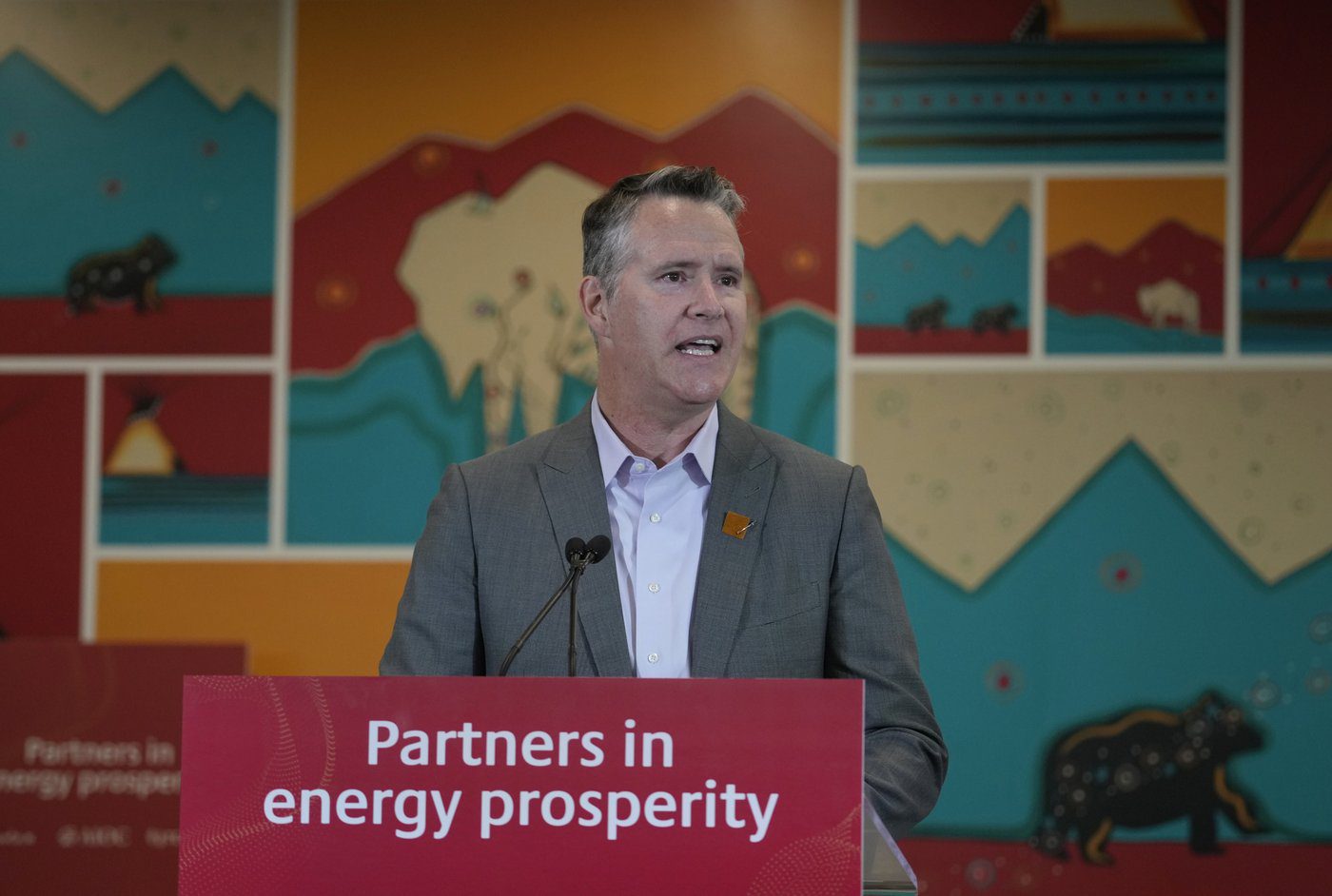
CALGARY — A Canadian pipeline boss led a new report advising the Trump administration on how to more quickly build new oil and gas infrastructure in the United States amid a push north of the border to do the same.
U.S. Energy Secretary Chris Wright requested the study on permitting from the National Petroleum Council, which includes 200 members he appointed from both inside and outside the oil and gas industry. The body was formed just after the Second World War.
TC Energy Corp. president and CEO François Poirier chairs the council’s committee on oil and natural gas permitting, and was in Washington on Wednesday for the release of the report entitled Bottleneck to Breakthrough: A Permitting Blueprint to Build.
Poirer said in an interview Thursday that common challenges arise in each of the three countries in which TC Energy operates: Canada, the United States and Mexico.
“We would like to see permitting timelines get shorter. We would like to see one application and one review as opposed to being reviewed by multiple bodies with overlap in reviews,” he said.
And he said his company would also like to see “clarity and stability and durability” of the rules applicants must follow.
TC Energy is headquartered in Calgary and operates the vast pipeline network that ships natural gas across Canada. Its U.S. presence is also substantial, delivering a quarter of total American natural gas demand, operating in 36 states and employing some 3,200 people across that country.
Poirier said the petroleum council selected him to steer the study because of TC Energy’s “domestic expertise” as a major player in U.S. infrastructure.
“However, we have the benefit of drawing from best practices in Canada and Mexico,” he said.
That Wright gave the council five months to put together the report — work that would normally take 12 to 18 months — signals the “very high level of urgency” of the U.S. administration, Poirier said.
Indeed, the report opens by saying the U.S. stands at a “pivotal moment” that will shape its economy, national security and global standing for decades to come.
“A surge in energy demand, driven by widespread electrification, the resurgence of domestic manufacturing, the proliferation of data centres and the strategic expansion of liquefied natural gas exports is colliding with aging and limited infrastructure,” said the petroleum council’s report.
“The country has reached the point where capacity has been expanded as much as possible. Outdated and fragmented permitting processes are increasingly unable to keep pace with these shifts, widening the gap between the infrastructure that is needed to sustain U.S. growth and reliability and what is actually being built.”
The group’s recommendations include a call for judicial reforms to avoid the kind of lengthy court battles that have slowed or ground to a halt past projects.
Poirier said the right to take such matters to court is important.
“What we’ve seen, however, in the U.S. is a creep beyond stakeholders who are directly impacted by specific projects, a creep into broader policy matters” like cumulative climate change impacts, he said.
“I would apply a similar concept within the Canadian context, which is … stakeholders and rights holders should have a right to litigate, but we’d like to see it apply to circumstances strictly where a rights holder or a stakeholder is immediately impacted by a project.”
The report also flags duplication among federal agencies that each have their own separate obligations under the environmental legislation, as well as overlaps with reviews at the state and local levels.
“The high degree of variability among state permitting processes — both in timeline and scope — can also introduce significant uncertainty and delay for infrastructure projects,” it said.
Longer term, the petroleum council is calling for more a more standardized approach to permitting.
That could mean a central federal permitting agency for projects crossing state lines that would “site critical infrastructure systems needed to serve or advance the public interest,” oversee compliance, impose conditions and grant approvals.
That’s a similar concept to the recently created major projects office in Canada, to which projects deemed in the national interest are referred for a speedy review, Poirier said.
He has called that “only the first step” and said he’d like see that streamlined approach applied across the board, not just to selected projects.
Ways to enable more oil and gas infrastructure to be built in Canada have been front-and-centre as the federal government looks to reduce its reliance on its biggest customer for energy products, the United States.
The petroleum council report comes less than a week after the Alberta and federal governments signed a sweeping memorandum of understanding on a wide range of energy policy issues.
The MOU includes measures to support construction of a new West Coast oil pipeline in tandem with a massive carbon capture and storage project in Alberta, as well as a strengthening of the industrial carbon pricing regime, doing away with a planned industrial emissions cap and the suspension of clean electricity regulations in Alberta.
This report by The Canadian Press was first published Dec. 5, 2025.
Companies in this story: (TSX:TRP)
Lauren Krugel, The Canadian Press