OTTAWA — An Ontario government anti-tariff ad posthumously narrated by Ronald Reagan is no doubt racking up plenty of views after being cited by Donald Trump as a rationale for cutting off cross-border trade talks. One thing viewers won’t learn from the controversial TV spot is that Ontarians can thank Reagan’s protectionism for the province’s thriving network of Japanese-owned auto plants and parts manufacturers.
“It’s hard to draw a direct line, but Reagan used a careful blend of carrots (and) sticks in his dealings with the Japanese that Canada was able to emulate,” said Greig Mordue, an expert in automotive and advanced manufacturing policy at McMaster University in Hamilton, Ont.
When Reagan took office in the early 1980s, Detroit’s “Big Three” automakers were getting decimated by a new generation of cheaper, more fuel-efficient Japanese vehicles. Rather than continue to watch the American auto sector bleed out, Reagan decided, in one of his first major foreign policy manpeuvres, to cut a deal with Tokyo.
Wielding the threat of a hard import quota, Reagan convinced Japanese officials in May 1981 to voluntarily limit auto exports to the U.S. by
, equivalent to a
tariff rate exceeding 60 per cent
.
Canada’s then trade minister Ed Lumley negotiated a
entering the Canadian market the same year.
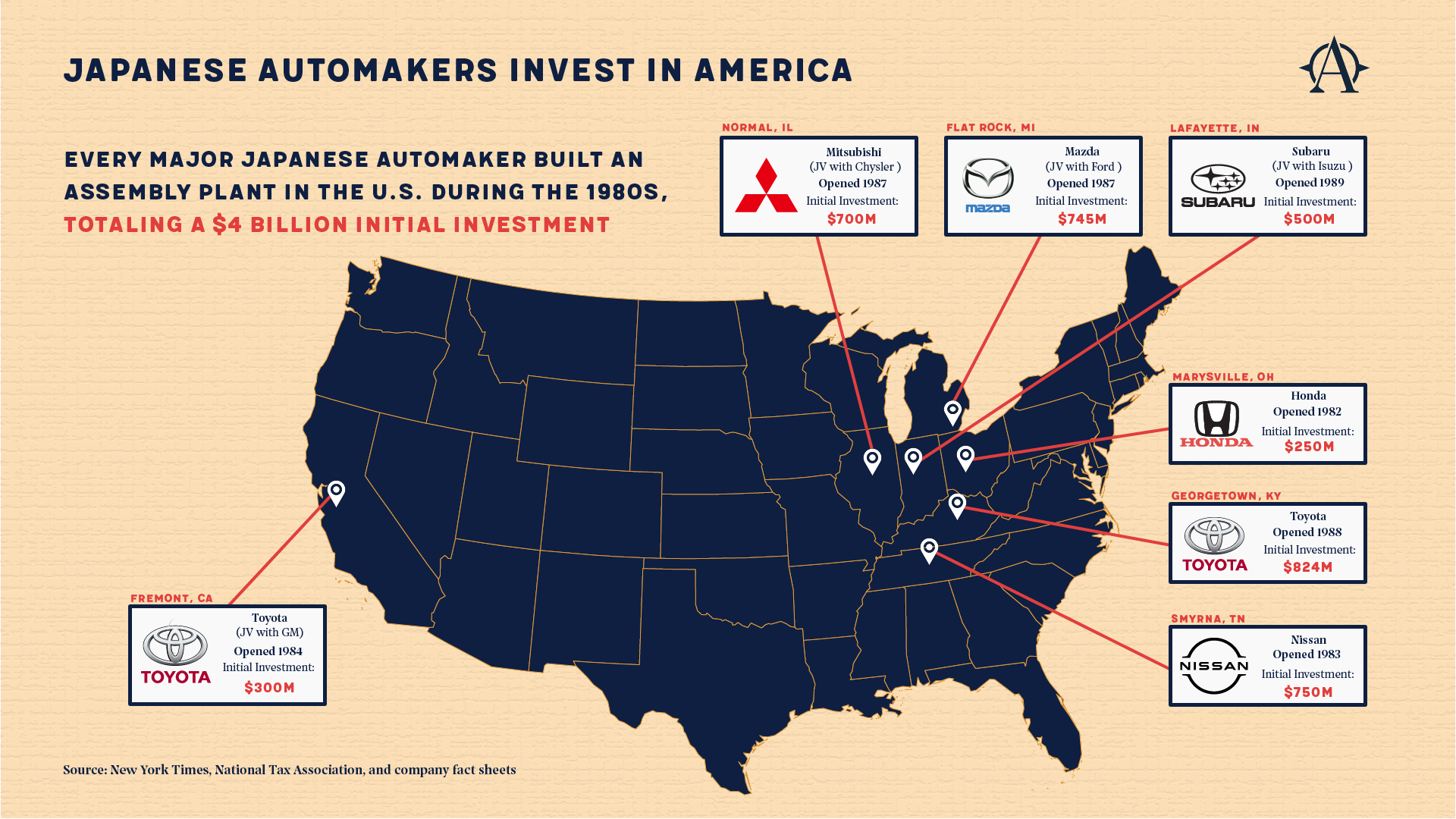
To skirt the de facto tariff, the Japanese automakers set up their own plants in North America. The first of these sprung up
, but it wouldn’t be long before they spread north of the border.
Honda became the first Japanese entrant in Canada in 1984, announcing
. Toyota broke ground on
in Cambridge, Ont., two years later.
Mordue said that a number of factors made Southern Ontario an attractive destination for Japanese car manufacturers.
“Just basic stuff, like lots of cheap land, no neighbours, close to rail and highways,” said Mordue.
He added that Japanese car companies have historically preferred to set up shop in small towns where they can be the primary employer.
Today, Southern Ontario is home to seven Japanese-owned auto plants and dozens of Japanese car parts manufacturers, supporting
Mordue said that lessons from Reagan-era auto sector diplomacy can be applied to Canada today.
“Historically, Canada’s auto sector has done the best when it’s attached itself to the ascendant automaking power: in the 1960s, that was the U.S., in the 1980s it was Japan, today it’s China,” said Mordue.
National Post
rmohamed@postmedia.com
Our website is the place for the latest breaking news, exclusive scoops, longreads and provocative commentary. Please bookmark nationalpost.com and sign up for our daily newsletter, Posted, here.