



First Reading is a Canadian politics newsletter curated by the National Post’s own Tristin Hopper. To get an early version sent directly to your inbox, sign up here.
TOP STORY
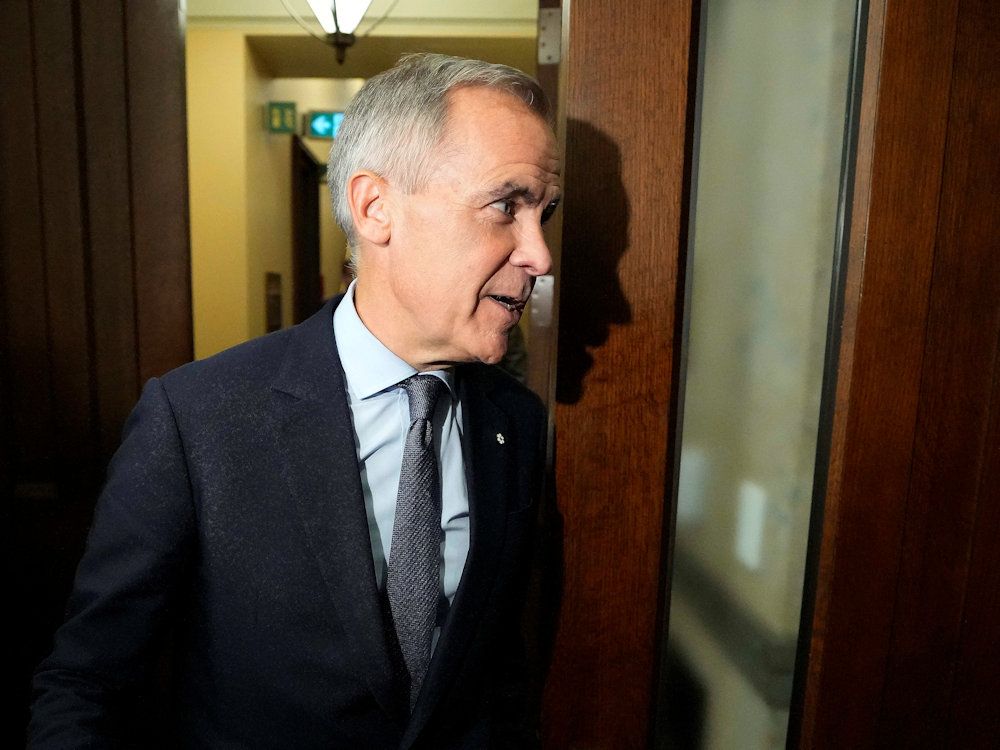
Prime Minister Mark Carney boasted that he speaks “regularly” with U.S. President Donald Trump after facing down criticism in the House of Commons that his government had unnecessarily alienated the United States.
“I speak regularly with the president,” said Carney in a French-language reply during question period on Monday, adding that “just over the weekend” he’d been on a call with Trump on the issue of “Ukraine, Russia and China.”
Carney also called it a “success” that Canada has largely dodged U.S. tariffs as a result of most Canadian exports being exempt under the terms of the Canada-United States-Mexico agreement (CUSMA).
“The real situation is this; we have the world’s best deal with the Americans,” said Carney.
At another point, he said to applause from Liberal MPs that “U.S.-Canadian relations are good.”
Carney was responding to attacks that had come, somewhat unexpectedly, from the benches of the separatist Bloc Quebecois.
Leader Yves-François Blanchet accused Carney of damaging the Canadian economy by pushing away the U.S., and even suggested the prime minister should be spending more time in the U.S. capital.
With Canada posting “very bad” economic figures, Blanchet called on Carney to “commit himself now to putting an end to tariffs and prioritizing a trade deal with the United States.”
Blanchet is by no means a fan of the U.S. leader, and he represents a party whose animosity to Trump is nearly total.
In March, a poll by Leger Marketing
the number of Trump supporters in Canada, and how they voted in Canadian elections. Among Bloc voters, a mere three per cent expressed a “favourable” opinion of the U.S. leader.
Nevertheless, Trump retains a complicated relationship with the cause of Quebec separatism, if only because his trade attacks on Canada inspired an unusual wave of federalism within Quebec nationalist circles.
During the spring federal election, Blanchet even promised to temporarily drop his party’s usual commitment to Quebec secession until the Trump situation could be stabilized. “We should not threaten to overthrow the government anytime soon,”
on the eve of election day.
On Monday, Blanchet’s principal attack on Carney was that he had displeased U.S. leadership to the detriment of the Canadian economy.
He even appeared to make specific reference to a March 27 campaign speech by Carney in which he declared that close relations between Canada and the U.S. were at an end. “The old relationship we had with the United States based on deepening integration of our economies and tight security and military cooperations is over,” Carney said at the time.
Speaking to the House of Commons on Monday, Blanchet said “the prime minister has said that our privileged and close relationship with the United States would no longer exist. This declaration has been very poorly received in Washington. Can he state today that he is committed to re-establishing that privileged and close relationship between Canada and the American administration?”
Blanchet would again reference the alleged displeasure of Washington in criticizing the “rare” presence of Carney in the U.S. capital. He urged him to start “seriously frequenting the capital of our principal partner.”
To this, Carney said that Trump is a “modern man” who owns a cell phone. “I speak regularly with him, and I send texts to him,” he said.
Carney’s comments on his relationship with Trump were marked by his somewhat halting French. While describing the percentage of Canadian exports that are not subject to U.S. tariffs, Carney stumbled over the French word for “85” until prompted by a fellow Liberal.
At another point Carney switched from French to English halfway through a reply, apparently struggling to find the French words for “stands up for Canada.”
“Je suis fier que ce gouvernement stands up for Canada” he said.
Monday’s question period had been hotly anticipated due to the presence of Conservative Leader Pierre Poilievre, who recently returned to the House of Commons after losing his former riding of Carleton during the April 28 general election.
“My mother taught me never to be late, so please forgive me for my late arrival,” said Poilievre in his opening remarks.
The word “Trump” wasn’t mentioned once from the Conservative benches during question period. The party mostly hammered Carney on the Liberal government’s high deficits and missed deadlines.
“He (Carney) promised that he would spend less; he’s already spending eight per cent more. He promised the budget would be in October, now he says it will be in November, more than halfway through the fiscal year,” said Poilievre.
IN OTHER NEWS
In his opening comments on Monday, Conservative leader Pierre Poilievre also thanked Prime Minister Mark Carney for quickly approving a by-election in the Alberta riding of Battle River-Crowfoot, thus allowing Poilievre to return to the House of Commons. If Carney had been feeling particularly petty, he could have dawdled for months before ordering the seat filled. Said Poilievre, “I wonder if one day he might regret that decision.” Also, at one point, Carney accidentally referred to Poilievre as “minister.” National Post’s Ottawa bureau has full coverage of question period and you can read John Ivison’s take here.
Just before the fall session of Parliament opened, the Carney government
rolled out the first baby step
s of its pledge to fix housing affordability by erecting industrial quantities of modular homes. The new Build Canada Homes agency has been given $13 billion and a mandate to establish six subdivisions of factory-built homes on federal land, totaling between 4,000 and 45,000 homes.
The easy critique of the program is that it doesn’t address one of the main barriers to housing affordability most often identified by the people who build them: The
of development fees and other homebuilding charges.
There’s also the small issue of Canada’s housing shortage being estimated at about three million units. So even if they get to 45,000 on time and on budget, that’s about 1.5 per cent of the total, not including however much the housing shortage will widen given 2025 population growth projections.
Get all of these insights and more into your inbox by signing up for the First Reading newsletter.

