



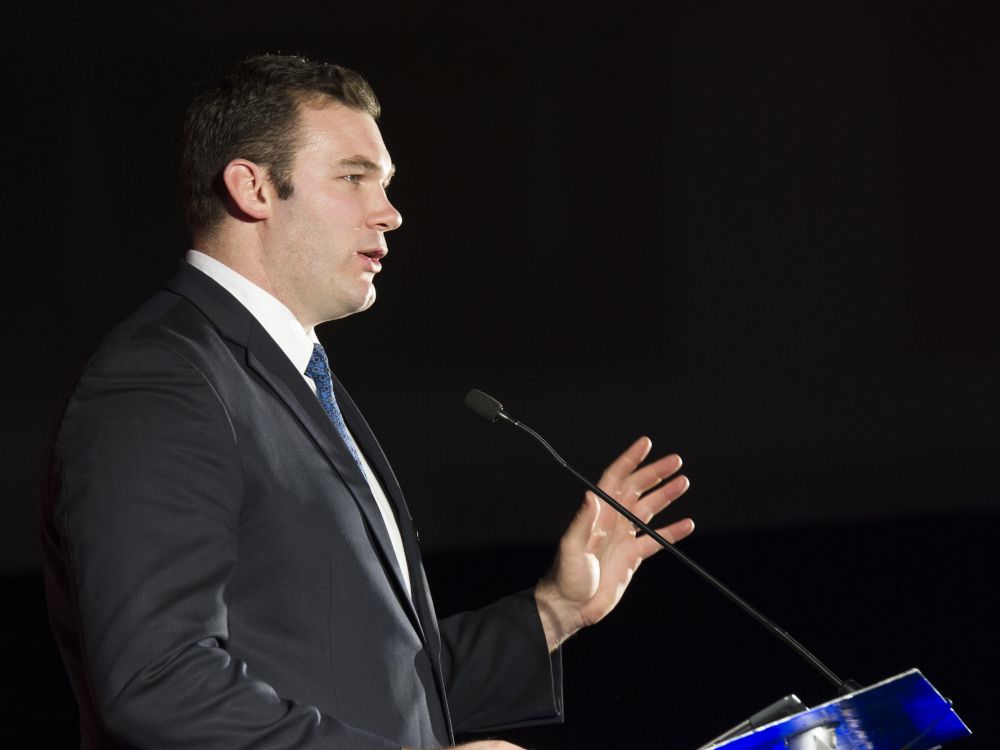
Last week, Alex Nuttall, the mayor of Barrie, Ont.,
a state of emergency in his city, due to safety concerns, namely the rise in criminal activity at homeless encampments.
“Barrie is a place you come if you need and you want help,” Nuttall, a former one-term Conservative MP, told reporters. “It is not the place you come and put a tent on the side of the road, use drugs, carry crossbows and pistols, and set up shop as a drug dealer. So, if you don’t want help and that’s not your thing, please go somewhere else.”
Moreover, the mayor
that, “These actions are necessary due to the length of time of lawlessness in our city and due to the increase in severity of lawlessness in our city.” He hopes the city’s state of emergency will help “reclaim our streets, our boulevards, our parks, our squares, our feeling of safety, and our order.”
Some observers have suggested that Nuttall’s declaration was nothing more than a publicity stunt. Lawyer Ajay Gajaria told CTV News it was “legally meaningless,” and that, “The legal issue really will be enacted or engendered at the time at which the municipality makes the determination to clear homelessness encampments, and the review by the courts will relate to that decision.”
Yes, it may have had a bit of flair for the dramatic. But so what? Nuttall’s state of emergency helps shine a light on a growing problem when it comes to keeping Canada’s streets, neighbourhoods and communities safe.
It also draws attention to the coddling of violent criminals in Canada’s justice system. Our judges need to punish the guilty with longer jail sentences and no chance of early parole so they won’t be released into the public early and re-offend quickly.
Some critics have suggested that this assessment is inaccurate. They point to sources like the
(CSI), which shows that the “volume and severity of police-reported crime in Canada … decreased four per cent in 2024, following three consecutive years of increases.” It also found that non-violent crime “declined six per cent in 2024, following a nine per cent increase from 2021 to 2023.”
But these statistics only look good relative to the high rates of crime experienced in 2023, when the CSI was more than 20 per cent higher than 2014, which saw historically low levels of crime due the the Harper government’s criminal justice policies.
The CSI also doesn’t account for crimes that are not reported to police. In a 2023 study, Statistics Canada, which developed the Crime Severity Index,
, “Southeast Asian (63 per cent), Black (52 per cent) and Japanese (47 per cent) people in Canada were less likely to have confidence in the police.”
In fact, polls have consistently found that crime is a top issue for many Canadians and that a majority believe the country is becoming less safe. And they’re right.
Global News
in July that, “Police forces across Toronto, Peel, Durham and Halton are reporting a spike in residential break-ins involving weapons, often carried out by young offenders,” and that, “According to Toronto police data, the number of residential robberies was up 49.7 per cent in 2024 when compared with the year prior — the highest jump in recent years.”
Ron Chhinzer, a former police officer, told Global that, “There’s really no consequence to a lot of these criminals.… They can break into a home one day, be out on bail and then be doing the exact same crime that night.”
Frustration about crime and violence isn’t limited to Barrie and the province of Ontario. It’s being felt across the country. Consider what recently happened in Alberta, where a 29-year-old woman was
with the first-degree murder of an eight-year-old girl who disappeared from Edmonton and was found dead in a hockey bag in April 2023.
A plea deal was arranged to reduce the woman’s charges to second-degree manslaughter and an eight-year sentence. This caused the Edmonton Police Service to take the highly unusual step of declaring this arrangement to be a “miscarriage of justice” and asking the province to intervene.
Police, like the general public, have been known to disagree with certain court rulings and jail sentences. Yet what the Edmonton police did is virtually unheard of in this country. It deserves credit for refusing to go along with an arrangement it strongly opposes, and attempting to ensure that justice will be served for a young girl’s brutal murder.
The level of frustration with crime and the criminal justice system in Canada is clearly on the rise. There needs to be more action taken by political leaders like Prime Minister Mark Carney and Ontario Premier Doug Ford, along the lines of what Barrie Mayor Alex Nuttall did. Politicians, and the media, must stop looking away from this significant problem.
National Post

