



First Reading is a Canadian politics newsletter curated by the National Post’s own Tristin Hopper. To get an early version sent directly to your inbox, sign up here.
TOP STORY
When a wave of Canadian figures took to social media this week to publicly celebrate the assassination of U.S. political commentator Charlie Kirk, it shouldn’t have been all that surprising that a disproportionate number of them worked in academia.
Kirk was murdered at a university while engaging in a very university-like activity: Peacefully debating students who disagreed with him. Ironically, Kirk was shot while responding to a Utah student’s assertion that claims of U.S. political violence were overblown.
Nevertheless, calls for the act to be repeated were loudest among those whose workplace was a university.
A screenshot
by B.C. conservative politician Dallas Brodie that allegedly shows University of Victoria’s Melia Bose saying “GOOD RIDDANCE. The ‘woke radical left’ finally sent someone with good aim,” in an Instagram post. Bose’s Instagram page has since been cleared of posts.
“Good riddance. The radical left finally sent someone with good aim.”
University of Victoria professor Melia Bose, who studies the “intersections of gender, power, and art” is celebrating Charlie Kirk’s murder.
She should be fired, immediately. pic.twitter.com/mBnWM92Iy7
— Dallas Brodie (@Dallas_Brodie) September 12, 2025
Against a headline reporting Kirk’s murder, University of Calgary associate professor Tawab Hlimi wrote “
,” and then “Charlie Kirk no longer exists” with an emoji of a laughing face.
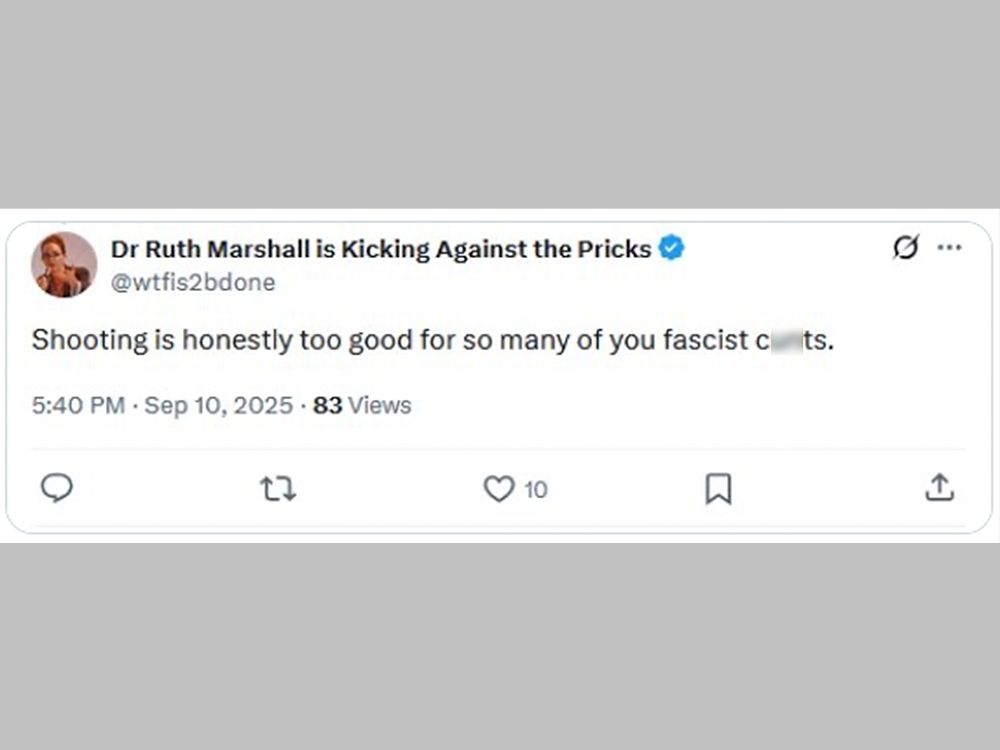
A University of Toronto political science professor, Ruth Marshall, uploaded a post on Sept. 10 reading “shooting is honestly too good for so many of you fascist c–ts.” Marshall’s prior posts have often adopted a loose definition of “fascist,” with the professor at one point referring to a Jewish children’s summer camp as “
.” She later denied that she was posting in response to Kirk’s death, but the university said she is on leave while they investigate.
https://x.com/AllFactsNoHate/status/1966279957782421822
This has all been happening for a while. Only two years ago, Canadian academia similarly
of faculty and campus organizations justifying or cheering the Hamas-led October 7 terrorist attacks against Israel.
Hlimi allegedly did enough of it to
assembled by the Jewish group B’Nai Brith. As recently as Aug. 31, he
“Hamas has the right to exist. Hamas has the right to resist.”
Tawab Hlimi @tawabhlimi is an Associate Professor with @UCalgary we covered before.
Tawa Hlimi’s response to Charlie Kirk being assassinated in front of his children is “Bullseye 🎯💚” and “Charlie Kirk no longer exists…🤣”@libsoftiktok @StateDept @marcorubio https://t.co/u3Oa31K2Qg pic.twitter.com/Wm8ekXUxiE
— Leviathan (@l3v1at4an) September 12, 2025
While the attacks were still ongoing, a McMaster University faculty union posted a jubilant message to social media reading “Palestine is rising, long live the resistance!” A University of Toronto Indigenous studies professor, Uahikea Maile, issued an Oct. 7 statement calling for more acts of “anticolonial resistance.”
Within hours of the October 7 attacks, York University law professor Heidi Matthews posted to social media, “A lot of obfuscation going on about what the right of resistance looks like in brutally asymmetrical contexts.” When a colleague warned against representing Hamas as freedom fighters, Matthews replied “I think I’ll leave it to the Palestinians to let us know what resistance means to them.”
The comments yielded virtually no professional sanctions. In many cases, it was just the opposite.
Matthews not only retains her position, but she’s subsequently been quoted as a “legal scholar” by CBC and the next year was
invited to be a featured speaker
at Memorial University with her talk “From Genocide to Unlawful Occupation.”
Harsha Walia, a former director of the B.C. Civil Liberties Association, appeared at a Vancouver rally celebrating the October 7 attack, and was recorded delivering a speech specifically praising Hamas’s use of paragliders to slaughter revellers at the Nova music festival.
Only a month later,
with a dedicated Toronto event hosted by the American Anthropological Association. Eight academics from seven universities convened for a roundtable “to celebrate the work of Harsha Walia.”
It’s perhaps not surprising that Canadian universities quickly became a hub of the anti-Israel extremism that has defined much of the last two years.
The summer of 2024, for instance, saw illegal “Intifada” encampments established everywhere from UBC to McGill University to the University of Ottawa. The McGill version even
used photographs of armed Palestinian militants
to advertise itself as the site of a “Youth Summer Program.”
When a Montreal anti-Israel demonstrator was photographed last November delivering a Nazi salute and screaming “the Final Solution is coming,” she was right outside Concordia University, where mobs of demonstrators had spent the entire day
to classrooms and campus spaces.
And this is all occurring on campuses where rising numbers of Canadian students are reporting discomfort with the extremism around them, and are actively censoring their own views to avoid sanction at the hands of faculty or administrators.
A recent report by the Aristotle Foundation for Public Policy found that
nearly 40 per cent of Canadian university students
considered themselves moderate or conservative, but diligently concealed these beliefs for fear they would be punished by instructors or investigated by campus authorities.
“Liberals basically feel free to say anything they want on any subject, regardless of consequences — that’s not an overstatement — while moderates and conservatives and libertarians feel like they have to radically self-censor, if they want to avoid consequences for their beliefs,” the foundation’s research director David Hunt
.
As Canadian universities once again produce a stream of public statements cheering political violence, the only difference this time seems to be a modicum of recognition from management that things might have gone too far.
Shortly after Marshall issued her “fascist c—ts” post, the University of Toronto announced that she had been placed on leave and was “not on campus.”
@UofT Professor Ruth Marshall has joined in group harassment against my videographer on campus.
At least two of the marshals standing in her vicinity have been arrested and charged in relation to their alleged protest activities.
📸 Oct 21, 2024#cdnpoli #Toronto #ProtestMania https://t.co/EDESMHGgFp pic.twitter.com/8loD4aYye2
— Caryma Sa’d – Lawyer + Political Satirist (@CarymaRules) October 23, 2024
Nevertheless, as of press time, no similar sanction has accorded to McGill University associate professor William Roberts, who recently called for Canada to send military aid to the terrorist groups Hamas and Hezbollah.
“We … need to begin supplying, supporting and even arming the Palestinian and Lebanese forces that can resist Israel,” Roberts, a vice-chair of McGill’s Committee on Student Discipline, explained in an interview with Postmedia.
As Roberts’ employer told local media, “McGill is aware of the comments made last week by a faculty member. When faculty members express themselves, they don’t speak on behalf of the institution.”
IN OTHER NEWS
It’s been nearly a year that the Government of Canada officially announced that a terrorist group, Samidoun, was
on the country’s West Coast. And yet, in the months since, Canadian authorities have done remarkably little to break up, interdict or arrest the members of said terror group. As critics have pointed out for months, the federal government didn’t even get around to pulling Samidoun’s non-profit status. This week, Industry Minister Mélanie Joly said
she’s going to have someone look into that
. “It is completely unacceptable that any organization listed as a terrorist entity by the Government of Canada continues to exist as a federally registered not-for-profit organization,” she wrote in a social media post.
Get all of these insights and more into your inbox by signing up for the First Reading newsletter.

