



First Reading is a Canadian politics newsletter curated by the National Post’s own Tristin Hopper. To get an early version sent directly to your inbox, sign up here.
TOP STORY
As the Carney government seeks to curb the sky-high immigration levels hit in the aftermath of COVID-19, any reduction in permanent residents is mostly happening thanks to Ottawa slashing the number of refugees being offered upgraded immigration status.
Also, the immigration cuts are mostly happening in regions outside of Ontario and Quebec, with both those provinces still mostly on track to dodge the reduced immigration targets pledged last year by the Liberals.
That’s all according to immigration data provided to the National Post by the Metropolis Institute.
“There has been much speculation about whether the Government will reach the targets but much less attention directed at how it will go about doing so and what categories of immigrants will be most affected,” wrote Jack Jedwab, president of the Metropolis Institute, in an accompanying analysis.
Jedwab found that the number of permanent immigrants entering Canada as skilled workers or to join family has been largely unaffected by Liberal immigration cuts. What’s more, the lowered immigration is not uniform across Canadian regions.
But what has gone down dramatically is what Jedwab calls the “easier go-to”: Refugees being upgraded to permanent residency, typically the last stop before being given full citizenship.
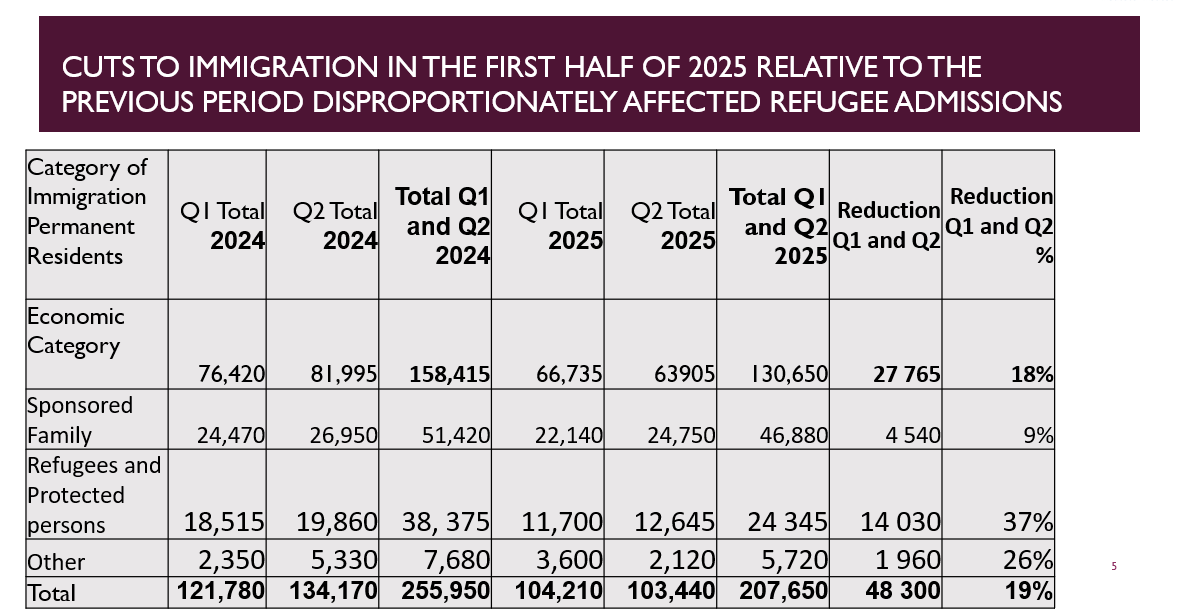
In the first two quarters of 2024, 38,375 people already in Canada as refugees were given status as permanent residents. In the same period in 2025, only 24,345 refugees received the same treatment – a reduction of 36 per cent.
Canada’s other immigration streams did see slight reductions, but not nearly to the same extent.
The number of permanent residency cards handed to newcomers entering Canada as part of family reunification was cut by about 10 per cent. In the first six months of 2024, 51,420 people entered Canada to join family, as compared to 46,880 who did so in the first half of 2025.
Meanwhile, the number of permanent residents entering Canada for economic reasons (ie: skilled workers or investor immigrants) went from 158,415 in the first half of 2024 to 130,650 in the first half of 2025 — a reduction of 18 per cent.
Numbers also show that cuts to permanent immigration are not being felt equally across the country, with Central Canada largely receiving the same number of permanent residents as before Ottawa’s promised immigration cuts.
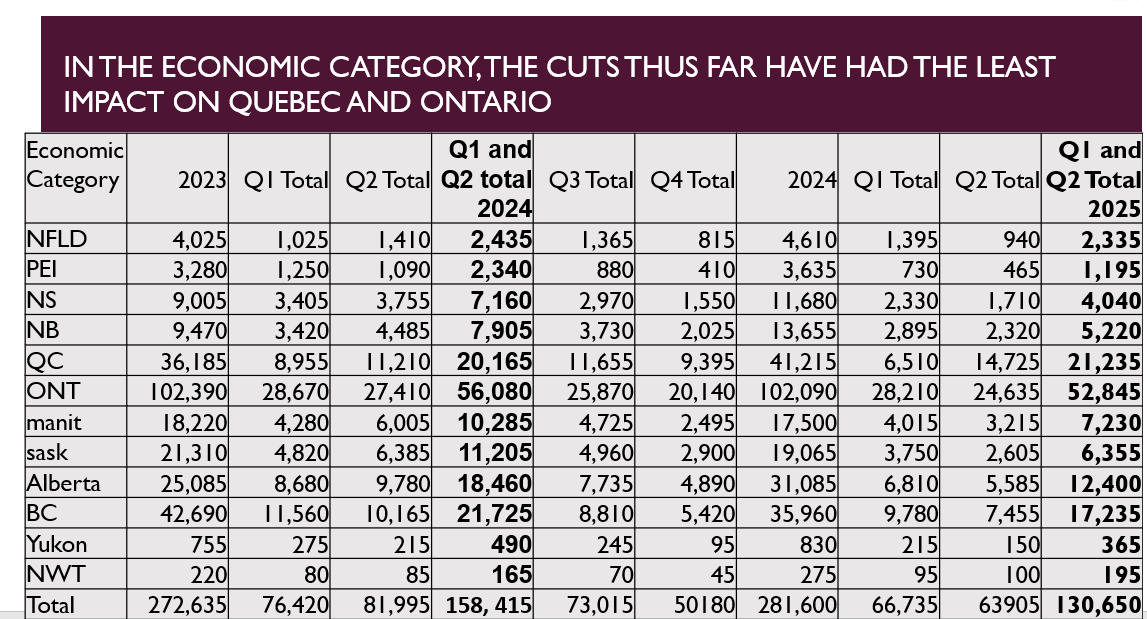
The prairies and the Atlantic provinces saw comparatively sharp reductions in new permanent residents. P.E.I., for one, saw the figure cut in half. In the first half of 2024, P.E.I. saw 2,340 permanent residents as compared to 1,195 in the first half of 2025.
The trend was much the same in Saskatchewan, with permanent residents dropping from 11,205 in the first half of 2024 to 6,355 in the first half of 2025.
Quebec, by contrast, is the only province in which the number of new permanent residents has gone up. From 20,165 in the first two quarters of 2024, to 21,235 in the first two quarters of 2025.
The equivalent figures for Ontario are 56,080 to 52,845.
In October, the Liberal government under then prime minister Justin Trudeau
promised to “turn off the taps” on Canadian immigration
, with pledged reductions to both the number of permanent residents entering the country, as well as the number of foreigners entering Canada on temporary visas.
As a backgrounder explained at the time, this was being done to put immigration levels more in line with “community capacity.”
While Ottawa had initially been planning to approve 500,000 new permanent residents in 2025, under the new plan this was dropped to 395,000.
Last month the
that Ottawa is on track to miss those lower targets. In the first seven months, Canada accepted 246,300 new permanent residents. At that rate, Canada is on track to bring in 422,000 by year’s end.
Although, in an email to the National Post, a spokesperson for Immigration, Refugees and Citizenship Canada said “we are on track to meet our target of 395,000 new permanent residents this year … this represents a 21% reduction compared to 2024.”
Jedwab told National Post he expects Ottawa will end up missing the 395,000 figure, but that this is to be expected when dealing with immigration streams that have application processes of several years.
“It’s not a process where you can (cut immigration) overnight,” he said.
Reducing the number of refugees getting permanent residency will bring Ottawa closer to the 395,000 target, but it isn’t really affecting population growth, since it’s largely just changing the status of people who are already in the country as refugees.
But Jedwab notes that Canada has simultaneously witnessed a dropoff in asylum claims, which is likely to reduce the raw number of people in the country as refugees.
By this point in 2024, more than 100,000 people had claimed asylum in Canada – including outsized rates of foreigners on student visas claiming asylum just as their term came to an end.
As of Aug. 1, the number of new asylum claimants for 2025 stands at 57,440.
IN OTHER NEWS
The Montreal Gazette has
obtained an official guidebook
handed out to Quebec civil servants informing them how to interact with English speakers. Even if the civil servant speaks English, the protocols tell them they must repeatedly prompt the citizen to instead speak French, to the point of informing them that undue communication in the language could be a violation of the law. This process may involve handing the English speaker a French-language pamphlet detailing as much. Only after all those steps are completed can English potentially be spoken. “After taking all reasonable measures, (employees) should exercise judgment and take the necessary steps to ensure appropriate communication,” it reads.

Get all of these insights and more into your inbox by
for the First Reading newsletter.