


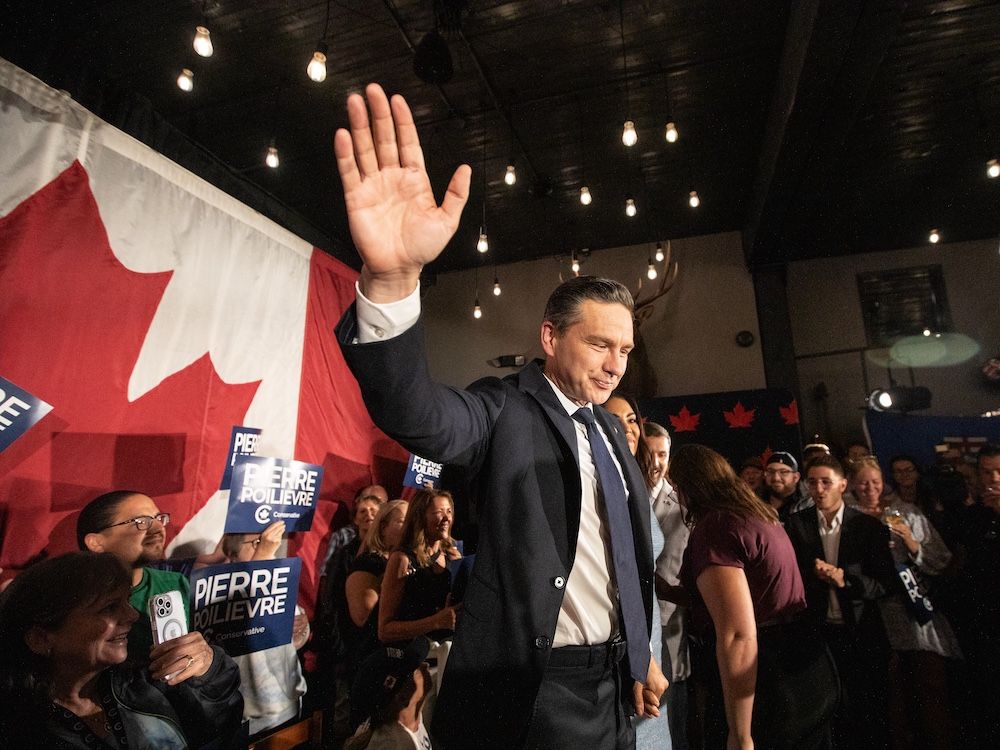
Conservative Leader Pierre Poilievre easily won Monday’s Battle River-Crowfoot byelection with 80.4 per cent of the vote. If anyone actually expected a different outcome in this extremely safe Alberta riding, they were fooling themselves.
While his victory wasn’t surprising, the fact that he was in this potentially precarious position to begin with certainly was.
Poilievre had served as an MP since 2004 in two Ottawa-based ridings: Nepean-Carleton (redistricted in 2012) and Carleton. He lost to little-known Liberal candidate Bruce Fanjoy in the April 28 election. Several factors likely contributed to it, including: voters having turned away from Conservative candidates in the Ottawa region, concerns related to U.S. President Donald Trump and tariffs, and, as Poilievre suggested in a July 12 interview with CBC’s The House, his campaign promise to cut public service jobs led to a “very aggressive campaign, particularly the public sector unions … to defeat me on that basis.”
No matter the reason or reasons, Poilievre needed to find a new parliamentary seat. This occurred when Conservative MP Damien Kurekresigned from his Battle River-Crowfoot seat and opened the doors to a byelection.
Battle River-Crowfoot has long been regarded as one of the safest Conservative ridings in Canada. Many residents in this rural Alberta riding have a fiscally conservative approach to politics and economics and socially conservative sensibilities. While the independence movement in Western Canada has some sway in these parts, its overall impact clearly didn’t affect the byelection result.
The safeness of the seat didn’t stop a slew of comments from the media and candidates like Bonnie Critchley, the independent military veteran who finished a surprising second in Battle River-Crowfoot, that Poilievre was an outsider in this race, and so would be at a disadvantage. While it’s true that he had never lived in the riding, he was born and raised in Calgary and didn’t move to Ottawa until 2000. Nevertheless the separatists in the riding pushed the narrative that because he called himself patriot, he didn’t have the riding’s best interests at heart — or the province’s. They also pointed to his support of equalization payments and supply management as evidence of this.
It didn’t amount to much. This is one of the safest Conservative seats in Canada, and any perceived weaknesses in Poilievre’s policies and beliefs was clearly exaggerated by his opponents.
The riding’s current boundaries were created during the federal re-election distribution in 2012. There hasn’t been a close election result to date. Kevin Sorenson won with 47,552 votes, or 80.91 per cent of the vote, in 2015. He was replaced by Damien Kurek, who won with 53,309 votes (85.49 per cent), 41,819 votes (71.3 per cent) and 53,684 votes (82.84 per cent) in 2019, 2021 and 2025, respectively.
It’s true that byelections have historically witnessed smaller voter turnouts and occasional upsets. The Longest Ballot Committee, an activist movement that has flooded ballots in several ridings with pro-proportional representation candidates with little to electoral effect, attempted to be a minor nuisance in the race, as they had been in Carleton. All that being said, only a village idiot would have believed a non-Conservative candidate would win in Battle River-Crowfoot.
Some of Poilievre’s critics in the political and media chattering classes to openly muse whether he had forced Kurek to abandon his seat. Just asking questions, as the nattering nabobs of negativity often like to say. The allegation was baseless, and Kurek has denied it on several occasions. (The former MP became a principal at Upstream Strategy Group, a government relations and public affairs consultancy firm, on July 4.) Poilievre described Kurek’s decision as “selfless.”
Then again, what if Poilievre had actually done this?
No Member of Parliament is entitled to hold a parliamentary seat in a particular riding until the end of time. (Some of them may think so in the quieter moments, but that’s just delusional.) If there’s a reason or necessity to step down, he or she may not like it privately but it’s always important to be a team player publicly. It’s also not unusual for party leaders to run in seats perceived as being safe entry points to Parliament Hill. Former prime ministers Brian Mulroney, Jean Chretien and Stephen Harper all had to do this in their political careers. There have also been instances where it didn’t work out, including former prime minister Arthur Meighen’s stunning 1942 byelection loss in the old Toronto riding of York South.
Poilievre didn’t face the same political fate as Meighen before him. He now has a new seat in the House of Commons and a renewed opportunity to become our national leader. When the fall session of Parliament begins, his focus will be squarely on toppling Prime Minister Mark Carney’s Liberal government in short order. As it should be.
National Post

