



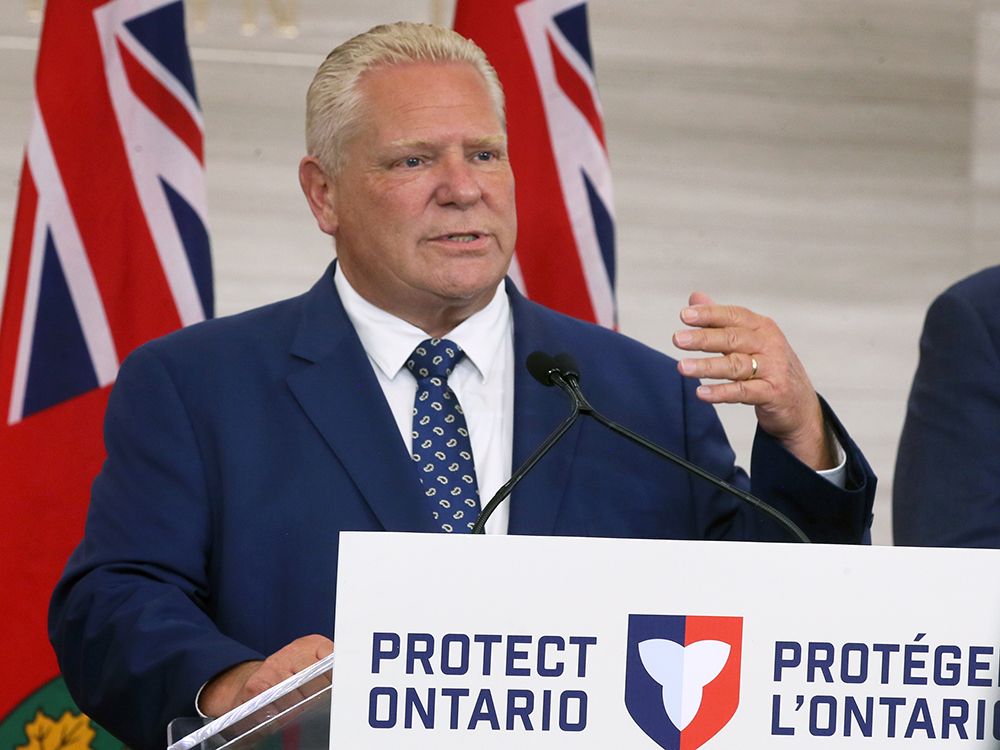
Self-awareness is seldom cited as one of Ontario Premier Doug Ford’s main characteristics, but can he really not see the hypocrisy of his “We are taxed to death” comment this week? For Ontarians, Ford is one of the people doing the lethal taxing.
Ford apparently thinks high taxes are a problem for someone else to solve. The premier is meeting with Prime Minister Mark Carney next week
. OK, but Ford hasn’t even kept his own 2018 campaign promises to cut business and income taxes. Carney, by contrast, is cutting personal taxes, if modestly.
Back in 2018, Ford promised a one-point cut to the second personal income tax bracket and a reduction in corporate taxes from 11.5 per cent to 10.5 per cent. Ford still hasn’t implemented either one.
It certainly wasn’t because government revenues were flat. In 2019-20, Ford’s first full year, the tax take was $108.2 billion. The latest update this week says it will be $153.7 billion this year.
The combined federal and provincial top marginal income tax rate in Ontario is 53.53 per cent. That’s
third highest of any jurisdiction
in Canada and the U.S.
Ford would now have you believe that tax cuts are just what the economy needs to combat President Donald Trump’s tariffs. As the premier put it, “It’s economics 101. Put money in the people’s pockets and they are going to go out and spend it. It is as simple as going out to dinner, buying a pair of sneakers, buying a pair of jeans; it stimulates the economy.”
If that’s what the Ontario economy needs, Ford should lead by example and cut some of his own taxes. Eliminating the $3.8 billion land transfer tax would lower housing prices. Paring back the province’s $40 billion sales tax take would certainly stimulate consumer spending. And yet, Ford has done next to nothing on the tax front, fiddling with gas taxes and road tolls.
Despite his own tax track record, Ford seems to think that he can squeeze an additional tax cut out of Carney, even though the Carney government says its income tax cut will cost $27 billion over five years. As well, the Carney government has made expensive defence spending commitments and is likely to face a
this fiscal year.
What does Ford expect to get from the meeting with Carney, except egg on his face?
Ford is desperately searching for something that would help him live up to his election promise to protect Ontario from American tariffs. High tariffs on autos, steel and aluminum will hurt the provincial economy, but the premier has never had the tools to combat them, despite his tough talk during the election.
Wednesday, he announced that the government would
dole out the first $1 billion in loans
from its $5-billion “Protect Ontario Account.” The government will lend businesses money in the hope that it might tide them over until the tariff problem magically disappears.
The Ford government even hopes that businesses would borrow government money to keep workers employed. Why would they, if there isn’t a market for the products or services they produce?
The difficult truth that both Ford and Carney have to face is that Trump’s tariffs are likely to cause long-term damage to some highly visible sectors of the Canadian economy.
It’s easy to talk about diversifying trade to other countries, but harder to do. Without U.S. market access, Ontario’s steel, automobile and aluminum industries will be, at best, much smaller. Trump’s anti-EV approach also makes the federal and provincial “investments” in EV battery plants look like a bad bet.
A politician’s natural instinct is to “protect” endangered jobs with the liberal application of public money as Ford is doing, but all that does is increase business’s dependence on government help. That’s unsustainable. It’s worth noting that e-commerce company Shopify has become Canada’s largest corporation by market capitalization without taking government money.
Ford also wants tax cuts, on someone else’s dime, but broad-based tax cuts to enable more sneaker sales are an ineffective use of money. Right now, American tariffs are a big problem in three sectors. Giving everyone a little bit of money won’t fix that. Ford should have learned that when he spent $3 billion to give almost everyone in Ontario $200.
In truth, both Ford and Carney lack the leverage to really stimulate the economy. Ontario has a $1.1 trillion gross domestic product. Canada’s GDP is nearly $3 trillion. A billion dollars of stimulus here or there is like someone trying to speed up an ocean liner by using a handkerchief as a sail.
Right now, the best thing Ford can do is leave the tariff problem to Carney and concentrate on delivering an effective government with a balanced budget.
Randall Denley is an Ottawa journalist. Contact him at randalldenley1@gmail.com

