



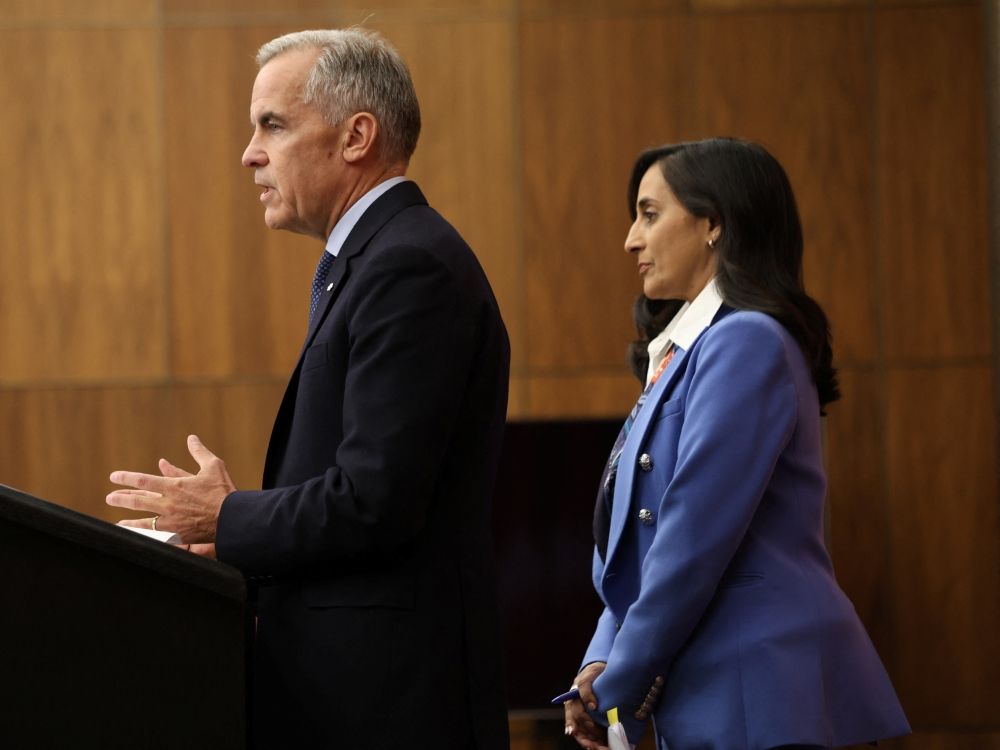
With Prime Minister Mark Carney’s declaration last week that Canada plans to recognize a Palestinian state in the fall, he sent chills down the spine of Canada’s Jewish community. By effectively demonizing Israel, he opened the floodgates for more antisemitic acts in Canada.
The prime minister’s
lists four factors that are “steadily and gravely” eroding prospects for a two-state solution: West Bank settlements, the Knesset’s vote calling to annex the West Bank, the humanitarian crisis in Gaza and Hamas terrorism (the government did not criticize, or even mention, the Palestinian Authority’s
which rewards the families of terrorists).
This is a head-scratcher since Israel made two offers in 2000 and 2008 that would have created a Palestinian state. Each was rejected by the Palestinian Authority, which would not give up the right of return for 3.5 million Palestinians. In 2005, Israel’s unilateral withdrawal of security forces and settlements from Gaza failed to make peace; instead, it led to a failed terrorist state controlled by Hamas.
As pointed out by
last Friday, Carney put the cart before the horse by offering to declare a Palestinian state in exchange for future hollow promises of demilitarization and democratization
— a trade
that makes it even more difficult to achieve a ceasefire and secure the release of hostages. Instead, his offer rewarded Hamas’s genocidal October 7 attack. Hamas leader Ghazi Hamad
for changing international attitudes in this way: “We are the ones who brought the issue back to the forefront, and that is why all the countries are starting to recognize a Palestinian state,” he said in a recent interview with
Al-Jazeera.
This is concerning to Canada’s Jewish community because antisemitic acts are reaching historic highs: in 2024, a record of 6,219 antisemitic incidents were counted in B’nai Brith’s
. The Jewish Educators and Families Association of Canada
earlier this month that “Carney’s call gives cover to activist educators who can now claim they are justified in bringing one-sided, hostile narratives into the classroom.”
These concerns are rooted in a history of antisemitism in Canada, sometimes perpetuated by past federal Liberal governments. Ever since Ezekiel Hart, the first Jew elected to Lower Canada’s legislature in 1807, was not allowed to sit, Jews have had to fight for freedoms and combat antisemitism. It was not easy with influential thinkers warning Canadians that Jews control the economy and politicians with secret agencies.
, who came to the University of Toronto in 1871 (after leaving Oxford and Cornell), charged that Jews were parasites, dangerous to the host country and enemies of civilization. While his over-the-top tirades reflected antisemitism in Europe and North America at that time, he was influential with two later Liberal politicians, Quebec’s Henri Bourassa (an MP from 1896 to 1907), who later recanted his antisemitism, and William Lyon Mackenzie King, who served three nonconsecutive terms as prime minister between the years 1921 and 1948.
On the positive side, Wilfred Laurier, Liberal prime minister from 1896 to 1911, opened the doors to immigration prior to the First World War and allowed many Jews to escape from pogroms in Poland, Romania and Russia. Canada’s Jewish population rose from
in 1901 to
by 1914 (four per cent of the 2.5 million total immigrants).
Despite the small Jewish population, antisemitism surged in the interwar period in Canada and reached its pinnacle during the Great Depression. Jews faced discrimination in employment, property ownership and university admissions. Maurice Duplessis, Quebec’s Union Nationale premier for all but five years between 1936 and 1959, and William Aberhart, Alberta’s Social Credit premier from the mid-1930s to the mid-1940s, were well known for their antisemitism. In 1938, then-prime minister Mackenzie King,
in his diaries that Jewish immigration would pollute Canadian blood.
Despite the desperate need for Jews to escape Nazi-controlled Europe, Canada would only take on average 400 Jews each year from 1933 to 1945. The worst incident was in 1939, when the Canadian government turned away the MS St. Louis, an ocean liner carrying 900 Jewish refugees, from its ports. Its passengers returned to Europe, some of them going on to
in Nazi death camps.
After the horrors of the Second World War, Jews continued to face discrimination. While Jewish immigration
to 4,000 per year from 1946 to 1956, many employment, housing and social restrictions continued. These barriers even persisted in government: Liberal prime minister Louis St. Laurent (in office from 1948 to 1957) did not want to make Louis Rasminsky governor of the Bank of Canada because he was Jewish. As author Bob Plamondon pointed out in his biography of Progressive Conservative prime minister John Diefenbaker, Rasminsky’s appointment was left to Diefenbaker to make in 1961.
Eventually, Jewish restrictions melted away, starting with Diefenbaker’s human rights code of 1960 and Pierre Elliott Trudeau’s Charter of Rights and Freedoms of 1982. Trudeau appointed the first Jew to federal cabinet, Herb Gray, in 1969 and the first Jew to the Supreme Court, Bora Laskin, in 1970. Clubs began to open for membership. Chartered banks no longer shunned Jews as corporate directors and senior executives. The Harper government signed the Ottawa Protocol on Combating Antisemitism in 2011 and withdrew funding from the United Nations Relief and Works Agency for Palestine Refugees (some of that funding was
by Justin Trudeau’s government). The International Holocaust Remembrance Alliance (IHRA) definition of antisemitism was
by the Canadian government in 2019.
Since October 7, 2023, antisemitism has been rearing its head once again. Jews have witnessed demonstrations calling for the destruction of Israel from river to sea, white supremacy, bomb threats of Jewish schools and institutions, intimidation, harassment, vandalism and the glorification of terrorism. Jews feel threatened, spending vastly more on security at their institutions. Some have even left Canada for Israel and the United States for safety reasons.
It is this backdrop that makes Canadian Jews worried about Canada’s disparagement of Israel without keeping a more balanced approach in mind. Many argue that criticism of Israel is not antisemitism. Even Israelis themselves debate the Netanyahu government’s actions. However, as the Canadian government’s own definition makes
, antisemitism arises when it goes too far, such as conflating Jewish self-determination with racism and comparing Israel to a Nazi state.
Whether the Liberal party likes it or not, it now faces a challenge from antisemitism. To overcome it, it needs to emulate the Liberals of the 1970s — not the 1930s.
National Post
Jack Mintz is the president’s fellow at the University of Calgary’s School of Public Policy.

