


Have you returned from a grocery store this summer after having dropped a small fortune on a steak, only to peel it off the barbeque to find it just wasn’t that satisfying?
It may not have been just the price that let your taste buds down. While the price of beef has
since January — leading to price increases in popular grilling cuts like striploin, up 34 per cent, top sirloin, up 34 per cent, and rib cuts, up almost 12 per cent — there could be another reason why your steak left you with a bad taste in your mouth.
Unbeknownst to you, the Canadian consumer, the steaks you purchased for your backyard Canada Day barbecue could have come from the United States (or Mexico or New Zealand or Australia) despite not having been marked as such.
According to Sylvain Charlebois, who runs the Agri-Food Analytics Lab at Dalhousie University and hosts the popular podcast, “The Food Professor,” “Beef has been off this summer, both in terms of quality and price stability.” He pointed to lower cattle numbers due to drought, and more imported beef on the shelves.
According to the Government of Canada, beef and veal imports
to 208,929 tonnes in 2024, from 186,629 tonnes in 2023.
“A few key factors are likely at play. First, we’re still seeing the ripple effects of drought-induced herd reductions across North America. The cattle supply has been tight for a couple of years now, and we’re at the stage where it’s really starting to impact availability and price at the retail level,” Charlebois told told the National Post in an email.
“Less beef overall means higher prices and more volatility. We are seeing more beef from Mexico and Australia in Canada as a result.”
According to the Canadian Cattle Association, “It will take time to rebuild the North American cow herd. The Canadian cattle herd is the smallest it has been since 1988, and in the United States, the cattle herd is the smallest it has been in 73 years.”
This is significant because Canada’s beef grading system is different than in other countries, most notably the U.S.
According to Charlebois, “While both countries (Canada and U.S.) grade beef based on quality, the systems differ in focus and structure. In Canada, grading is overseen by the Canadian Beef Grading Agency, with four main categories: Canada Prime, AAA, AA and A — largely based on marbling.
“The U.S. system, managed by the USDA (United States Department of Agriculture), also emphasizes marbling but includes more detailed carcass maturity assessments and broader use of branded programs like Certified Angus Beef. Canada’s system is more standardized, while the U.S. approach is more market-driven and fragmented, especially at the premium end.”
This explanation was
by Amanda Bennett, executive director of the Canadian Beef Grading Agency, who pointed out some key differences between Canadian and American beef: “Canada’s quality grades of Canada Prime, Canada AAA and Canada AA grades are correlated in the marbling levels but the Canadian grades do not allow dark coloured meat, yellow fat, older animals or other off-quality characteristics.”
It’s possible, then, that a lack of consistency in foreign standards might mean that imported beef tastes different, and if there is more of it on the shelves, it could partially explain the more pronounced differences in flavour this summer compared to previous years.
I visited the meat sections of four grocery stores in the Toronto area to speak to butchers about the rising price of beef, its quality and the availability of different cuts. They all remarked that the price had risen quickly, and said that due to this, they were no longer (or very rarely) ordering some premium cuts like T-bones, because many customers simply can’t afford them anymore.
What was more interesting, however, was what happened when the conversation turned to quality. The first butcher I spoke with at a Metro store noted that the aging process is different between American and Canadian beef and the cattle are fed differently. This, he explained, may affect the taste.
I asked him how I would even know I was buying American beef, as I did not see any labels that would indicate that the items weren’t Canadian. He said that there was no way to tell. The labelling does not show this information.
He pointed to a grilling steak in his display case and said, “The only way to know would be for the butcher to check the boxes out back.” When I asked him to write down his name for the interview, he seemed very nervous about what the company might think of him revealing this information.
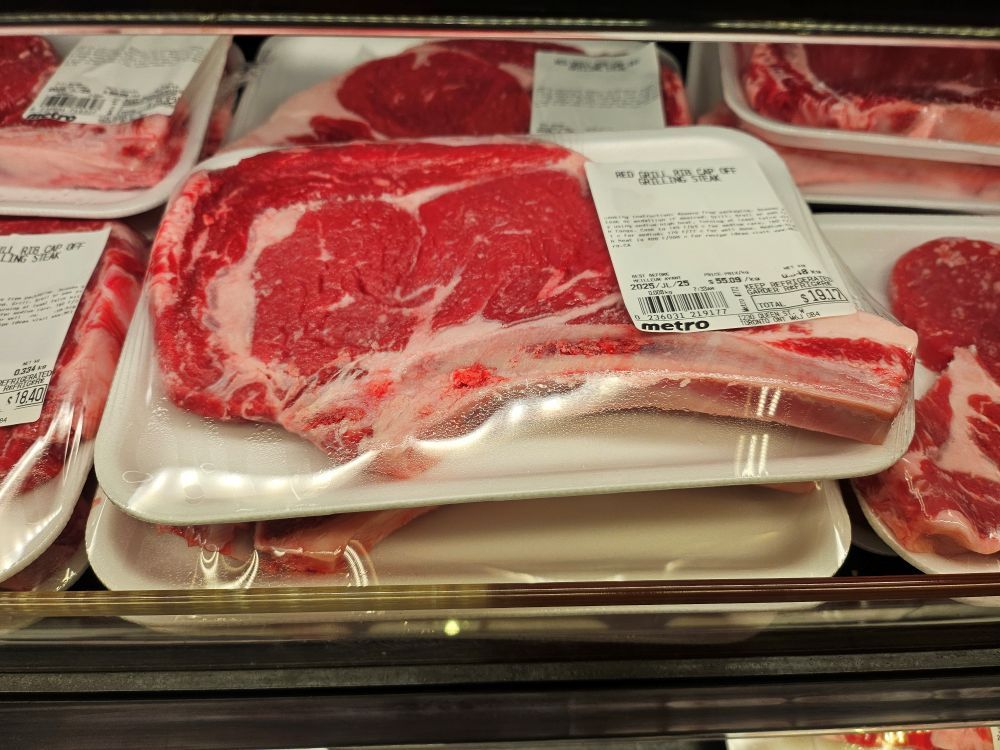
Some Canadians would probably be surprised to learn that the absence of a label specifying that the meat was imported doesn’t mean that it’s Canadian. Many who believe they have been giving the ol’ elbows up to American beef may have, ironically, only been consuming American beef, if they haven’t been checking very carefully.
This practice would at least appear to contradict the
laid out by the Canadian Food Inspection Agency (CFIA), which state that the country of origin “must be declared on the label of an imported meat product in close proximity to the product’s common name.”
The rules further state that, “This applies whether or not the imported meat product is subsequently packaged or labelled in Canada without being manufactured or prepared in Canada.”
Next, I spoke with a butcher at a Longos store who informed me that this would not be an issue at its locations, since “it’s all only Canadian beef. We don’t sell anything American.”
I stopped by another Metro store to see if the labelling practice was shared by another location. I asked a fellow working behind the counter making sausage if he’d noticed a difference in the quality of the meats. “There’s only been a couple of things that came in and I was like, this is smaller than it used to be, striploins,” he said.
Asked if they came from Alberta or everywhere, he responded: “Honestly, I couldn’t tell you where it came from. The boxes were there. We worked them, we noticed they weren’t very good. Got rid of them. That was it.”
When questioned about where the meat comes from, he said that, “The chicken is almost 99 per cent Canadian. The beef and the pork, one day we could get 10 cases of back ribs and it’s all Canadian, and the next day we get two cases of American.”
Yet “none of the labels would tell you. That’s what the little flags are for,” he explained, pointing to signs sitting above a bin of meat. “Every couple of hours, they’re constantly revising it in terms of what is and what isn’t (Canadian).”
Again, there was nothing on the individual packages of meat to indicate whether the beef is foreign or homegrown, just flags or signs being shifted around to indicate whether beef is Canadian.
I spoke to a fourth butcher, this time at a Loblaws store, who confirmed that if it is not marked, there is no way for consumers to tell if the beef they are buying is from the United States or elsewhere.
At this location, a display case with unpackaged prime cuts featured some pieces of meat with flags indicating that they were Canadian. However, other meats in the case did not have any country-identifying information.
There were packages of beef marked “Canadian Beef,” with stickers saying, “Pick the Beef with the Leaf,” and clearly displaying a black Canadian flag with “Canada” written in the centre on each individual package.

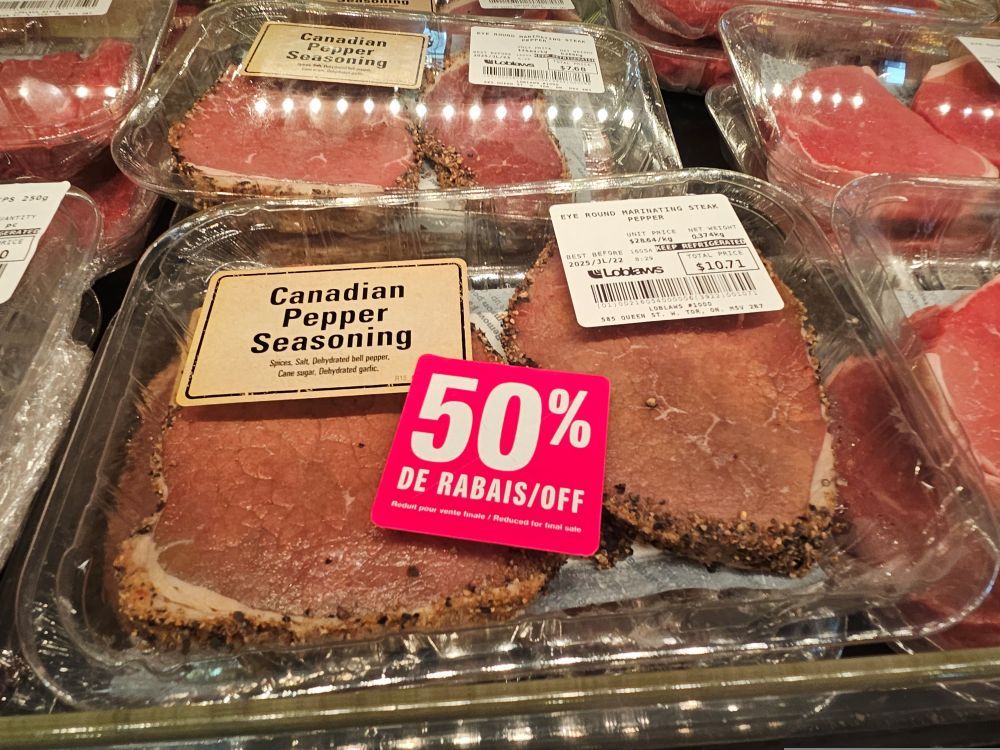
However, there was also beef that was unmarked. For example, a section filled with stewing beef, striploins and eye round marinating steaks with and without “Canadian Pepper Seasoning” did not bear the same Canadian symbol on the individual packages.
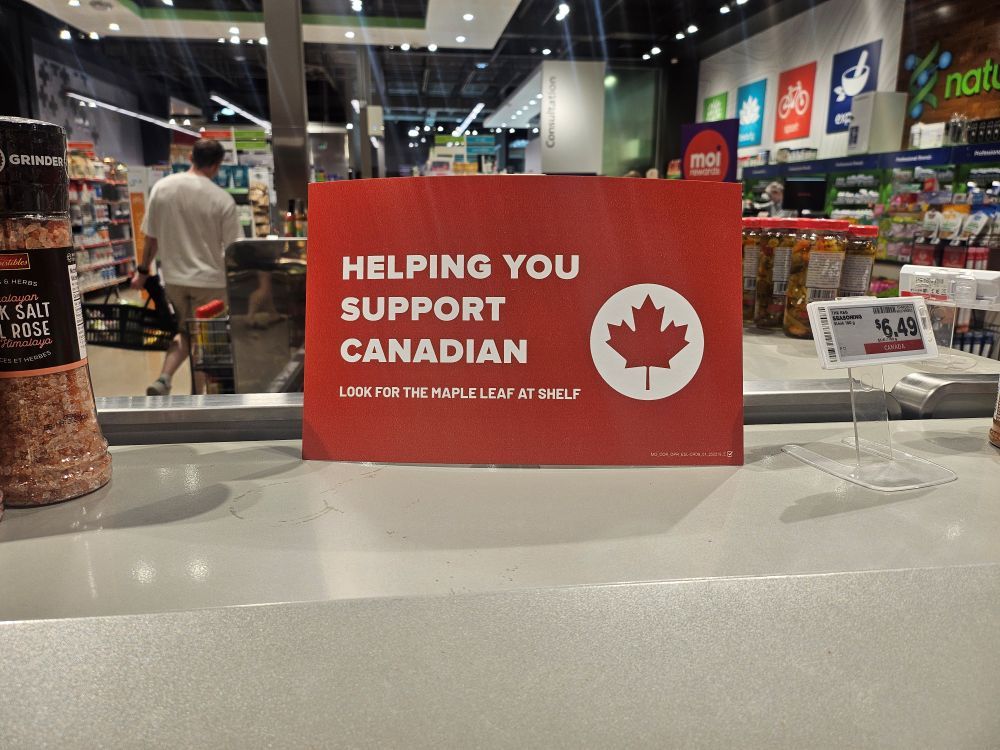
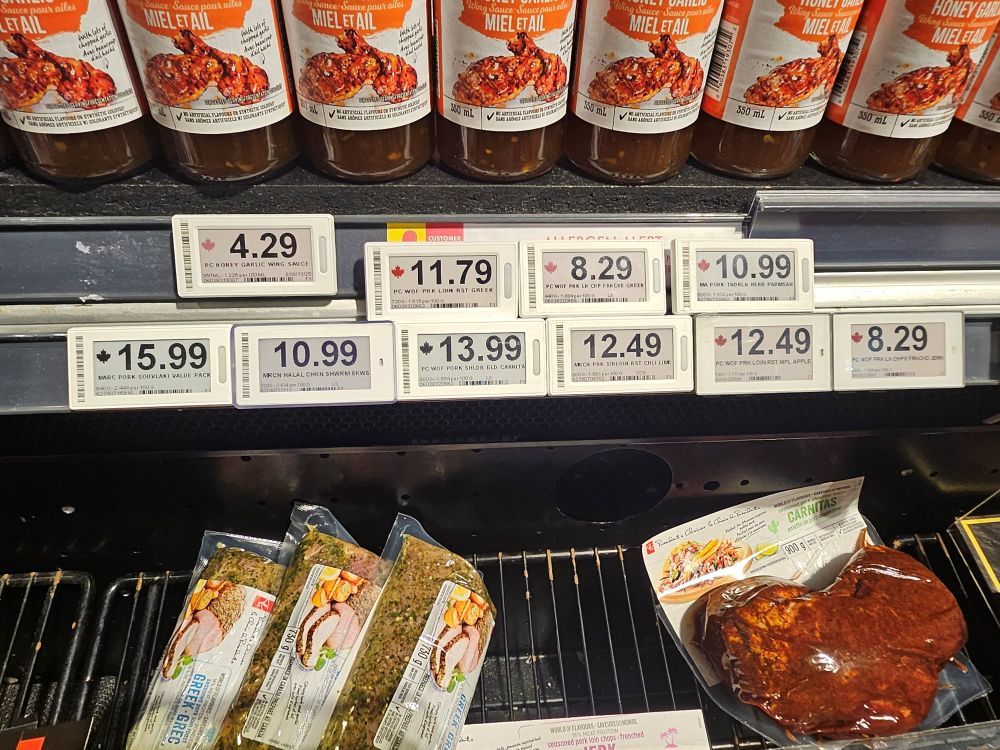
The Loblaws butcher did, however, point to price tags above one bin of meats that had Canadian flags on it. These, he told me, were brought in as part of the “Buy Canadian” movement against U.S. President Donald Trump’s tariffs. But these weren’t everywhere in the store. In this location, they were above some vacuum-sealed, pre-seasoned pork products.
Grading requirements aside, I needed to determine whether the butchers were correct about Canadians not being able to tell if their meat is not Canadian.
I contacted Metro, Loblaws and the CFIA to ask why, as per the butchers I spoke with, there appears to be a lack of clarity around the labelling of meats from foreign countries, despite the rules posted on the food agency’s website.
I asked Stephanie Bonk, communications manager for Metro, if the butchers were correct in saying that beyond marked boxes out back, consumers in the store would not be able to know if their meat was Canadian. Bonk said that Metro follows
, which do not require country of origin labelling.
When I asked about store inspection, Bonk said that, “To ensure compliance with federal and provincial requirements, the stores could be inspected by CFIA and/or” the Ontario Ministry of Agriculture, Food and Agribusiness.
She explained that, “There is no requirement for country of origin on retail meat cuts that are cut and packaged at store level. This would include ground meats, stewing meat, kabobs, stir fry meat, etc.”
Loblaw’s public relations department confirmed that, “In the case of meat, Canadian labelling requirements differ depending on how the product is packaged. For prepackaged meat (i.e., products that come into the store already separated, weighed, etc.), the country of origin is required and indicated on the label.
“However, for meat processed and packaged at the retail level, as is the case in many of our Loblaws stores, regulations do not require country of origin labelling on each package. If the retailer wants to highlight the meat grade, it can be displayed via counter signage.”
Loblaws said that its “approach is aligned with CFIA guidance and ensures consistency across our store network while reflecting the realities of today’s dynamic supply chain.”
I contacted the Canadian Food Inspection Agency to find out if it believed these stores were following its guidelines.
A spokeswoman at CFIA said that, “A meat product that is imported and sold to the consumer in its original packaging must include a country of origin statement, for example, ‘Product of Australia.’ For imported meat products that are re-packaged or labelled in Canada, the country of origin declaration must be displayed on the new packaging.”
However, she also explained that, “When imported meat is further processed in Canada, such as cutting or grinding, the final meat product no longer requires the country of origin statement on its label. However, companies can voluntarily declare or advertise the origin of the meat product as long as it’s not false or misleading.
“For example, the label can include a ‘Made in Canada’ claim with a qualifying statement to indicate whether the meat is made in Canada from imported ingredients or a combination of imported and domestic ingredients.”
This would appear to contradict the CFIA’s own website, which states that country of origin is required “whether or not the imported meat product is subsequently packaged or labelled in Canada without being manufactured or prepared in Canada.” (I asked about this contradiction, but did not receive a response by press time.)
The spokeswoman did, however, note that that, “Consumers can use the address on the label to contact the company, or inquire with the retailer, to obtain more information about the food, including the country of origin.”
According to Charlebois, Canadians have
taken notice and have begun to do just that
. He said that the CFIA “
received 97 complaints related to product origin claims between November 2024 and mid-July 2025. It conducted 91 investigations and confirmed 29 violations.” Charlebois sees this as signalling “a growing lack of tolerance for deceptive marketing in the grocery sector.”
Canadian’s shouldn’t have to guess, find a sign or ask their butcher to check the box out back to find out which country their steak is coming from.
National Post
tnewman@postmedia.com