



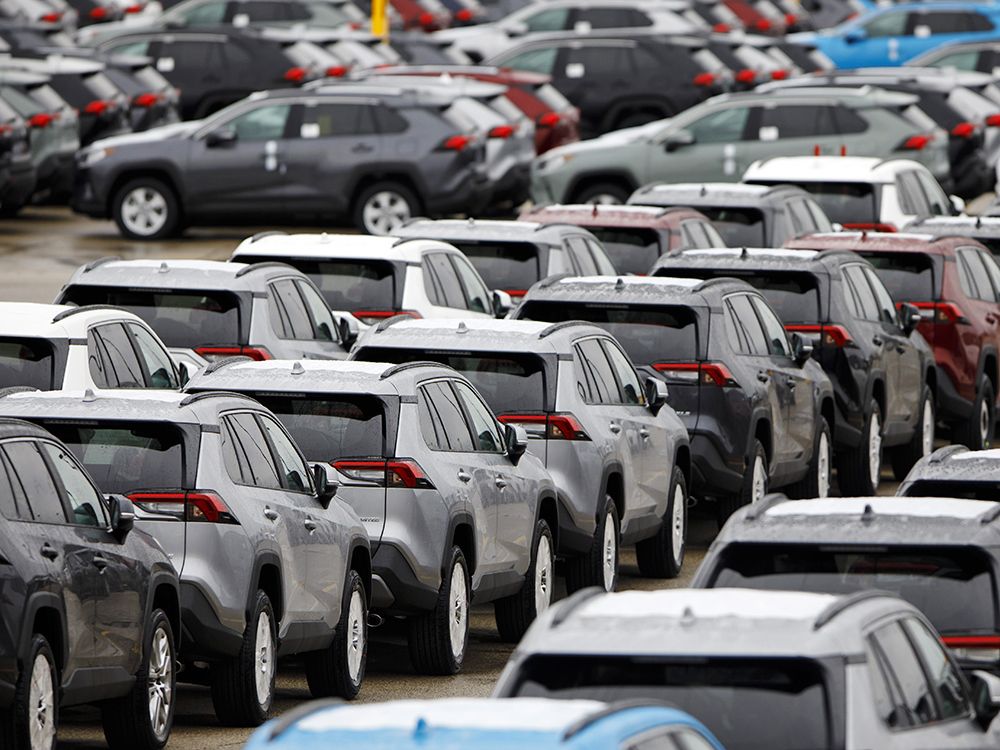
The inherent absurdity of President Donald Trump’s tariff mania was laid bare in the deal he has just announced with Japan.
After it comes into force, a
Toyota RAV4 made in Japan will be charged a tariff of 15 per cent
, while a similar vehicle made in Cambridge, Ont., with two-thirds North American content, will be charged a 25 per cent import levy. Trump has threatened that Canada will face a 35 per cent tariff on all goods not covered by the U.S.-Canada-Mexico trade deal (USMCA), including autos, by Aug. 1 barring any last-minute deal. Needless to say, Toyota is unlikely to continue making cars in Canada for long, if that differential remains in place.
Trump heralded his agreement with Japan as “the largest TRADE DEAL in history” on social media.
The broad terms will see Japan’s 25 per cent tariff rate reduced to 15 per cent across the board, except for steel and aluminium, in return for the commitment to invest US$550 billion in the U.S.
Japan will also buy 100 Boeing planes and hike defence spending with American firms by US$3 billion a year.
The president said that Japan will “for the first time ever” open its market to the U.S. for autos and rice, “which was always a complete NO, NO”.
There is a kernel of truth in this typical bluster: Japan will allow simplified safety checks on U.S. vehicles, which will likely increase U.S. imports from a paltry 16,000 last year. Japan has always allowed a minimum amount of rice to enter the country tariff-free, nearly half of which comes from America. That minimum access framework will remain in place but more of the discretionary amount will come from the U.S.
Trump said he will have a say in where the Japanese invest the US$550 billion and the U.S. will receive 90 per cent of the profits. Let’s check the joint text when the deal is made public to find out if this is another of the president’s subtle untruths.
The old phrase “the beatings will continue until morale improves” was not meant to be taken literally. Yet, news of the deal’s terms was welcomed with the kind of euphoria that used to greet Deep Purple at the Budokan arena in the ’70s.
Pre-Trump, Japan used to pay an average of 1.6 per cent in tariffs. Yet, at the prospect of 15 per cent, stock prices shot up in Japan: Toyota rose 14 per cent; Honda increased by 11 per cent. Auto stocks also rose around the world, including among the Big 3 North American carmakers that remain targeted by high tariffs.
GM said this week that it
took a US$1.1 billion pounding from tariffs
in the second quarter and expects the impact to worsen in the third. The prospect of the Detroit-based giant only being beaten up by a 15 per cent tariff going forward, instead of 25 per cent, saw its stock soar by 6.29 per cent on Wednesday.
Steve Verheul, Canada’s former chief trade negotiator and now a principal at consultancy GT&Co., said the clear inconsistency of penalizing cars made with two-thirds North American content, combined with the losses being reported by U.S. manufacturers, should provide Canada and Mexico with leverage to get a better deal than Japan.
Against that, U.S. Treasury Secretary Scott Bessent said Japan was given the deal “because they were willing to provide the innovative financing mechanism” that he did not think other countries could replicate.
Is the Carney government willing to arrange hundreds of billions of dollars of loan guarantees to invest in Canadian operations in the U.S., and then hand over 90 per cent of the profits? Unlikely.
Goldy Hyder, president and chief executive of the Business Council of Canada, said Canada’s special market access to the U.S. is under increasing threat. “Clearly it isn’t in Canada’s interest if cars made in Japan, Korea, the EU and the U.K. are going to the U.S. at lower tariff rates than from here … We have consistently been pounding on the importance of USMCA and expanding the (non-tariff) exemption,” he said.
Verheul said the Japanese agreement reinforces why Canada should not be in a hurry to get a deal with Trump. “We need to see what others get first, in order to ensure we have preferential treatment in the U.S. market, in comparison to countries outside North America,” he said.
There is another good reason to hold off. As U.S. economist Paul Krugman noted in
, American consumers are still facing a major price shock that could sour voters on Trump’s tariff wars.
There has been a relatively muted effect on consumer prices so far, but there is no evidence that the prices Americans are paying for imports is falling, which is what you might expect if foreigners were really paying for the tariffs.
Instead, Krugman said U.S. businesses are absorbing the costs, rather than passing them on to consumers, by selling off inventory bought before tariffs hit. Importers are hoping that tariffs go away. But if they don’t, inflation is coming, he said.
In that light, Canada should probably hold out until reality bites and Trump’s leverage is winnowed away by rising prices.
National Post

