



The premiers are conferencing this week in Ontario with a scheduled drop-in from the prime minister. Then there will be a news release hopefully reporting incremental progress of some kind — perhaps on trade barriers, infrastructure, more counter-tariffs, or whatever.
But suppose, just suppose, that at some future federal-provincial conference the assembled first ministers are forced to fry much bigger fish. Suppose they are forced to consider major amendments to the constitution — maybe even re-drafting it — because some province, east or west, has actually obtained a “clear majority” in a referendum on a “clear question” to secede.
I know, I know… such a situation is highly unlikely and it is considered unpatriotic to even raise it. But sometimes strange things happen — like a banker becoming prime minister of Canada or the Blue Jays attaining first place in the American League East — so please bear with me. And unpleasant as it may be to many of my generation to even contemplate the word “secede,” that is the word to be used for the sake of clarity if that is in fact exactly what its proponents mean and intend.
According to the federal Clarity Act and the Supreme Court’s interpretation of it, here is what would not happen if some province were to get the support of a “clear majority” of its citizens on a “clear question” to secede. Such a province — notwithstanding the naïve assumptions of some sovereigntists — could not then march merrily into Independence Land. Instead, what would be triggered is a full-blown federal-provincial conference in which the federal and provincial governments would be obliged, according to the Supreme Court, to enter into “good faith negotiations” with the subject province, such negotiations to be governed by such court-enforceable principles as
the rule of law, democracy, federalism, and the protection of minorities.
To implement the results of these negotiations — no matter what they were — would most likely require major amendments to the Canadian constitution, with all of the provinces having a major role to play since significantly amending Canada’s constitution requires the agreement of the federal parliament and at least two-thirds of the provinces having, in aggregate, at least 50 per cent of the population of all the provinces.
In other words, any serious secession attempt and the constitutional negotiations it would trigger, could in effect open the door to a partial or complete overhaul of our constitutional arrangements — a Re-Confederation, if you will.
Just as the original fathers of Confederation were strongly motivated by fear of the United States, so might today’s participants in any re-confederation exercise find themselves influenced by the same fear. And just as the original founders were obliged to promise the building of the Canadian Pacific Railway to secure B.C.s commitment to Canada, so their modern equivalents might find themselves obliged to commit to the creation of a sea-to-sea energy/transportation corridor in order to bind Canada West to the re-confederated entity. Who says history doesn’t repeat itself?
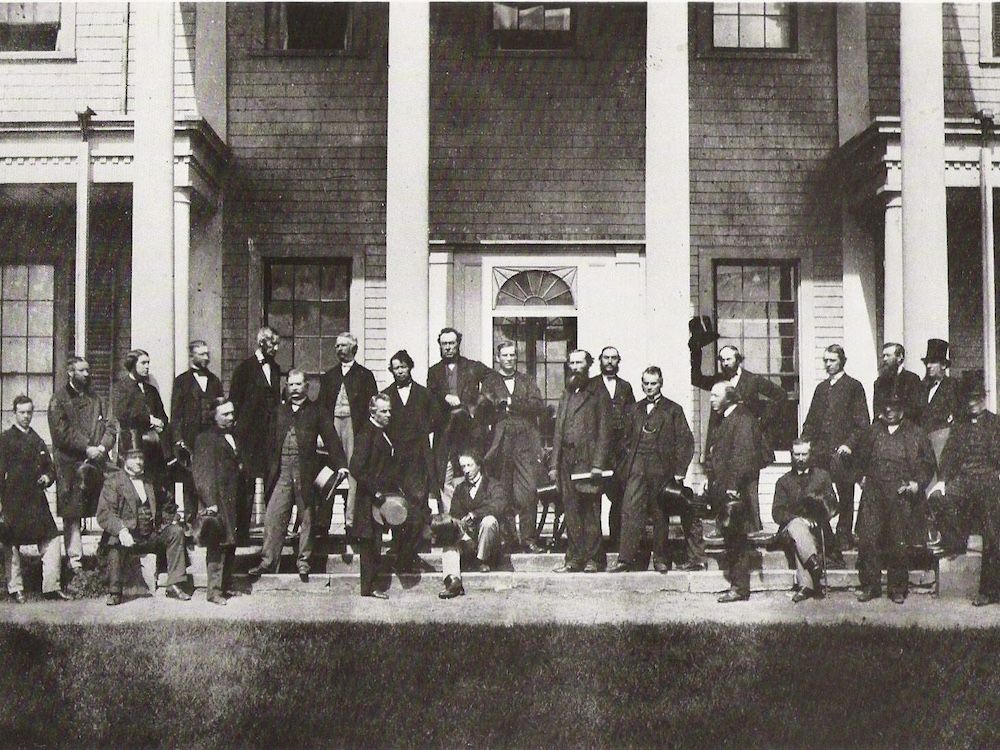
Exploring the potential parallels between the original confederation conferences and any Re-Confederation Conference a little further: who would be the present day equivalents of Charles Tupper and Leonard Tilley, vigorously championing the interests of Atlantic Canada? Who would be the equivalents of George-Étienne Cartier and George Brown, vigorously representing the divergent interests of Quebec and Ontario? Who would be the present day champions of those regions and interests conspicuously absent from the original confederation discussions — the champions of the interests of Canada West, the northern territories, and Canada’s indigenous peoples? And would the re-founders include the equivalent of a John A. Macdonald — someone with the stature, skills, lubricating capacity, and luck required to even keep any Re-Confederation Conference from blowing apart, let alone giving birth to Canada Next?
Finally, what might be the major demands and concessions that the principal participants in such a conference would bring to the re-confederation table?
Quebec would of course be expected to press its sovereignty association demand in one form or another. And this time there is unlikely to be strong and charismatic champions, within or outside Quebec, for “Please Stay, Don’t Leave.” Certainly the current prime minister — an anglophone banker who speaks French poorly and despises nationalism — is ill-equipped to play that role. And under current circumstances, several of the western provinces might be inclined to support Quebec’s ultimate assertion of sovereignty, provided one of the terms of its future “association” with Canada was an ironclad agreement to provide an open energy/transportation corridor across its territory to the Atlantic.
Conceding sovereignty association to Quebec, however reluctantly, might also cause Canada West to rethink its own position within any re-confederated Canada. What if Canada West were to simply take Quebec’s vacated place within the federation — its 3 seats on the Supreme Court, its 24 seats in the Senate, and the majority of its seats in the Commons? Might Quebec conditionally “out” and Canada West more effectively “in,” largely alleviate the strains that both Quebec nationalism and western alienation currently place on the federation?
Besides Quebec arriving at any future Re-Confederation Conference with its well thought out sovereignty-association proposition, it would behoove the other major components of the Canadian federation to think through how they would rewrite the constitution of Canada if they had the opportunity to do so.
Canada West, in particular, should be prepared to come to any such conference with its own clearly thought out redraft of the current constitution — a redrafted constitution in which any future Senate is made democratically accountable and genuinely representative of regional interests; a redrafted constitution in which the currently inequitable equalization formula is made largely unnecessary because Quebec is now on its own and each of the remaining provinces is sufficiently equipped and responsible to carry its own weight; and a redrafted constitution now completely devoid of those current clauses which give the federal government the means of overriding the constitutionally defined division of powers between the central and provincial governments.
And so, Re-Confederation to form Canada Next. Possessor, guardian, and developer of the vast northern portion of the North American continent. Just a pipedream you say? But that’s what many said when those parochial colonials, with all their conflicting interests and passions, first met at Charlottetown to begin the creation of the original Canadian federation. Can we not do as well or better than they, if the times and circumstances were to demand that we do so?
Preston Manning is a former leader of the Opposition.

