


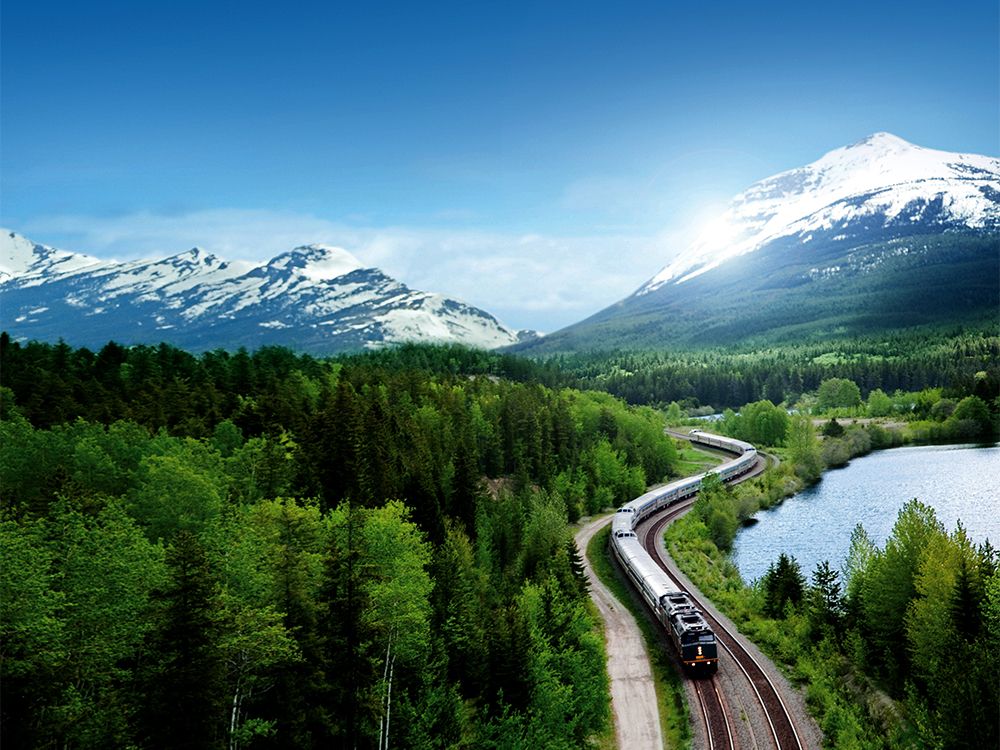
ON BOARD THE CANADIAN — One hundred and fifty years ago, on the left bank of the Kaministiquia River, four miles from Thunder Bay, the first sod was turned for the main line of the Canadian Pacific Railway. It was a June afternoon in 1875.
“We have met today for no other purpose than to inaugurate the beginning of the actual construction of the Canadian Pacific Railway,” said Judge Delevan Van Norman to the assembly of some 500 dignitaries.
In this sesquicentennial summer of patriotic holidays prompted by the American menace — or more precisely, one menacing American — when better to board The Canadian, Via Rail’s four-day trip from Vancouver to Toronto — over the Rockies, across the plains, around the Great Lakes and down the Canadian Shield?
It’s not exactly elbows-up in a sleeper berth or the dining car, but from each according to his ability, as our prime minister certainly did not say. Yet with George Grant, Pierre Berton and Richard Gwyn in my mobile library, it is a propitious time to think about the Canadian project. My copy of
Lament for a Nation
belonged to the late Hugh Segal, so memories of eminent Canadians are company along the rails.
A century and a half of history asks if we are still capable of great projects. Prime Minister Mark Carney insists that we are, and Parliament recently passed a bill fast-tracking projects of national importance. No project was ever as important as the CPR was to the nation. It made the nation.
Judge Van Norman spoke of recent immigrants to Canada, who “seeking a new home in this new world, but still under the old flag, may with celerity, safety and certainty examine the country from Cape Breton in Nova Scotia to Vancouver’s Island in British Columbia, in the meantime passing over a space as vast as the great ocean that divides and separates the old world from the new.”
Canada was still new in 1875; less than 10 years had passed since Confederation. This Sunday (July 20) marks the anniversary of British Columbia joining the fledgling Dominion in 1871. Sir John A. Macdonald promised a national railway as a condition of joining. It was an reckless promise to make, impossible to fulfill in any timely manner. Sir John A. kept his promise.
It was a national project, not a partisan one. Scandals over CPR contracts drove Sir John A. from office in 1873, but the project was continued by his successor,
, Canada’s first Liberal prime minister. How important was the CPR? Mackenzie appointed himself his own minister of public works, directing the railway project himself.
There were other considerations in the 1870s beyond linking B.C. to the eastern provinces. The Americans had concluded their Civil War in 1865, with an enormous number of men under arms. Standing armies do not always remain standing around, so there was fear that troops might be turned north to occupy the vast territory between the Great Lakes and the Pacific Ocean.
, chronicler of
The National Dream
— his 1970 book — observed that “the Canada of 1871 was a pioneer nation without an accessible frontier. The Canadian Shield was uninhabitable, the North West virtually unreachable. The real frontier was the American frontier, the real West the American West. As the decade opened, a quarter of all Canadians in North America were living south of the border.”
Some went for adventure, some for economic opportunity. Canadians who wished to go out west had to go south. The “North West” — the Hudson’s Bay territory of
— was too forbidding.
Rupert’s Land was an immediate priority after Confederation. That same year, 1867, the Americans had bought Alaska. Would they buy Rupert’s Land — one-third of Canada by land mass — too?
Canada got Rupert’s Land, but what to do with it? Jacques Cartier famously referred to the north shore of the Gulf of St. Lawrence as the “
.” What would he have said about the North West?
Berton opens
The National Dream
with a sketch of the North West.
“How many white men inhabit this empty realm?” he asks. “Perhaps twenty-five hundred. Nobody knows for certain because there has never been an accurate census. The North West is a scattered archipelago of human islets, each isolated from the others by vast distances and contrasting lifestyles — Scottish farmers, Métis buffalo hunters, Yankee whiskey traders, French missionaries, British and Canadian fur merchants. In the lonely prairie between these human enclaves the nomadic and warlike Indian bands roam freely.”
Canada managed in 10 years to conquer the North West, and the Rocky Mountains! From 1875 at Kaministiquia to the last spike at Craigellachie in 1885 – the railway was completed, the country united, the dominion secured.
Are we capable of such now? Toronto’s 19-kilometre Eglinton LRT line is now 14 years into construction and not yet complete. It’s not possible in 2025 to ride the rails across Eglinton Avenue. Better then to board The Canadian, from the Pacific Ocean to Lake Ontario.
National Post

