



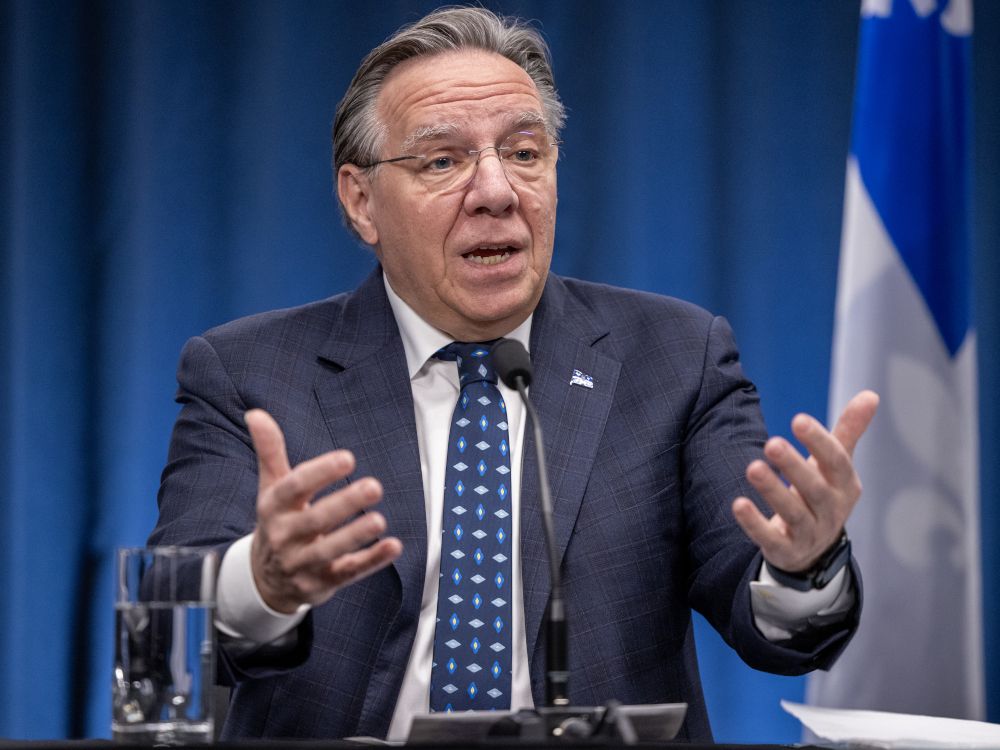
School boards, teachers and parents are
with François Legault’s government for cutting
from the province’s current year education budget.
Services to students, they
, will inevitably suffer. The cutbacks having been announced without warning, the anger is understandable. However, Quebecers would do well to get used to such financial restrictions: the province’s fiscal situation is dire, and at this stage, there is no other choice but to slow the rise in expenditures, especially for the two largest parts of the
by far, that is health care (44 per cent) and education (15 per cent).
Several school boards have announced layoffs of much-needed supporting staff, notably remedial teachers and speech therapists. Extracurricular activities have also been cancelled. To many, this is simply unacceptable. A
to the National Assembly demanding that the spending cuts be reversed has gathered more than 150,000 signatures in two weeks.
The government argues that, in fact, spending on education this year will be
than in 2024-2025. This is only true according to clever calculations made by the Department of Finance’s officials. If you compare the moneys actually spent last year to the amounts planned for this year, the increase is only
. This is much less than what is needed to compensate for inflation and the generous pay increases negotiated with the teachers’ unions. Consequently, school boards have no choice but to cut somewhere.
The governing Coalition Avenir Québec (CAQ) also argues that since it was first elected in 2018, it has increased the education budget by
. Exactly! Therein lies the problem: in education as in other fields, the province’s expenditures have risen much too fast, so that the deficit is projected to reach a whopping $13.6 billion in 2025-2026. This has led Standard & Poor’s to
Quebec’s credit rating,
“a confluence of factors including slowing population growth, higher renumeration spending, and lower revenues” that will produce “persistent operating deficits and large after-capital deficits — even before heightened economic uncertainty related to tariffs.” The future is bleak, to say the least.
Last spring, the minister of Finance, Éric Girard,
a five-year plan to balance the budget. The plan requires a drastic slowdown in expenditure increases. Even so, the government will have to find a yet unidentified $6 billion in expenditure cuts or additional revenues to reach its objective.
In an editorial published earlier this week, the
Wall Street Journal
noted
that “the crisis of the welfare state — fiscally unaffordable but politically unreformable – afflicts nearly every 21st century Western democracy.” This is certainly the case of Quebec, where the welfare state has become larger than in any other jurisdiction in North America. This is a policy choice that Quebecers have collectively made beginning with the Quiet Revolution in the 1960s: they agree, at least in principle, to carry a heavier tax burden in order to benefit from more generous public services. Unfortunately, those services have become grossly inefficient while requiring ever increasing amounts of money, money that the province simply does not have.
Elected in 2003 with a strong mandate to “re-engineer” the state, Jean Charest’s provincial Liberals were never able to act upon their promises, so strong was the resistance organized by unions, intellectuals, artists and, in the end, most voters. Quebecers are very much attached to the “Quebec model,” that they see as part of what makes the province “distinct,” to use a poisoned word. Confronted with the cost of this model, they want to believe that there exists some easy fix: tax the large corporations! Make the rich pay! Demand more money from Ottawa! The truth is that such “fixes,” were they practicable, would not suffice.
In other words, the budget cuts that have been announced this year in the education sector are just the beginning. Those restrictions contribute to the current
towards the Legault government, and deservedly so, considering that they inherited a significant surplus and transformed it into a gaping deficit. However, even if the October 2026 elections were to deliver a new government, Quebecers will face the same intractable problem that for years they have sought to avoid: how to preserve the large welfare state they hold so dear if they cannot afford it?
André Pratte is a communications consultant and former chair of the Quebec Liberal Party’s policy committee.
National Post

