



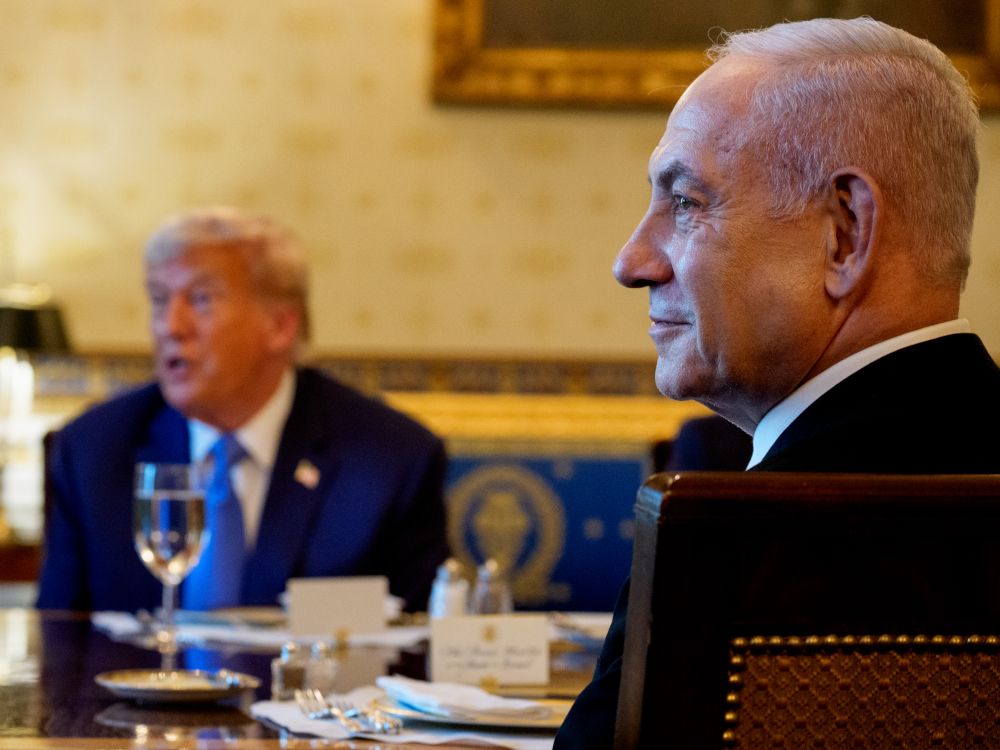
SDEROT, Israel — For the third time since U.S. President Donald Trump’s inauguration, Israeli Prime Minister Benjamin Netanyahu has travelled to Washington, D.C., for what is certain to be a few days of very intense discussions and negotiations.
Expectations by all parties are high. The president has been clear that he would like to announce a big peace deal by the end of the week — even if it’s just a partial deal, meaning that some Hamas hostages remain in their underground torture chambers, indefinitely, along with the bodies of murdered Israelis.
But at what cost? Hamas, which is said by military analysts to be nearing the point of collapse, has lost control of much of the territory of Gaza, along with the food supply. Its cash reserves are depleted, and the organization is unable to pay most of its workers — whether fighters or those employed in civilian capacities.
Responding late on Monday to the joint American-Israeli proposal for a partial ceasefire and hostage-release deal, Hamas added some new conditions that it knows Israel will not accept.
Each party has its red lines. Hamas is determined to remain in power. Whether it’s a bankrupt government loathed by the civilian population is unimportant to Hamas’s leadership. They must survive this almost two-year war against the greatest military power in the region. That, for them, would be a victory.
Israel, of course, is firmly entrenched at the opposite end of that spectrum, having made clear that the destruction of Hamas is a paramount goal of this war. Exactly what that overused phrase means is unclear. “Total victory” has become Netanyahu’s mantra.
He is also facing intense domestic pressure to finally bring all the hostages home — at once. No more of these torturous, staggered releases. Domestic pressure in Israel on this issue is explosive. The continued captivity of hostages is a humiliation, and one that Hamas exploits brilliantly. The hostages are Hamas’s most powerful weapon with which to strike Israel.
In a pre-dinner chat at the White House on Monday night — with the press in attendance — Netanyahu made clear that he would not accept a Palestinian state that could in any way harm Israel militarily.
Hamas is also
on its demand that the Gaza Humanitarian Foundation should no longer be allowed to control the distribution of humanitarian aid within the Strip. Israel is unbending on that issue, as the previous system allowed Hamas to pilfer aid, strengthening it significantly. Food, in the Strip, is power.
President Trump is a guy who likes to make deals. He likes to close. He hates war and suffering and has become somewhat personally involved in the conflict between Israel and Hamas. Numerous hostages and their families have paid Trump a visit after they were released, and he welcomed them so graciously. It’s a side of the president that few manage to see — warm, connected, sincere.
When
, a 21-year-old American-Israeli IDF soldier who was recently released from Hamas captivity visited Trump in the Oval Office last Thursday, Steve Witkoff, America’s special envoy to the Middle East, was also present. Witkoff asked Alexander to tell Trump how his conditions changed following the November election in the United States.
“They moved me to a new place, a good place,” Alexander said. “People did everything. They treated me really well.”
Trump revelled in the confirmation that Hamas feared him, quipping: “They weren’t too afraid of Biden.” Alexander quickly agreed.
By the end of this week, Trump wants a deal. A big, beautiful deal that will usher in a significant expansion of the Abraham Accords, perhaps announcing that negotiations will include Lebanon and Syria, which would be groundbreaking.
The jewel in the Middle Eastern crown — Saudi Arabia — will likely hold back, as it has indicated consistently. The Saudis will condition their embrace of a new Middle East security and economic order on the end of the war between Israel and Hamas.
It will thus fall to Witkoff to work his magic in Doha and find a way to bridge the critical gap between Hamas and Israel. That would likely involve the first stage of a ceasefire, partial Israeli withdrawal and the phased release of living and dead hostages. Trump would take that as a win at this point.
The final stretch will be the toughest. Hamas will continue to hold living hostages, as they are its only leverage. And Israel will resist committing to a full withdrawal from the Strip with Hamas still standing — even barely — in order to bring them all home.
No one in the region — aside from Iran, Hezbollah and, one has to assume, Qatar — is keen to see Hamas survive. Qatar, of course, is friends with both the United States and Hamas — hosting the largest U.S. military base in the region, while financing and providing a home base to the terrorist organization’s leadership in Doha.
With the flick of a wrist, Qatar could take down Hamas. It has not done so. So we continue with this absurd situation: the battered Hamas terrorist force, which is ideologically committed to the destruction of Israel, is left holding these very powerful aces — human beings.
Waiting on the sidelines is the jewel of the Middle East, Saudi Arabia. Only when the dirty details are swept away will the Saudis even consider joining Trump’s big, beautiful plan to bring peace and glory to the Middle East. Steve Witkoff has a big job ahead of him.
National Post
Vivian Bercovici is a former Canadian ambassador to Israel and the founder of www.stateoftelaviv.com, an independent media enterprise..

