


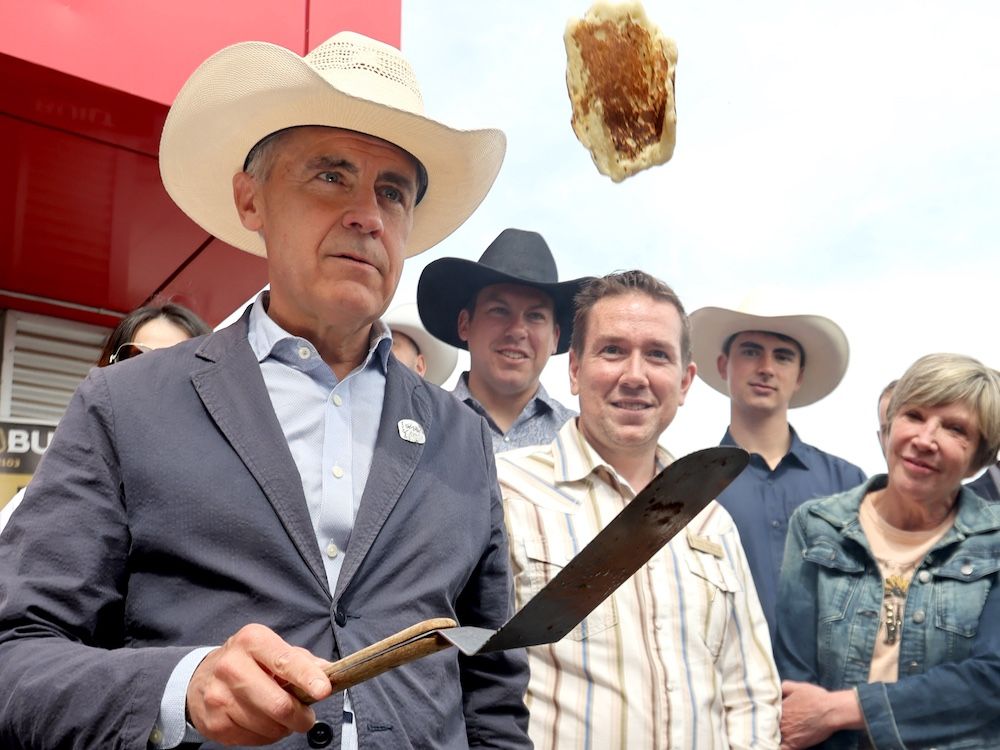
For months, Prime Minister Mark Carney has spoken about making Canada an energy superpower. He said it
mentioned it again in an
with CTV news in May, and
last weekend at the Calgary Stampede. While he usually inserts the qualifier of “both clean and conventional energy,” in
he stated that it’s “highly, highly likely” that at least one oil pipeline will make the government’s list of national strategic infrastructure projects.
Those words aren’t a dog whistle — they’re a bugle call to western premiers, notably Alberta Premier Danielle Smith. At a press conference with Ontario Premier Doug Ford this week, Smith
about a “grand bargain” involving pipelines and the Pathways Alliance, a group of energy producers promoting carbon capture as a means of “decarbonizing” fossil fuel production. The two premiers
the construction of a pipeline to the East and a rail line to the West, to send Alberta oil to eastern Canada and critical minerals from Ontario’s Ring of Fire to western ports.
Those national infrastructure projects appear to be chugging along, full steam ahead. But they still need the federal government on board — and despite his talk, Carney still must walk the walk. And that may not be as easy as some may hope.
First, Carney has a very verdant past. He is a longtime climate finance evangelist, promoting green energy projects as chair of Brookfields, authoring a book on “value(s),” arguing for ESG investment frameworks, and serving as the UN Special Envoy on Climate Action and Finance. Will he turn his back on those beliefs — or find a way to reconcile them with pro-development positions?
Second, the Liberal Party’s green flank is likely to see red. Former and current environment ministers Steven Guilbault and Julie Dabrusin are part of the anti-oil crowd, as are many rank and file members of the party in urban Ontario, Quebec, and B.C. Until now, they called the tune: under Prime Minister Justin Trudeau, the Liberals were the party of carbon taxes, not carbon capture, of emissions caps, not Energy East.
Third, there are potential roadblocks that are out of Carney’s control. Opposition is brewing among environmental and indigenous groups to his recently passed Bill C-5, the “One Canadian Economy Act,” which promises to streamline approval for resource projects. Canada has seen civil disobedience before, when members of the Wet’suwet’en band blocked railways in early 2020 to protest pipeline construction: a sequel could be coming to a rail line near you, and it’s not clear how Carney would respond.
So far, Carney has stickhandled these issues by avoiding specifics. He hasn’t said which pipeline, or where, or when. But when plans start to firm up, maps are drawn and suddenly a pipeline is running through someone’s back yard, he’ll have to make a choice — and that choice will have serious political implications for both his party, and others.
For the Liberals, it means possible internal rifts, as cabinet minister are asked to fall in line. For the NDP, Carney’s embrace of energy infrastructure could boost the green left, as the party prepares to choose a new leader and possibly new direction. For the Conservatives, it could deny leader Pierre Poilievre his monopoly on “common sense” jobs-and-growth politics.
But in some ways, Carney doesn’t have a choice. As with everything else these days, policy is being dictated by what’s happening south of the border. The United States under President Donald Trump is clipping climate regulation, scrapping EV subsidies, and pushing “drill, baby, drill” policies. Canada is still facing tariffs and a rough renegotiation of our trade agreement with Washington. Meanwhile other markets, in Asia and Europe, are looking for stable suppliers of oil and LNG.
Diversification isn’t just a buzzword; it’s survival. In the end, Carney may find that the green that speaks loudest is in Canadians’ wallets.
Postmedia News
Tasha Kheiriddin is Postmedia’s national politics columnist.

