


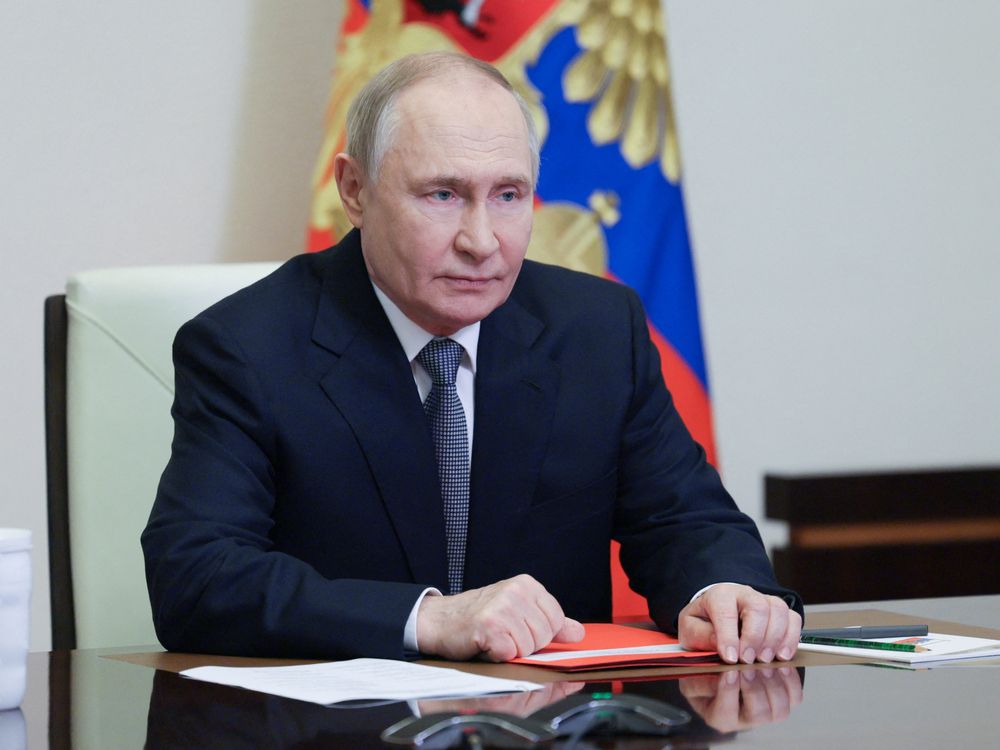
When Iran’s Foreign Minister Abbas Araghchi met with Vladimir Putin — just before a dozen or so Iranian ballistic missiles were half-heartedly aimed at the U.S. Al Udeid base in Qatar — he was surely looking for at least a little moral support.
He was to be disappointed.
Reuters
that Iran was disappointed after the meeting: “Iran has not been impressed with Russia’s support so far,” Iranian sources told them, “and the country wants Putin to do more to back it against Israel and the United States.” Reuter’s Iranian sources “did not elaborate on what assistance Tehran wanted.”
Russia — previously considered to be a restraining factor on U.S. actions towards Iran — is seeing its influence in the region declining. China may be only too happy to replace it.
U.S. (and Israeli) planners surely noted Russian support for the Assad regime evaporating in its swift end in December 2024, sacrificing a precious warm-water port on the Mediterranean in the process.
Just prior to Assad’s fall, the
Iran-Israel skirmish of October 2024
also showed the parlous state of Iran’s air defences with Russian-supplied S-300 systems easily taken out by Israel’s “Operation Days of Repentance.”
Russian diplomatic and material support has proven ineffective, for Iran and previously Syria. Having been much sought after by Middle East customers, Russia now sees confidence ebb in the performance of its military hardware.
Prospective customers for new military systems are symbiotic with investment in research and development. One goes with the other, and once the R&D muscle atrophies due to a lack of buyers it’s hard to build back.
While it is long believed Russia had agreed to supply the newer, and theoretically superior, S-400 system to Iran, it has never been proven that they were delivered. The performance of the system has seen a mixed record in Ukraine, and Russian military overstretch now means it can’t afford to spare any air defence systems — especially since Ukraine’s devastating “
.”
Turkey must be pondering how useful its controversial 2017 acquisition of the S-400 system was.
Long-standing buyers like Pakistan have also gone elsewhere, mainly to China which has emerged as the
to Western-supplied systems. The superior performance of China’s J-10C jet in Pakistan’s recent hostilities with Indian-supplied French jets has been noted, with Iran now
considering buying J-10Cs instead of Russian Su-35s.
Russia’s interests in the region, which go all the way back to the Soviets and Tsars, have seen it compete, cajole and sometimes even try to cuddle Islamic Iran and its preceding Pahlavi imperial rulers.
Stalin occupied Northern Iran during and after the Second World War. Then, shortly after the Islamic Revolution in 1979, the Soviet Leadership attempted to extend an olive branch to the new anti-U.S. regime, only to be swiftly rebuffed by Ayatollah Khomeini who took a dim view of the U.S.S.R.’s invasion of Afghanistan and Soviet atheism.
Putin’s Russia, horrified by its inability to counter U.S. actions in Iraq after the 2003 invasion realigned away from the West after 2007 and sought new partners in the region. Following the “Arab Spring” of 2011, Russia and Iran gradually moved closer, first in supporting their mutual Syrian proxy, and increasingly following Russia’s invasion of Ukraine in 2022.
Iran sensed both a useful foe-turned-ally against the common threat of the U.S., and a commercial opportunity in supplying thousands of Shahed drones. More recent technology transfer has seen the creation of a factory in the Alabuga special economic zone in Tatarstan to build
by summer 2025. Iran has secured treasure — literally in the form of gold bars — amid much speculation about what else Russia is helping with, including its nuclear program.
But Russia’s retrenchment in the region since 2024 has shown it can only service one priority — its campaign in Ukraine.
Despite the photo opportunities and grand words, the reality of Iranian, Russian, and now Chinese relations is purely transactional. China buys around
90 per cent of Iran’s oil exports
. Russia likely hopes to usurp this to offset the bargain basement prices China has paid for Russian oil since 2022, and Russia has sensed an opportunity to try to restart negotiations on the Power of Siberia 2 gas pipeline to China.
President Trump has dismissed Russian diplomatic efforts in the Middle East
Putin, “mediate your own (conflict)” in a tacit reference to Trump’s frustration over a lack of peace in Ukraine.
Given Arab unease with the U.S.’ actions in Iran, China may seek to pursue its commercial and strategic interests in the region as with its brokering of the 2023 rapprochement between Iran and Saudi.
China still plays catch up, given the scale of U.S. military assets and diplomatic heft, but many “
” defence hawks like Elbridge Colby doubt a long-term presence in the Middle East now the U.S. is largely energy independent.
China, with
–
per cent of its crude oil carried on tankers down the Strait of Hormuz, is most certainly not.
While the U.S. debates its long-term presence in the region, the Russian bear declines. Both could be replaced by the Chinese Panda.
David Oliver is a geopolitical strategy expert and founder of Minerva Group. You can follow him on his Substack The Ultima Ratio.
Othón León is the managing director of the Canadian Centre for Strategic Studies.
National Post