



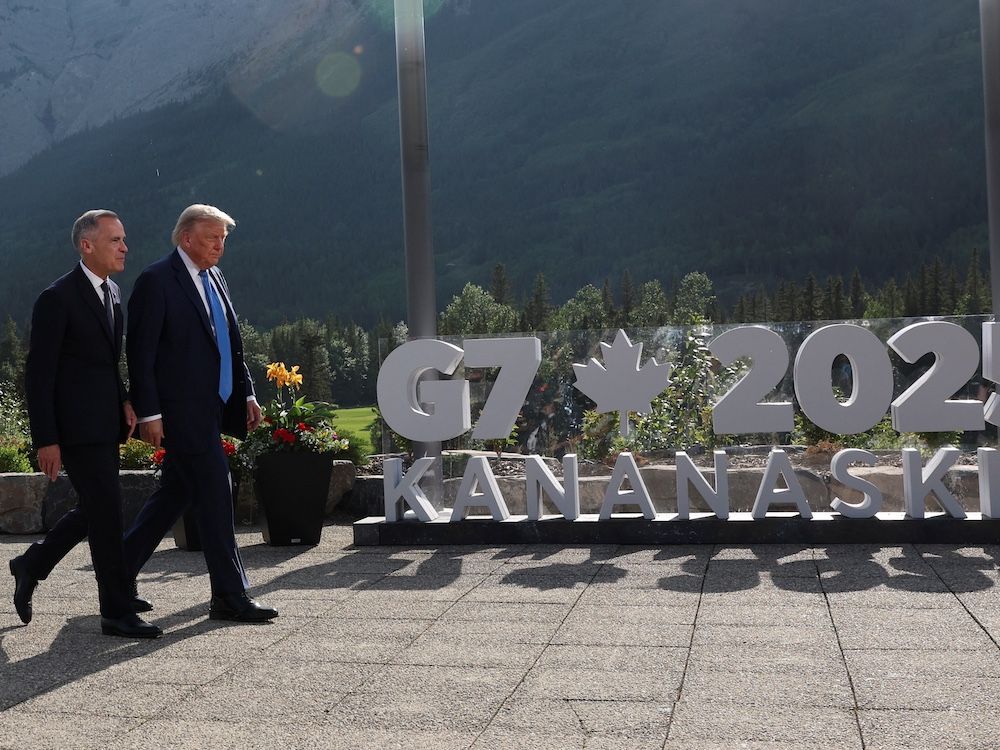
For a while there, things were going so well. Prime Minister Mark Carney — aka “the Trump whisperer” — had morphed from critic to texting buddy of the U.S. President. Over the past three months, Carney had been chatting with Donald Trump, building backchannel goodwill. After the successful G7 summit in Kananaskis, Alta., hopes were high that Ottawa would strike a deal with Washington in 30 days, and that the rhetoric of making us the “51st state” had finally been retired.
Until last Friday, when everything fell apart.
That’s when President Trump abruptly cut off trade negotiations with Canada over our three per cent digital services tax, set to take effect June 30. Aimed at U.S. tech giants Amazon, Meta, Google and AirBNB, the tax was retroactive to 2022 and would have cost them an estimated $2 billion in back payments. The tech bros howled, the president barked, and Carney blinked. Sunday night, he backed down and cancelled the tax: Monday morning, U.S. Commerce Secretary Howard Lutnick
for the climbdown, as did the Canadian Chamber of Commerce. Negotiations were back on.
But if you thought that was the last bump in the road, you couldn’t be more wrong. In
broadcast Sunday morning on Fox, Trump mentioned a veritable mountain: supply management. That’s the system that protects Canadian dairy, poultry and egg industries from foreign competition through quotas and tariffs, including Trump’s favourite bugaboo, a 200-plus per cent markup on U.S. dairy products.
It’s true that the tariff only kicks in after the U.S. exports 50,000 zero-tariff metric tons of milk and 12,500 metric tons of cheese per year — levels it is
. But supply management was already a sticking point with Trump in the CUSMA negotiations under Prime Minister Justin Trudeau, and Republican lawmakers and U.S. dairy producers continue to demand its elimination.
In our country, unfortunately, it has become a hill on which political careers go to die. Case in point: People’s Party Leader Maxime Bernier, whose
to lead the Conservative party in 2017 was
thwarted by the Quebec dairy lobby
after he promised to ditch the policy. And the sacred cow lives on: in June, the
passed a Bloc Québécois bill with all-party support to prevent bargaining supply management away.
Carney knows that he owes his recent election victory in large part to Quebec voters — and with a minority, needs the support of opposition parties like the Bloc to stay in power. But if Canada wants a serious trade deal with a Trump White House, supply management will have to go. Not just for the sake of negotiations, but because it’s a cartel policy that has had its day.
The economic case against supply management is straightforward. A study by the
estimates that by limiting Canadian production, the average family pays hundreds more annually for milk, cheese and eggs, compared to countries without such a quota system. The
found that these inflated prices protect a tiny number of producers, mostly large, established farms with valuable quotas, at the expense of millions of Canadians and would-be producers who can’t afford to break into the market. It’s the worst kind of protectionism: one that punishes the poor, rewards the entrenched and chokes competition.
Carney faces the same dilemma as Bernier, in reverse: will he let trade dreams die on this hill? Will he jeopardize our steel, aluminum and auto sectors, as well as deals for critical minerals, for a policy that makes it harder for Canadian families to afford milk for their kids?
If Carney is serious about leading this country and these talks, he must put the national interest ahead of political orthodoxy. As this weekend showed, Trump will not hesitate to call Canada’s bluff. The Americans want the big cheese — and they’ll hold everything else hostage until they get it.
Postmedia Network
Tasha Kheiriddin is Postmedia’s national politics columnist.