



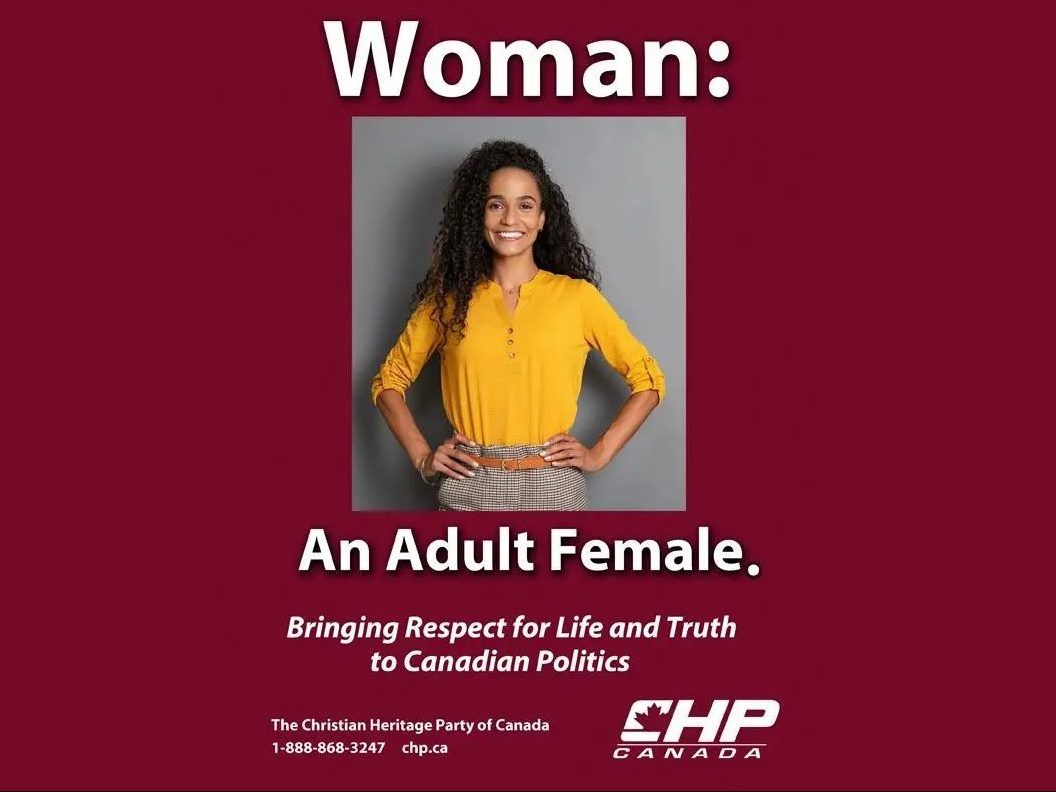
We have clearly entered the realm of the ludicrous when a local government in Canada is banning what most reasonable people would regard as the dictionary definition of what is a woman.
The City of Hamilton, Ont., believes that “Woman: An Adult Female,” is too harmful, too toxic and too outrageous to be put on a bus shelter billboard.
Once more, it is the institutions, such as local governments and universities, that we expect to be guardians of our fundamental rights, which, instead, trample them into the dust.
But the “Woman: An Adult Female” billboard isn’t just about free speech, it is a glimpse into a Canadian — and, indeed, Western — society that has lost the ability to talk and disagree among itself.
“I think our society has unfortunately become increasingly polarized,” says Lia Milousis, a lawyer with the Acacia Group, an Ottawa-based law firm specializing in defence of churches and charities from Charter abuses and government overreach.
“And I think part of that is we’ve not practiced disagreeing and we have taken up this view where disagreeing is essentially hating someone. People don’t have practice tolerating other views.”
And in this climate, the rather innoxious, inoffensive, dictionary definition that a woman is an adult female becomes a hateful slogan that the City of Hamilton cannot permit to be expressed publicly.
In 2023, the billboard advert proposed by the Christian Heritage Party of Canada (CHP), a registered federal political party, was rejected by Hamilton.
The city said grounds for concern included the messaging which appeared to support “a traditional and biologically determined definition of gender in line with conservative values.”
The city also consulted with LGBT groups before concluding the ad would not provide a safe and welcoming environment for all transit users.
But as Milousis, who is fighting the billboard ban, points out, “The ad in question is the most tame way you can communicate this message. It is not inflammatory. It says, ‘Woman: An Adult Female.’ It doesn’t even say biological female. It doesn’t even say genetic female. It just says an adult female.
“The city acknowledges that this is a basic dictionary definition but then talks about exclusionary undertones and how this is a definition associated with conservative values.”
We have reached the stage when describing a woman as an adult female is such a provocative statement that it flusters the delicate mandarins of Hamilton.
However, an Ontario divisional court
that in rejecting the ad, Hamilton had followed proper procedure and been reasonable. The CHP is now raising funds to challenge the ruling, and the Appeal Court has agreed to hear the case.
The City of Hamilton did not answer a request for comment by press time.
A central issue, of course, is whether freedom of expression, as enshrined in the Charter of Rights and Freedoms, is as sacrosanct as many believe it to be. Too often, our expected right to freedom of speech is being overthrown by courts or institutions because of someone’s “superior” right not to be harmed or offended.
The City of Hamilton didn’t even wait for a complaint. The city, so sensitive to our cultural times, actively sought out people who might be offended and then based their rejection on the feedback.
When you are in a position of power, it is easier to censor the side you disagree with.
“This is not a case where this was hate speech, or calling for violence, or causing any kind of danger,” says Milousis in an interview with the National Post. “There is no reason why having this advertisement would make the transit system unsafe or unwelcoming.”
She argues that the divisional court judgement appears to suggest that there is a right not to be offended or at least shielded from views that you disagree with. “And that’s not a constitutionally protected right.”
“The expectation is that people in a democracy will be capable of handling robust discussion even on issues that they have strong opinions about,” says Milousis.
“To be clear, this is not a debate about the existence of transgender people. It’s just about how we define woman and how we define man and that is a very live political discussion,” she says.
Another concern is that if Hamilton bans a political message on an important public issue because it’s too conservative, why can’t another city ban something because it’s too Liberal? We could have a patchwork of different political bans all over the country.
“It raises deep concern about the democratic freedom of Canada,” she says.
Milousis also sees, “a level of intolerance at the institutional and particularly the administrative level that is concerning.”
She cites the Saskatchewan student who faced a
hearing for questioning diversity, equity and inclusion provisions. As well as the Manitoba medical student who was
for making pro-life comments.
“I think it is only a very arrogant person, an arrogant society, that says, ‘I need to know nothing about other views. I do not want to know. I do not want to hear. I do not want to see. I can learn nothing from you.’
“There’s a humility that it takes to say, ‘This is what my view is, but maybe I have something to learn from you.’”
Humility in a society so self-absorbed may be a tough virtue to foster. But we can start by talking to each other — and not banning ads we disagree with.
National Post

