



First Reading is a Canadian politics newsletter curated by the National Post’s own Tristin Hopper. To get an early version sent directly to your inbox, sign up here.
TOP STORY
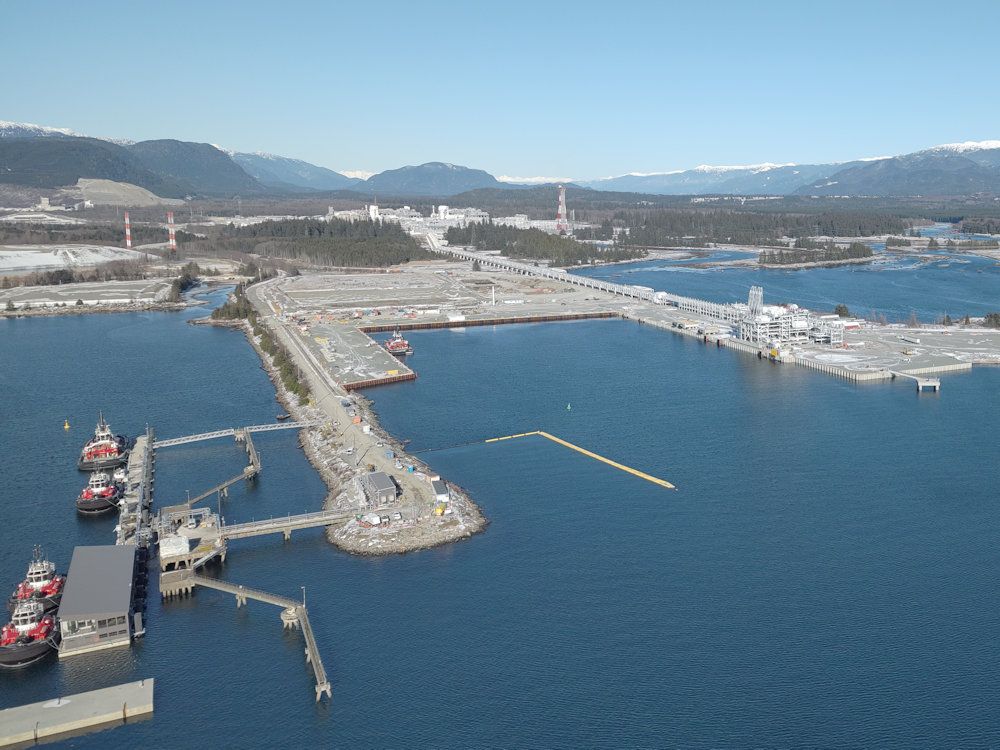
Early on Sunday morning, word leaked out from the Pacific Coast port of Kitimat, B.C. that Canada had produced its first-ever liquid natural gas for export.
Unnamed sources told Reuters that at 4 a.m. local time, the $40-billion LNG Canada terminal was first able to turn Canadian natural gas into a super-chilled liquid destined for Asian buyers. It’s set to be loaded into the LNG tanker Gaslog Glasgow, a ship that as of press time was just entering Canadian territorial waters.
Although the milestone is being feted as the beginning of a new multi-billion-dollar Canadian resource sector, it also neatly illustrates how far behind Canada has been allowed to lag in an industry where it could feasibly have been a dominant power.
In all the world’s other major producers of natural gas, this moment came years if not decades ago. The United States exported its first LNG in 2016, Qatar dispatched its first LNG vessels in 1997 and Australia was pioneering LNG export technology as early as 1989.
All three are now raking in hundreds of billions in annual LNG money that could have been Canada’s if it been able to reach the starting line earlier than Sunday morning.
In Australia, the LNG export sector is now bringing in the Canadian equivalent of $220 million per day. According to the most recent figures from Australian Energy Producers, annual LNG export earnings
were now worth $81.5 billion CDN
.
This kind of money added to the Canadian economy would represent a three per cent rise in overall GDP. Put another way, it would be akin to adding a Manitoba’s worth of extra GDP to the economy (Manitoba’s GDP
).
In the nine years since the United States’ first LNG export, the country has turned into the world’s largest single exporter of the fuel.
The United States now
has eight dedicated LNG export terminals
, the most recent having opened in December.
That same month, a report by S&P Global estimated that LNG exports had added a cumulative $400 billion ($550 billion CDN) to the U.S. economy.
“Export revenues from U.S. LNG already exceed those of U.S. soybeans, are twice that of the nation’s movie and television exports and half those of U.S semiconductors,”
.
Canada could have feasibly been an early contender in the LNG trade for the simple reason that — just like the U.S., Qatar and Australia — the country has lots of natural gas as well as the technology to produce it.
As of 2023, Canada is the world’s fifth-largest producer of natural gas, and its proven reserves are
roughly on par with those of Australia
.
But any natural gas exports have had to go via pipeline to the U.S. Without any capacity to export liquified natural gas via tanker, Canada has been denied access to the gas-hungry markets of Asia or Europe.
What’s held back LNG development, according to industry, is a Canadian political and regulatory regime that has kept the sector in limbo even as LNG revenue has exploded in other countries.
The LNG Canada project, which is just now coming online, is one of 18 total LNG proposals received by Natural Resources Canada since 2011, with most of the others having been cancelled due to regulatory delays.
A 2022 analysis by the Fraser Institute noted that in the time it took for Canada to approve and complete one LNG export facility, LNG Canada, the U.S. built seven and “and approved 20 more.”
The “missed opportunity” of Canadian LNG was something that came up often during the most recent session of the House of Commons, particularly during debates surrounding Bill C-5, a Liberal proposal to grant unilateral powers to the prime minister to fast-track resource projects deemed to be in the “national interest.”
Conservative MP John Barlow, for one, cited a major export deal inked earlier this year between Japan and Alaska LNG.
The deal, notably,
came in the wake of a 2023 visit
to Canada by Japanese prime minister Fumio Kishida in which he requested Ottawa’s assurances of LNG exports, but was denied.
“The revenue from that one LNG agreement should have been helping pay down our debt and lower taxes for Canadians here in Canada,” he said.
Kishida would be one of at least four foreign leaders to have faced similar treatment from the Canadian government. One of the most notable being Germany, whose chancellor came to Canada in 2022 on an explicit mission to obtain Canadian LNG as an alternative to Russian sources.
“As Germany is moving away from Russian energy at warp speed, Canada is our partner of choice,” Chancellor Olaf Scholz would announce during the visit.
But after then Prime Minister Justin Trudeau announced there was “no business case” for LNG exports to Europe, Germany
contract with Qatar.
IN OTHER NEWS
Canada never ended up getting that spring federal budget they asked for.
One of the first votes of the 45th Parliament was
calling on the Carney government to table “an economic update or budget this spring, before the House adjourns for the summer.” The motion, which passed 166 to 164, was in response to the new Liberal government announcing that they
probably wouldn’t bother with a budget until at least 2026
. But as the motion was non-binding, the Liberals simply didn’t bother.
Arguably Canada’s greatest coup from its just-hosted G7 summit was a commitment from U.S. President Donald Trump to
strike a new Canadian trade deal within 30 days
that would presumably bring an end to the two countries’ ongoing trade war. But on Monday,
Prime Minister Mark Carney seemed to say that the 30-day deadline isn’t really a thing, and that “nothing’s assured.”
Get all of these insights and more into your inbox by signing up for the First Reading newsletter.