


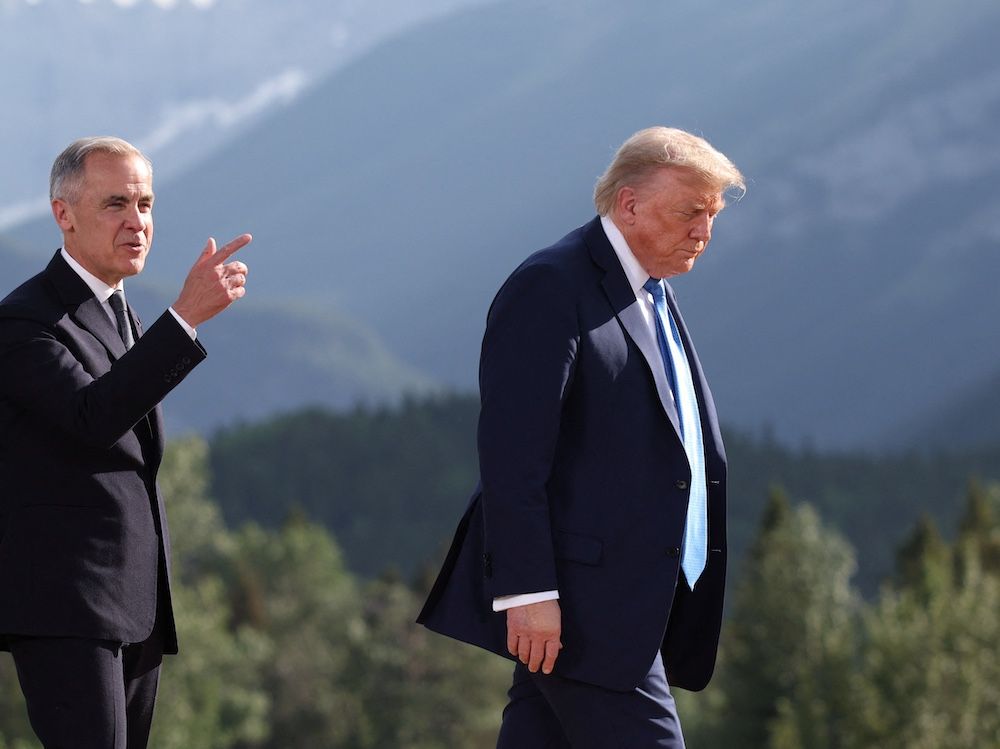
Well, at least he didn’t walk out. While U.S. President Donald Trump left the G7 meeting in Kananaskis Monday night, it wasn’t in
the huff
the world witnessed at Charlevoix in 2018. This time, after a day of huddles and the signing of a U.K.–U.S. mini-deal that slashed auto tariffs, Trump
hurried back
to the White House because of “what’s going on in the Middle East.” His exit left Prime Minister Mark Carney and the remaining five leaders to hammer out the rest of the agenda, from trade to security to artificial intelligence, while keeping a nervous eye on the Iran-Israel war.
Throughout the meeting, Carney didn’t step on any mines, but did make a major pivot. In welcoming Trump to Canada, Carney diplomatically
thanked him
“for his leadership” and that of the United States in the G7, and praised Trump further at the start of the meeting. It’s a far cry from his tone during the spring election campaign, when Carney depicted Trump as an existential menace to Canadian sovereignty that only he and the Liberal party could contain.
Since taking office, however, Carney has switched gears. He avoided getting Zelenskiied
at the White House
in early May, and then paved the way for this week’s G7 with personal texts and phone calls to Trump, which the President
has reportedly appreciated
. Carney also finessed the summit’s agenda, putting economics and energy at the top of the list, while climate change was an also-ran.
The goal was not just to run a smooth meeting: Carney wants a trade deal before the summer is out. And he may get one. Trump
committed to doing a deal within 30 days
, despite the two leaders’ very different philosophies on tariffs. Trump and Carney talked for 30 minutes of a larger 70-minute Canada-U.S. bilateral meeting, which Carney
later described
as “Fantastic.”
But the summit’s most revealing moment came not from Carney or Trump, but from Brussels. On Monday, European Commission president Ursula von der Leyen
conceded bluntly
, that “Donald is right” on the threat posed by China, which is flooding international markets with state-subsidized goods. While the EU’s solution is greater trade among allies, instead of an international tariff regime, the end game is the same: isolate Beijing and undercut its economic and geopolitical influence.
This will be Carney’s next big domestic test, and he has a lot of voices competing for his attention. Container traffic from China through the Port of Montreal is
up sharply
since Trump’s first-round tariffs. Western and Eastern premiers are clamouring for a deal with Beijing to remove punitive tariffs on Canadian canola and seafood. Meanwhile, former CSIS and RCMP investigators have
called for a public inquiry
into a “Buddhist monastery” linked to the Chinese Communist Party that has bought thousands of acres of Prince Edward Island farmland, alleging that is it
establishing a stealth CCP beachhead
in our own backyard.
So far, this government has ignored the issue of foreign interference. It hasn’t established a foreign agents’ registry or taken steps to implement the Hogue report. Carney has taken a tougher stance on fentanyl and money laundering, as evidenced by the government’s
new border security bill
, motivated by Washington’s demands, not domestic politics.
But, Carney will have to choose sides. And if he wants that cozy relationship with Trump to continue, and get a trade deal with the U.S., it’s clear where he needs to come down.
Fortunately, it’s the same side that Canada should have picked for the last decade. If there’s a silver lining in the current chaos, it’s that Trump’s economic realignment will move allies to act in concert against the bigger threat: the hegemonic ambitions of Beijing. America may not be the friend it once was, but in this brave new world order, it’s still the better choice.
Postmedia News
Tasha Kheiriddin is Postmedia’s national politics columnist.

