



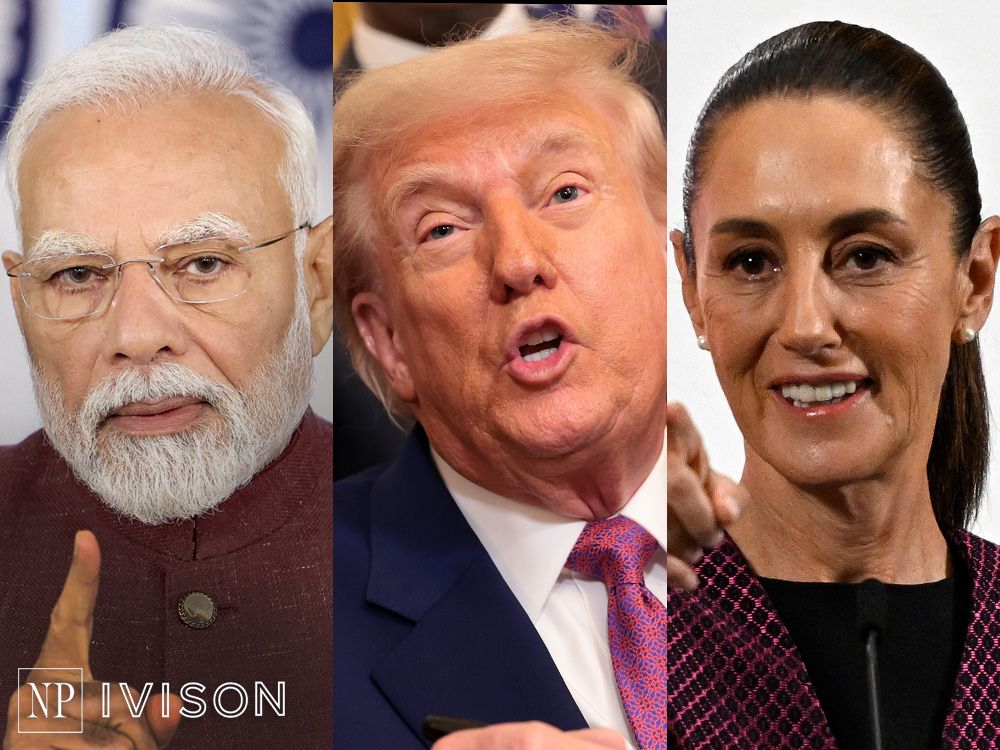
President Donald Trump is coming back to Canada for a G7 meeting in Kananaskis this weekend.
The last time he came north was to the Charlevoix summit in 2018, when he refused to sign the joint communiqué and called his host, then prime minister Justin Trudeau, “dishonest and weak.”
To discuss whether we can expect another Trump wrecking ball in Alberta, John Ivison is joined by Louise Blais, former Canadian ambassador and deputy permanent representative at the United Nations, who is now a strategic advisor to the Business Council of Canada.
Ivison asked if the G7 can function properly when the president of the United States clearly disdains multilateralism in all its forms.
Blais pointed out that this is the first multilateral meeting since Trump was re-elected.
“But all the leaders this time have had practice. They’ve had their one-on-one meetings with them. We’re all at the receiving end of a slew of tariffs. But you can see that the leaders are trying to find a way to keep relations cordial. I think everyone will try to avoid a disaster. It’s not without its dangers. It can be unpredictable. But it is my sense that the prime minister has been speaking to the president and I don’t think he has been speaking to him only about Canada-U.S. relations and the lifting of our tariffs. I think he’s also been speaking to him about the G7 and how we can maybe make him at ease and move some things of common interest forward,” she said.
Prime Minister Mark Carney has said that if the U.S. does not want to lead, Canada will. Ivison asked if this is empty rhetoric or whether Canada has a real opportunity to set the agenda?
“I’m very cautious about that ambition personally. I think there’s a very good chance that the prime minister will shine next week. If you had asked me a month ago: ‘Should we pass on this G7 this year?’, I would have probably said yes. Too risky, wrong year for us. We’re in an election. It was really difficult to prepare.
“But now that we’re on the other side, we’re already seeing the elements of the foreign policy that the prime minister wants to put forward. We have established some form of cordial dialogue with the president. I think that it’s actually turned into an opportunity for Mark Carney to show leadership and to balance sort of the core interests of Canada with international leadership.
“On the other hand, he needs to be careful and not present himself too overtly as an alternative. If the world sees it that way, then fine. But I think he personally has to be careful because he has to balance both the president and the president’s sense of himself.”
Blais said Trump’s relationship with China will have a massive influence on how he handles allies at the G7. “I think that the sense probably now in the White House is that it’s difficult for the Americans to take on China on their own. And so, the president is coming to the summit having absorbed that and having (concluded) that if they really want to make headway, they will have to work with allies,” she said.
Ivison said former G7 Sherpa and now Canadian Senator Peter Boehm has suggested there will be no consensual joint communiqué this time, and that the G7 may wrap up with a summary statement from Carney, as the chair of the meeting.
Blais said she is hearing that there may be separate statements on different issues like Ukraine.
“In other words, not putting everything into one, where if you don’t agree on every single comma and every single period, the whole thing is out the window. I know that from experience at the UN, it can happen. It’s tough. It’s really tough to get consensus now in general in the multilateral world,” she said.
Ivison suggested Carney’s decision to invite Indian Prime Minister Narendra Modi and Saudi Crown Prince Mohammed Bin Salman, despite human rights concerns, is symbolic of a new realism in Canada’s foreign policy under Carney.
Blais agreed: “It’s clear that he’s signalling that he wants a foreign policy that is much more focused on our core interests. And those core interests are very simple. They’re sovereignty, territorial, primarily, and of course, economic prosperity. Those are the two things that really Canada needs to focus on… We need to grow up. We need to adapt. And we need to prioritize those interests. That doesn’t mean that we will sacrifice our values at the altar of our own core interests. But it’s a balance that is shifting.”
Blais said her time at the United Nations taught her that world leaders and ambassadors quickly grew tired of Canada attaching progressive values to its relationships.
“We were pushing things that certain countries weren’t ready for. And it’s okay to try to improve the lives of people around the world. But at the end of the day, we have to think about our impact as a nation. We’re not a super-power, we have to be realistic. And we certainly can’t promote those things at the expense of our own interests. I think that’s where it went too far.
“To be honest, what always struck me is no matter how principled the position we took, and no matter what the price of that position might have been, we did not impact the change that we had hoped for.
“We ended up really with very complicated relationships with very important powers, some of them regional, some of them global, and it hurt our interests.”
Get more deep-dive National Post political coverage and analysis in your inbox with the Political Hack newsletter, where Ottawa bureau chief Stuart Thomson and political analyst Tasha Kheiriddin get at what’s really going on behind the scenes on Parliament Hill every Wednesday and Friday, exclusively for subscribers. Sign up here.

