



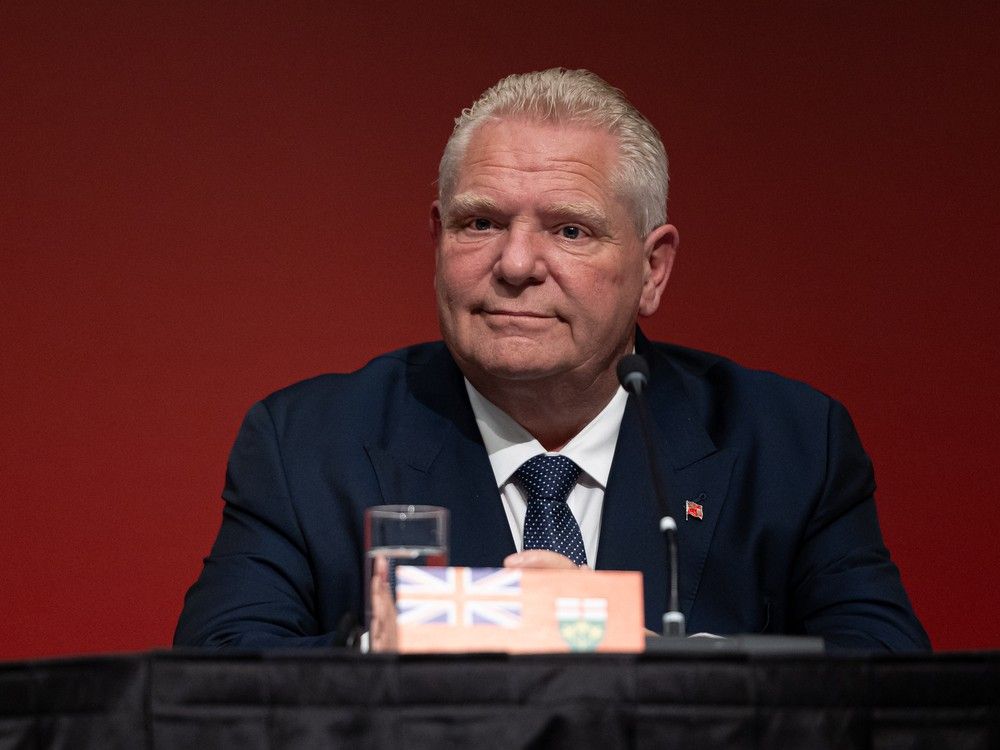
Ontario Premier Doug Ford has done something truly conservative. His government’s proposed
rule changes for colleges, universities and school boards
are aimed squarely at shifting power away from the diversity, equity and inclusion (DEI) crowd and weakening their control over education.
It’s welcome news for anyone who thinks that public education should be about learning and diversity of ideas, not a playground for political activists.
Ford and his team are not selling their new Bill 33 as an attack on DEI, but that’s clearly what it is. Universities and colleges will be obliged to admit students on merit, rather than their membership in a targeted demographic. That should stem their ability to impose reverse discrimination to over-correct for perceived past injustices.
The government intends to take far more direct control over school boards. “Progressives” who run many big city boards will have little remaining authority and the province will be able to countermand pretty much any move it doesn’t like.
For starters, the Ford government is banning ideologically driven school renaming. So much for the
Toronto District School board’s plan
to erase the names of Sir John A. Macdonald, Egerton Ryerson and Henry Dundas from its schools on the grounds that these historical figures are tied to “systems of oppression.”
The legislation also mandates a return of school resource officers in areas where police services provide them. Seventeen school boards have prevented police from working in schools because of the supposed harm it causes to racialized students.
Both these moves are intended to block the historical revisionism and anti-police attitude found in some school boards.
So far, the most vociferous reaction has come from the university sector. School trustees have not yet found a compelling argument against their neutering.
The
Ontario Confederation of University Faculty Associations said
it is “particularly troubled by language around admissions criteria, which appears to target initiatives aimed at increasing representation from equity-seeking groups.”
The Ontario Undergraduate Student Alliance
saying it “is worried about how this move will decrease pathways for under-represented students. Many institutions across Ontario have made efforts to lower barriers to access for students with disabilities, low-income, first-generation, Indigenous, and racialized students.”
The fact that admission based on merit is perceived as highly controversial within the university world shows how far the sector has departed from the mainstream. The proposed legislation does not define what merit is. The government will consult with universities on that, but surely merit must involve some combination of academic achievement and personal characteristics.
What it should not include is extra points for applicants who belong to special designated groups. Any publicly funded institution should treat people equally, not equitably. The two words sound similar but they are miles apart in current meaning. Equity admissions give extra weight to individuals from groups that have previously been under-represented. It might be a noble idea, but it’s still a form of discrimination.
The core flaw of the DEI world view is the idea that people are primarily defined by their membership in a group. Further, certain groups can only succeed if the bar is lowered for them. That can be insulting and inherently racist, and yet its proponents think they’re battling racism.
The changes for school boards are far more extensive than those for colleges and universities. The legislation gives the government sweeping power to keep the boards tightly focused on student success and sound financial management. In effect, the education minister is now the trustee in chief for boards across the province.
As
Education Minister Paul Calandra put it,
“We are making it clear that school boards must put students first — not politics, not bureaucracy — and that we will act decisively when they fall short of that responsibility.”
Ontario Public Service Employees Union president JP Hornick said,
“Bill 33 is a power grab, and a dangerous one.” But the provincial government already had power over school boards. What it is doing now is offering enhanced oversight and more control, if necessary.
It’s certainly required. While most school boards are meeting the government’s expectations, some are
.
Trustees in the Thames Valley District School Board, which covers the area around London, Ont., thought it just fine to spend almost $40,000 on an offsite retreat, while those in a Brantford-area Catholic board
spent nearly $190,000 on a trip for four trustees to Italy to buy art
. The $190,000 includes $63,000 in legal fees to manage the fallout. Other boards are facing large deficits. They blame provincial underfunding, but their job is to manage within the money the province gives them.
The Ford government wants trustees who focus on student learning and fiscal responsibility. It will be no accident if that profound change deters future social-justice warriors looking to launch a political career.
National Post
randalldenley1@gmail.com
Get more
deep-dive
National Post political coverage and analysis in your inbox with the Political Hack newsletter, where Ottawa bureau chief Stuart Thomson and political analyst Tasha Kheiriddin get at what’s really going on behind the scenes on Parliament Hill every Wednesday and Friday, exclusively for subscribers. Sign up here.