




First Reading is a Canadian politics newsletter curated by the National Post’s own Tristin Hopper. To get an early version sent directly to your inbox, sign up here.
TOP STORY
Despite Canada’s reputation as a safer version of the U.S., newly compiled data is showing that crime has worsened to the point where, on some metrics, Canadian cities are becoming more lawless than the U.S.
Americans are still getting shot and murdered at higher rates than Canadians, but when it comes to theft, carjackings and break-ins, figures show that some Canadian cities are doing worse than their American counterparts.
In fact, two Canadian jurisdictions — Kelowna, B.C., and Lethbridge, Alta. — now rank worse than any other urban area south of the border.
In 2022, Lethbridge recorded 5,521 property crimes per 100,000 people, an average of one crime each year for every 18 residents. The worst-ranked U.S. city for property crime, Pueblo, Colo., saw property crimes hit 4,911 per 100,000.
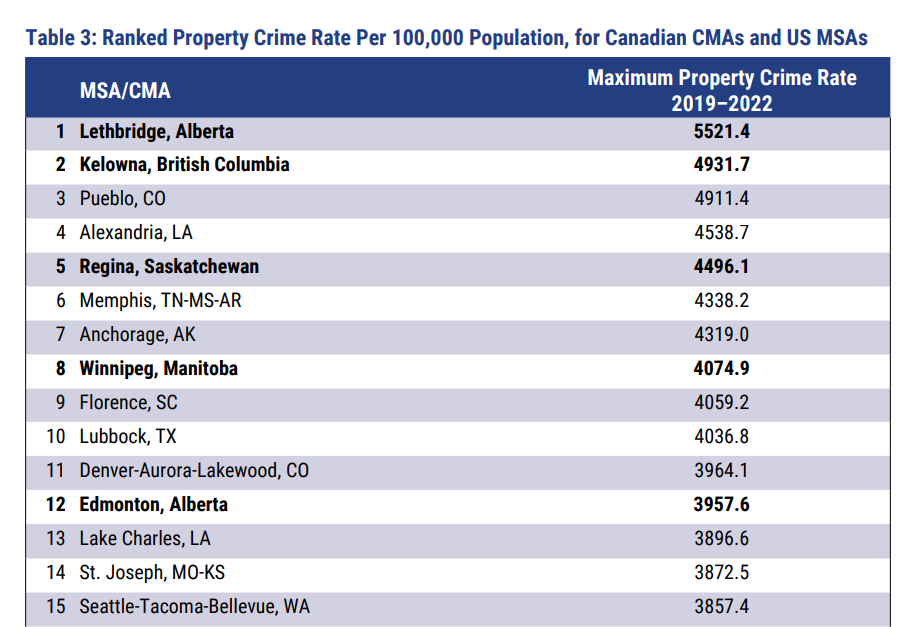
This is all according to
of U.S. and Canadian crime rates compiled by the Fraser Institute.
Researcher Livio Di Matteo took city-specific crime data from Statistics Canada and the FBI and compared it across the 18 years from 2004 to 2022.
When Di Matteo compared rates of “average annual property crimes” across metropolitan areas, he found that Canada was now in the lead after years of trailing the U.S.
An introduction framed the figures as a check on the notion that Canada is “a peaceable kingdom marked by less crime.”
An infographic accompanying the report highlights that of the 86 U.S. and Canadian cities surrounding the Great Lakes, it’s Canada’s that have the worst rates of property crime.
Thunder Bay and London, Ont. were the two worst-ranked cities of the 86. And the property crime stats for Windsor, Ont., were higher than for Detroit, located just across the river.
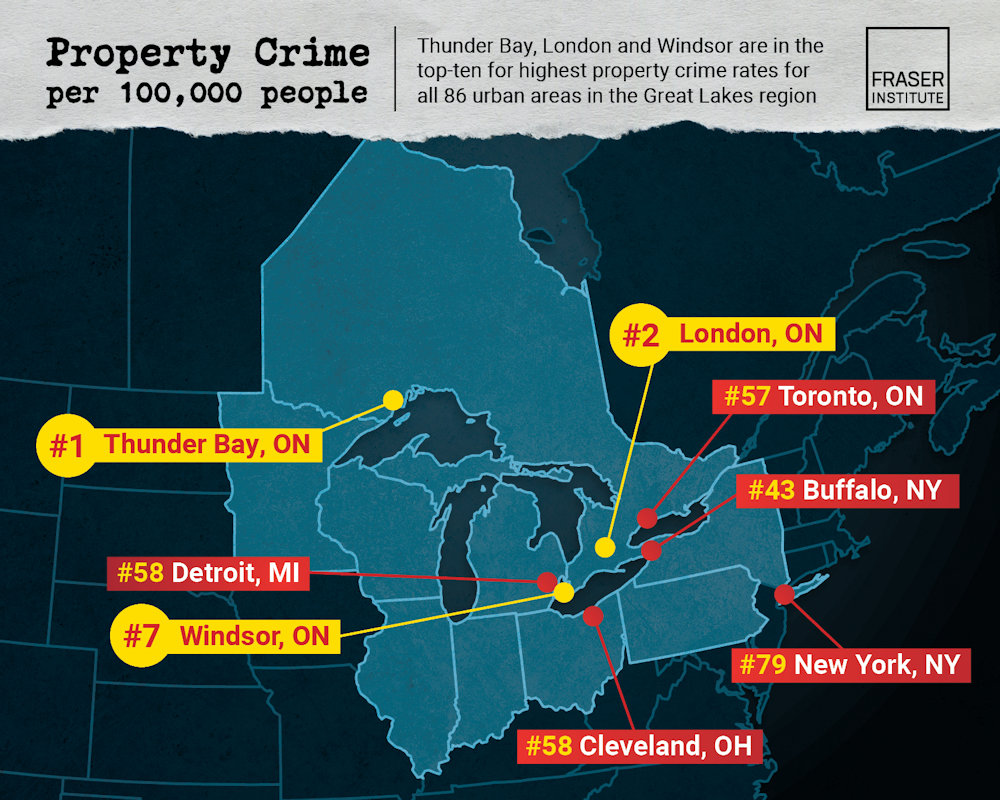
In a news release, the Fraser Institute wrote that the average Torontonian is now more likely to be a victim of property crime than the average New Yorker.
The report warns that comparing U.S. and Canadian crime rates is an imperfect science, in part because of the two countries’ differing views of what constitutes a crime.
As one example, Canadian law adopts a broad definition of sexual assault that creates a single category for “any unwanted sexual act.” In the U.S., meanwhile, sex crimes are still stratified into specific categories such as
.
The two countries also can’t be compared in terms of “crime severity.” Since 2009, Canada’s leading crime metric
has been the Crime Severity Index
, a tool that not only measures the quantity of crimes committed in a given year, but also tries to weight them in terms of relative damage or societal impact. The U.S., though, has no such metric.
As such, the Fraser Institute report had to work with raw figures of police-reported crime, differentiated only by whether a crime was violent or non-violent.
The “comparability” of the two countries’ crime figures could be skewed by something as simple as police being more diligent in counting petty crime as compared to more serious offences. But Di Matteo wrote that it was still an acceptable way “to indicate overall crime patterns.”
And for most of the 2004-2022 period, the average Canadian city did indeed post lower rates of property crime than the average American city. These averages then became tied in 2020 and 2021, with Canada pulling ahead in 2022.
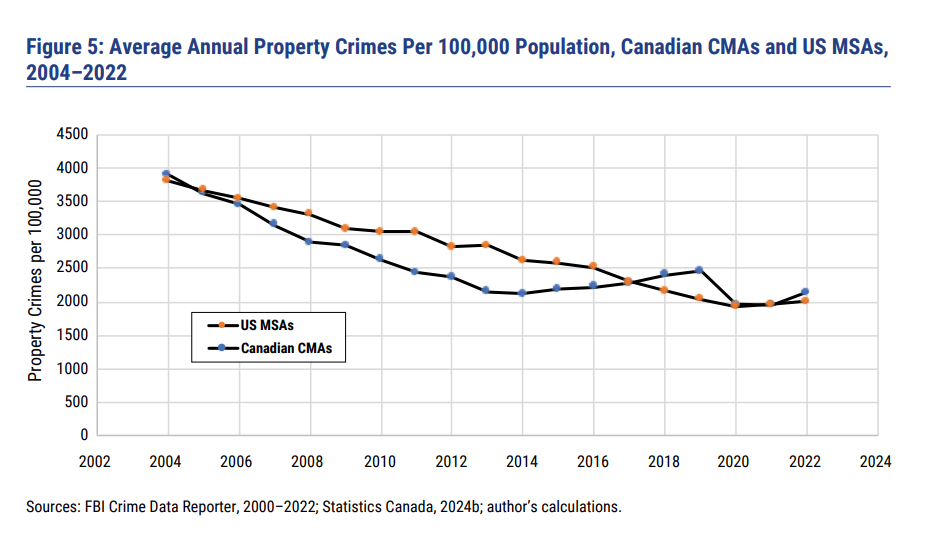
The year 2022 happens to be when Canada was seized by a number of unprecedented crime waves, including a wave of arsons against churches, and a massive spike in car thefts that would eventually cause Canada to be dubbed by the BBC as an “auto theft capital of the world.”
But while the average Canadian city-dweller might be more likely to get their car broken into, they still trail the United States in terms of being hurt or killed by crime. On the measure of “violent crimes per 100,000 population,” the Fraser Institute report found that while Canada has seen violent crime increase in recent years, the U.S. remains well in the lead.
This remains most dramatic in terms of homicide rate. Canada has a relatively consistent murder rate of two homicides for every 100,000 people. In recent years, the U.S. homicide rate has come close to nearly tripling that amount.
The Fraser Institute report was published on March 18, and was largely overlooked amid Mark Carney’s swearing-in as prime minister and the start of the 45th general election on March 23.
Last week, it was highlighted in a widely circulated social media post by Dubai-based influencer Mario Nawfal. “Canada’s biggest cities are now clocking higher property crime rates than the American metros most people think of first when they hear the word ‘crime,’” wrote Nawfal.
IN OTHER NEWS
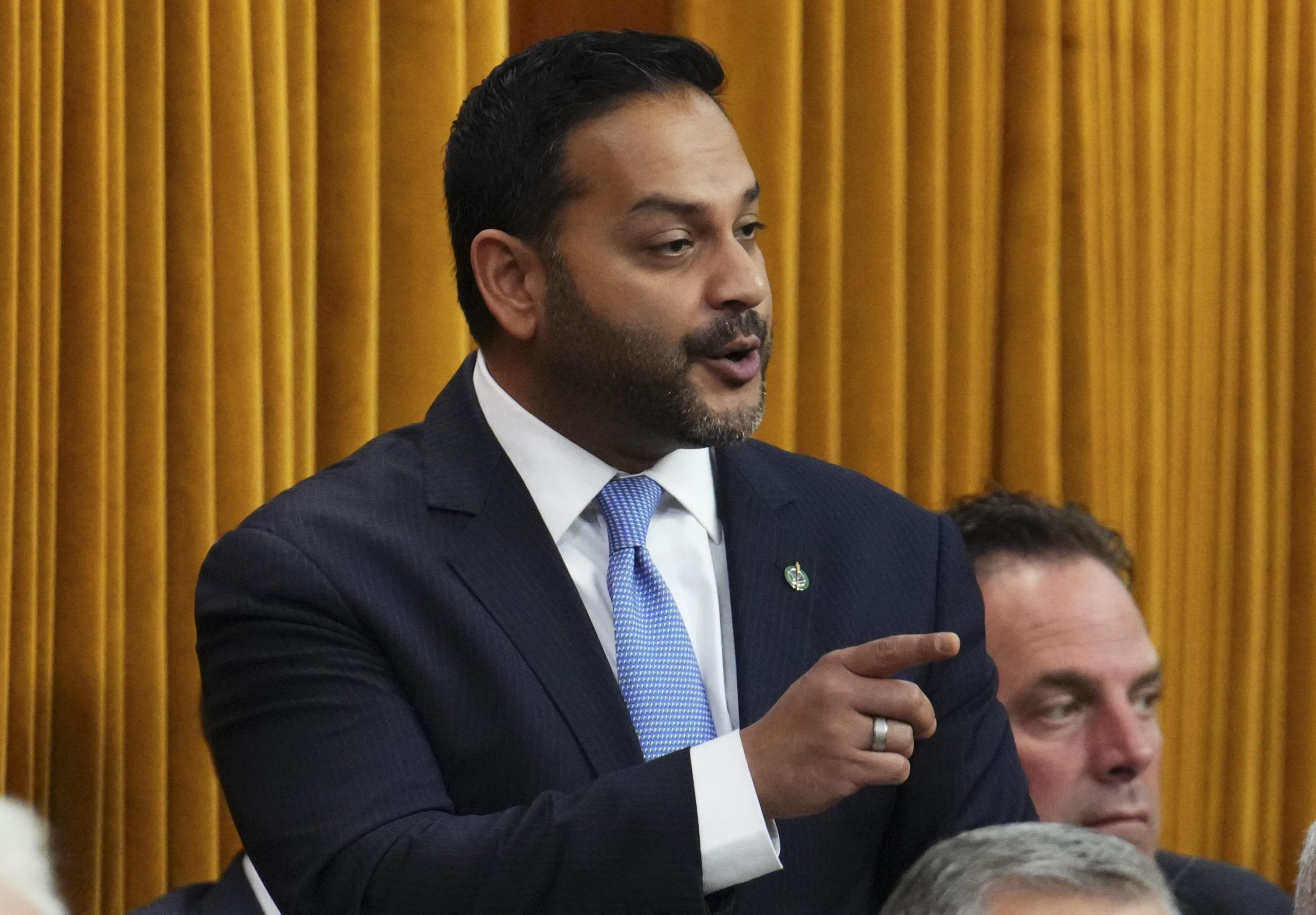
The NDP’s interim leader Don Davies has announced that his party
will vote “no” on accepting the terms of the Carney government’s throne speech
(Davies said it wasn’t “worker-centred” enough). Since the Liberals are governing as a minority, this means that either the Conservatives or the Bloc Québécois will have to vote “yes” on the speech,
lest the government fall on a confidence vote and Canada be plunged into another federal election.
The opposition could always weasel out of a decision by simply abstaining on the vote, given that polls are showing that any election would probably just deliver the same result as last time. But the whole exercise has illustrated that
Prime Minister Mark Carney’s grip on power may not be as strong as he’s indicated.
It was only two weeks ago that he was speaking of having a “mandate of change.”
And in the unlikely instance that the 45th parliament ends up dissolving almost immediately due to a procedural vote on the speech from the throne,
this will technically mean that we dragged King Charles III here for nothing.

Get all of these insights and more into your inbox by signing up for the First Reading newsletter.