


Have you heard the good news: our federal, provincial and territorial leaders all agree on the pressing need to build the critical infrastructure necessary to develop our natural resources, get them to market and turn Canada into an “energy superpower.”
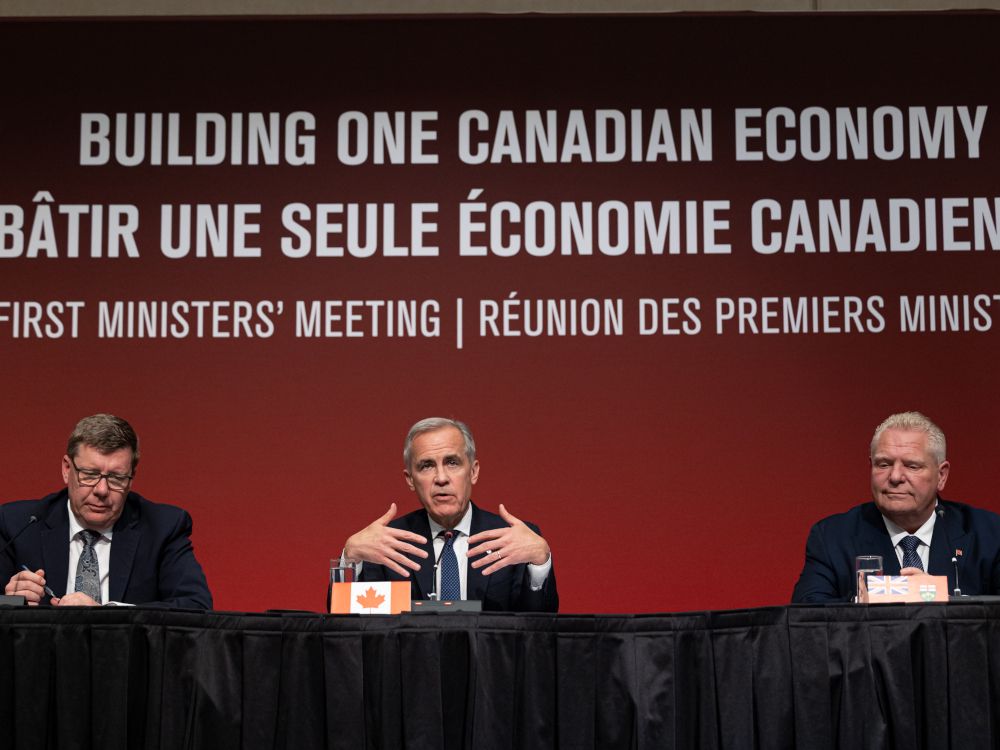
Yet despite all the optimism and goodwill expressed by Prime Minister Mark Carney and his provincial counterparts following the first ministers’ meeting in Saskatoon on Monday, it’s readily apparent that the seeds of disunity and obstructionism are already taking root.
At a
, the leaders made a point of highlighting that this is a “generational opportunity,” and that they are united in their quest to tear down internal trade barriers and build critical infrastructure.
“We are united. We’re going to move this country forward, the likes of which we’ve never seen before,” said Ontario Premier Doug Ford.
Saskatchewan Premier Scott Moe called this “a generational opportunity for Canadians,” while Manitoba’s Wab Kinew noted that it’s also a “generational opportunity for some of the poorest communities in our country.”
Even Alberta Premier Danielle Smith expressed cautious optimism that the process will bear fruit for her province.
But, as usual, the devil will be in the details, and Carney spent an inordinate amount of time going over all the fine print.
While he promised to work “with the provinces, the territories and Indigenous peoples to identify and expedite nation-building projects,” the catch is that they will have to be deemed to be “in the national interest” by the Liberal brain trust, along with provincial and Aboriginal leaders who represent a host of often competing interests throughout this geographically and culturally diverse country.
To be in the “national interest,” Carney said that prospective projects will have to “strengthen the Canadian economy, strengthen our autonomy, our resilience, our security, providing undeniable benefits to Canada, have a high likelihood of successful execution, be a high priority for Indigenous leaders and … drive Canada’s clean growth potential.”
Which pretty much gives politicians license to reject any project for any reason at all.
Premier Ford did express confidence in the prime minister’s ability to create the “environment and conditions for people to come here, companies to come here and invest,” which is exactly what we need.
But it’s hard to imagine too many businesses risking their time, energy and capital when they know their investment could be flushed down the drain if the mandarins in the Canadian politburo think it doesn’t meet Carney’s criteria of being “in the national interest,” having sufficient “Indigenous participation, advancing clean energy” and providing “material benefits to Canadians.”
These may be slightly different priorities than those contained within the Trudeau government’s
, which impedes major infrastructure projects by placing onerous requirements on developers, but they are vague and broad enough that they could be used to kibosh just about anything.
Part of the problem is that the first ministers have lumped private infrastructure developments, such as mines and pipelines, in with public works projects, like roads and bridges, when they should be evaluated on different criteria.
Of course private projects should have First Nations buy-in, meet environmental standards and have a high likelihood of success. But Indigenous participation should be limited to the bands that have legal title over the affected areas, not those that claim them as their “unceded,” “ancestral” or “traditional” lands.
Regulations should ensure that the natural environment isn’t being polluted and that reasonable measures are being taken to limit greenhouse gas emissions, but the extent of Carney’s commitment to pipelines was to say that there are “opportunities” for “
an
oil pipeline” (singular), but within “the broader context of national interest, the interest is in … decarbonized barrels” (whatever that means).
And saying that a project has a “high likelihood” of success should simply mean that a company thinks it’s economically viable without a government backstop, as the last thing we need is for our heavily indebted federal government to step in to buy another pipeline.
Requiring new infrastructure to be “strategic” and in the “national interest” should be reserved for public works projects built with taxpayer funds. Unfortunately, Carney is conflating private and public infrastructure, ensuring that governments will continue to centrally plan our economy, rather than unleashing the full potential of the free market.
And as we know from experience, when decisions such as these are made based on politics, rather than economics, everyone tries to get a piece of the pie.
Immediately following the first ministers’ meeting, Quebec Premier François Legault attempted to
over an east-west pipeline, with his office saying that, “Quebec would have to benefit if such a project were to move forward.” B.C. Premier David Eby has also
about the prospects of another pipeline to the West Coast in recent weeks.
These two provinces have long stood in the way of getting Alberta bitumen to tidewater, and if Carney can’t convince them to get past their banana republic mindset, it will likely limit future pipelines to the Port of Churchill or the Far North, which present their own set of challenges.
Meanwhile, the war drums of Indigenous opposition are already being heard. Late last week, Assembly of First Nations National Chief Cindy Woodhouse Nepinak
that “free, prior and informed consent” be given by First Nations before infrastructure projects can go ahead, while threatening “conflict and protracted litigation” if it’s not.
And on Monday, the Federation of Sovereign Indigenous Nations
that it wasn’t given sufficient representation at the first ministers’ meeting, while demanding that the federal government repeal the
natural resources transfer acts
of 1930, which gave Alberta, Saskatchewan and Manitoba control of their resources, as the Constitution intended.
If there’s one thing practically everyone seems to agree on it’s that the status quo is unsustainable and Canada needs to take steps to improve its economy. But at the moment, Carney seems to be falling into the classic Canadian trap, in which idealism stands in the way of progress and attempts to satisfy competing interests ensure that nothing of significance ever gets built.
I sincerely hope the prime minister is able to harness this moment to overcome these challenges, but the fissures we’re already seeing between the premiers, Indigenous leaders and other special interests will only widen in the months and years to come.
Unless Carney is able to narrowly define the national interest as anything that’s good for the Canadian economy — a rising tide, after all, lifts all boats — and uses his bully pulpit to prevent other levels of government from standing in the way of what needs to be done, very little is likely to change.
National Post
jkline@postmedia.com

