



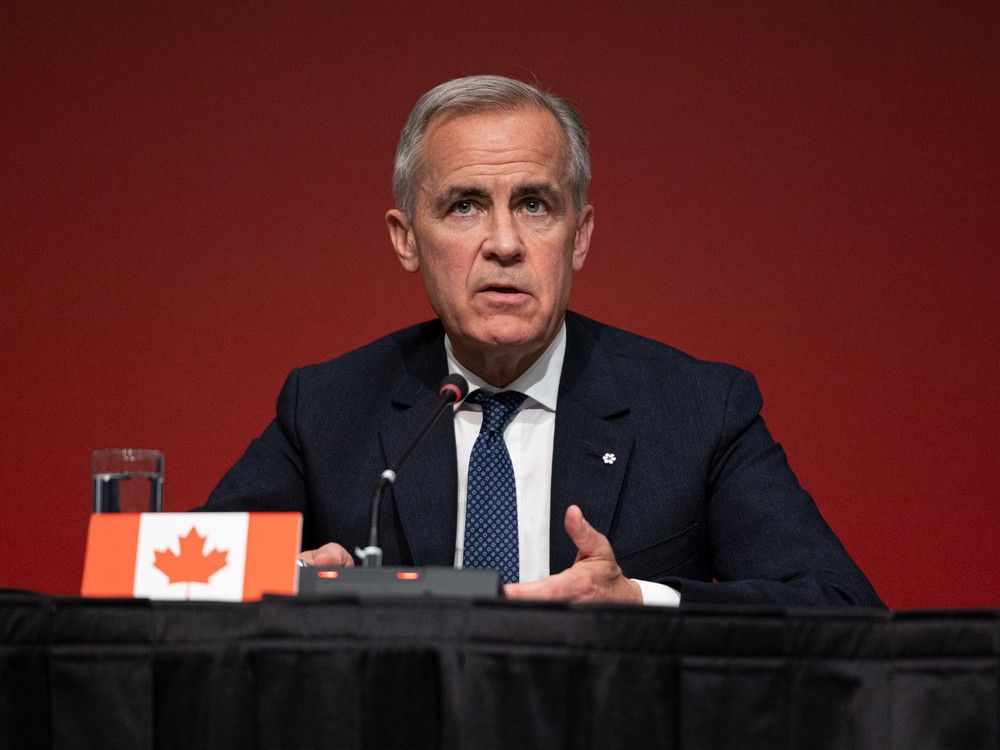
The parade of premiers complimenting Mark Carney before and after the first ministers meeting in Saskatoon made for a curious spectacle.
These events have tended to leave prime ministers looking like Oliver Twist handing over stolen goods to a roomful of Fagins and Artful Dodgers.
Yet this time the mood reflected what one senior Alberta official called “a special moment”: more about seizing a potentially transformative opportunity than squeezing the federal government for the maximum number of taxpayers’ dollars.
Ontario Premier Doug Ford said the meeting was “all about Team Canada, about telling the world that Canada is open for business, so come and invest.”
Ford said it was the best first ministers meeting in 10 years. “I’m very, very confident there’s hope,” he said.
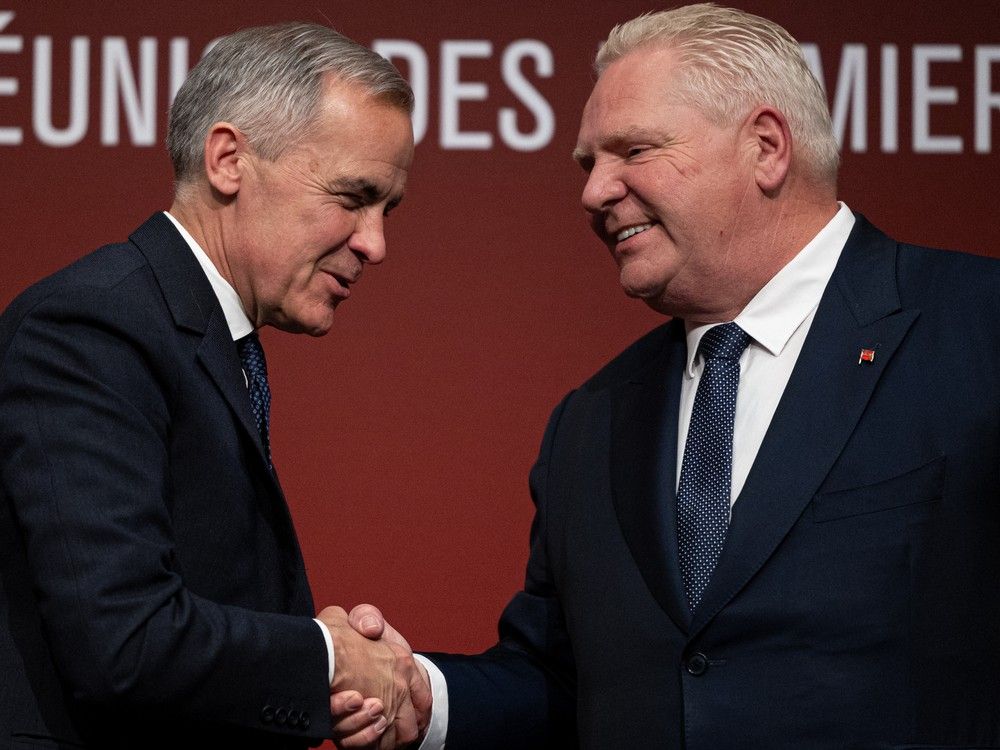
The gathering did not produce a definitive list of projects that will receive fast-track federal approval, but the Ontario premier said there was no expectation that it would.
Manitoba’s Premier Wab Kinew said he will remain positive, even if his province’s proposals do not appear on the list of national projects to be fast-tracked.
“This is Team Canada. It doesn’t matter if you’re there for the puck drop or if you’re killing penalties. At the end of the day, everyone’s going to have their time on the ice and everyone is going to have a role in building up this great country,” he said.
Scott Moe, the Saskatchewan premier, said he is in agreement with Carney’s aspirational targets — making Canada the strongest economy in the G7 and building the country into a global energy superpower — but that words will have to be matched with action. He called the project-selection process “a generational opportunity for Canadians.”
That would require a regulatory shift to remove barriers to investment, but Moe acknowledged that the federal government is talking about introducing legislation that would circumvent the Impact Assessment Act (the former Bill C-69) that many blame for blocking projects.
Even Alberta Premier Danielle Smith, often an outlier among first ministers, said there seems to be an appetite for building pipelines to get oil to markets other than the United States. She said she was “encouraged by the change of tone” evident in Saskatoon.
She reportedly sent Carney a letter last month saying an oil pipeline has to be on the prime minister’s list of “nation-building” projects to be fast-tracked, or it will send an “unwelcome” signal to investors and Albertans concerned about Ottawa’s commitment to national unity.
Carney said there is “real potential” to move forward on pipelines full of “decarbonized” bitumen.
Smith said that decarbonization could be achieved using carbon-capture technology, but that
the Pathways project being proposed by oil sands companies
to do just that was a big-ticket item. Estimates are $10 to 20 billion.
However, she said a million-barrel-a-day pipeline to the northwest coast of British Columbia would generate $20 billion a year in revenue.
“It would be a good value proposition if both projects could proceed at once,” Smith said. “Let’s call it a grand bargain.”
Nobody is holding hands and singing Kumbaya.
B.C. Premier Dave
Eby remains opposed to ending the moratorium on tanker traffic off his province’s northern coast
.
One Albertan official said his federal counterparts are “oozing sincerity,” but absent an unequivocal public declaration that overhauls the regulatory regime, industry will not invest in engineering and designs of new projects.
“Past Liberals created this mess; these Liberals don’t want to take advantage of this special moment and make changes,” he said. “There are discussions, but so far, no compromises. It’s early, but not as promising as it could be.”
Still, we are a long way from the days in mid-January, after prime minister Justin Trudeau’s resignation and just before President Donald Trump’s inauguration, when it truly felt that Canada was drifting rudderless towards the falls.
Maybe a more accurate analogy would be the eve of the fall of Saigon. Federal ministers were more focused on their re-election prospects and the Liberal leadership contest than the threat of a trade war, while the bureaucracy downed tools in preparation for a new government.
The lack of a sense of collective mission was apparent in a communiqué from the premiers in January saying they would ensure a robust response to Trump’s tariff threats —a
document Danielle Smith refused to sign
.

Trump’s modus vivendi — dividing and conquering — was working and there were worries that the centre might not hold.
Five months on, Canada is in a much better place and voters have noticed.
A
suggests two out of three voters approve of the way the federal government is handling its responsibilities, even though current voting intentions remain similar to where they were on election day.
Nearly four in 10 right-of-centre voters agree the government is performing well, as does a small majority of Albertans.
The main reason seems to be personal approval for Mark Carney as prime minister, with voters judging him intelligent, hard-working and likeable. Carney seems to have convinced even many Conservatives that he is in politics for the right reasons, despite being pilloried as being a tax cheat, a radical leftist and an elitist during the election.
Bruce Anderson, Spark’s chairman and a Carney supporter, suggested Canada has become less polarized than many might assume.
“Voters generally won’t dig into the substance of policy choices but they are as astute as hell when it comes to knowing what a clear vision, empathy and honesty looks and sounds like,”
But it goes beyond a recognition of likeability. I would argue the bipartisan support for the government’s performance is a collective realization that Canada once again has a serious, grown-up government.
Unlike its predecessor, its priorities are almost exclusively economic, not social; its focus is on stability, not its perception of morality; and it is policy-driven, not politically driven.
A good example of this more seasoned approach is the appointment of Marc-André Blanchard, Canada’s former ambassador to the United Nations, as Carney’s chief of staff. It was a move that was hailed on social media by former Harper-era ministers,
and
.
Blanchard has
his critics for positions taken at the UN
or when he was in business, but few doubt his competence.
He has also articulated the role of modern government better than most.
In a speech to the Public Policy Forum in April, he said the breakthroughs that shape the next generation will be made when public and private sectors truly collaborate.
He acknowledged that the distance between ideals and actions has never been so radically exposed as now, and conceded that citizens need to see better results from their institutions.
He concluded that engagement must be built on trust and there is no shortcut to that happy destination.
“There is only steady, honest, uncelebrated work of listening; of engaging with people who disagree with us; not thinking we know better; of standing in someone else’s shoes; of doing the right thing.
“And the right thing is often not theoretical perfection but a good, old-fashioned Canadian compromise, even when it’s hard,” he said.
At the end of the first ministers meeting, Carney said Ottawa will now refine the list of projects over the summer. They will be judged against the benchmark criteria: whether they bring the country together; make it more resilient; diversify its markets; and have a good prospect of Indigenous partnership.
The new prime minister has already built a new relationship with the premiers.
It’s a promising start. But to justify that trust, he will need to make the most of this “special moment” and deliver results.
National Post
Get more
deep-dive
National Post political coverage and analysis in your inbox with the Political Hack newsletter, where Ottawa bureau chief Stuart Thomson and political analyst Tasha Kheiriddin get at what’s really going on behind the scenes on Parliament Hill every Wednesday and Friday, exclusively for subscribers. Sign up here.

