



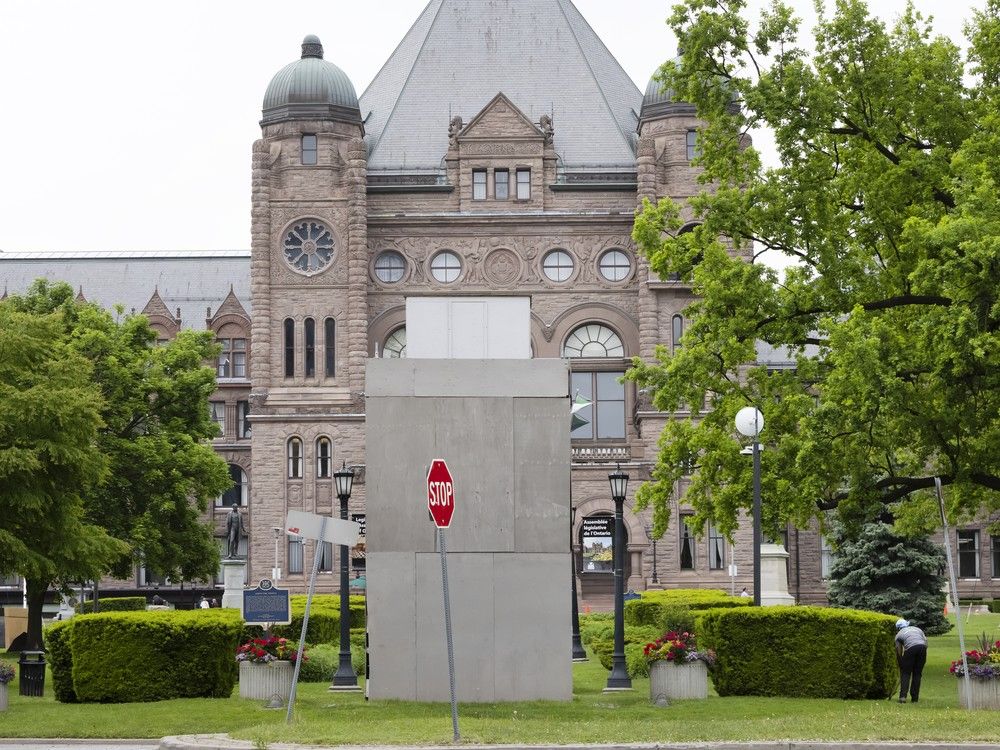
All eyes will be on Toronto later this summer — or they should be, because it could be darkly hilarious. That’s when Queen’s Park undertakes a bold, interdisciplinary experiment in Canadian history, policing and law: The province is going to let Sir John A. Macdonald’s statue out of the plywood prison it has inhabited for five years. The monument had been restored after previous vandalism, only to find itself in a box to prevent future vandalism.
It is possible,
as National Post’s Tristin Hopper argued this week
, that we may be seeing the end of “Canada’s nationwide purge of historic figures and names” — at least by governments themselves. That’d be nice. But has anyone asked the yobbos who vandalize and tear down statues if they’re done with the purge?
“How are you going to stop the same thing from happening all over again?” was among the questions reporters asked of the people in charge. The answer wasn’t entirely convincing.
“Legislative security will be keeping a close eye on it,”
, based on speaker of the legislature Donna Skelly’s remarks. Legislative security and the Ontario Provincial Police, who patrol the legislature grounds (with assistance from the Toronto Police Service), had better be keeping a close eye on it, because Skelly even invited the Macdonald-haters to come to the as-yet-unscheduled unveiling.
“People have the right to protest here. As long as no one is hurt, and you don’t break the rules or the law, you’re welcome,” said Skelly (a Progressive Conservative MPP), before taking it even further: “This is where you should be protesting.”

So, maybe that’s not where to go for Canada Day.
Of course, it’s unlikely anyone would try to splatter, behead or topple Macdonald during an official event. So one hopes the Queen’s Park security aces at least have a camera or two trained on the statue, if not to actually prevent any vandalism then at least to apprehend and charge the offenders.
But then, this is a city where a certain traffic speed-enforcement camera
has been taken down five times by vandals in six months
— and in one case, subsequently thrown in a pond — and apparently no one has thought to install a camera that might record people doing it. We are not imaginative people.
Montreal police never found the gang that beheaded Macdonald’s statue in Place du Canada in 2020;
instead, the city just decided not to reinstall it
, since it was constantly getting vandalized. Problem solved! Why waste police time over some old dead bronze guy?
In 2021, something calling itself
an Indigenous Unity Rally hauled down the statue of Macdonald
in Gore Park in Hamilton, Ont.
City police investigated in earnest
, by the sounds of it, and laid charges against a 56-year-old suspect. Then, prosecutors stayed the charges.
In 2020,
Toronto Police charged three people
alleging they defaced statues of both Macdonald and Egerton Ryerson, the public-education pioneer in Upper Canada
whose legacy has been dragged through a pigsty by morons
. Those charges were all dropped.
Indeed, as we have seen since the Oct. 7, 2023 terrorist attack on Israel,
Crown prosecutors seem distinctly uninterested in prosecuting
overzealous protest. It’s not to their credit, but it’s perhaps understandable why other cities,
,
Kingston, Ont.
and (of all places) Charlottetown
— where Macdonald, George-Étienne Cartier and some other nation-building heavyweights
gathered in 1864 to talk Confederation
— just removed their statues pre-emptively. Who needs the headache?
Statue-protection is a great example of how over-focused the Canadian law-and-order discussion is on the federal level. Especially when we’re talking about the grounds of a legislature, or facilities under the control of the National Capital Commission in Ottawa, you need co-operation among multiple police forces and jurisdictions just to get someone in the back of a squad car.
Then you need the Crown prosecutor’s office, which answers to the provincial attorney general, to be interested in pursuing charges. You need judges and juries to be in interested in convicting them. You need sentences that would at least provide
some
kind of theoretical deterrent — and for that you need the federal government to write good laws, and you need Crown prosecutors to be willing to read sentencing ranges with an eye toward the higher end.
As someone inculcated in the idea of an “adversarial justice system,” I find it remarkable to read often about the Crown and defence
agreeing
on sentencing provisions. This is usually in the context of securing a guilty plea and avoiding a trial, of course — for better or worse. Sometimes, though, there’s a judge willing to call it out. When the Crown and defence recently jointly requested a 120-day sentence for a man convicted of attempting to disarm a police officer, assaulting said police officer, breaking and entering, and fraud under $5,000, Justice Angela L. McLeod of the Ontario Court of Justice
last month waved the idea away like a bee
.
Quoting a 2016 Supreme Court decision
, McLeod described the sentence “so unhinged from the circumstances of the offence and the offender that its acceptance would lead reasonable and informed persons, aware of all the relevant circumstances … to believe that the proper functioning of the justice system had broken down.” McLeod sentenced the guy to 300 days instead. (She is a former criminal defence lawyer, incidentally.)
Goodness knows statue abuse isn’t among Canada’s greatest problems. But statue abuse is emblematic of bigger problems. We need more of McLeod’s instincts, as illustrated there. We need the government in Ottawa to recognize that there are people on the street who have proven over and over and over again they should not be allowed the street, and yet courts can hardly keep track of how many things they’re out on bail or parole for.
In its throne speech Tuesday, the federal Liberal government recommitted to making bail harder to attain for repeat criminals. It’s a critical step. We’ll see how serious they are about that. But the real seriousness has to come, equally, much further down the chain of command.
National Post
cselley@postmedia.com
Get more deep-dive National Post political coverage and analysis in your inbox with the Political Hack newsletter, where Ottawa bureau chief Stuart Thomson and political analyst Tasha
Kheiriddin
get at what’s really going on behind the scenes on Parliament Hill every Wednesday and Friday, exclusively for subscribers. Sign up here.

