




First Reading is a Canadian politics newsletter curated by the National Post’s own Tristin Hopper. To get an early version sent directly to your inbox, sign up here.
TOP STORY
Just as the Canadian Union of Postal Workers mulls another strike, Canada Post released an annual report that is dripping with warnings of impending doom.
The word “insolvency” is mentioned 13 times. “Outdated” is mentioned 22 times, and “urgent” comes up 19 times. There are bolded sections warning that the “financial situation is unsustainable” and that “the future of the national postal system is at risk.” There are references to a “Great Mail Decline” that is bleeding the corporation white.
“A postal system built for 5.5 billion letters cannot survive on two billion letters,” reads a quote included in the report twice.
But the headline number is that the corporation racked up $1.3 billion in operational losses over the last fiscal year, and $4.5 billion in operational losses since 2018. Those are mammoth numbers for an institution that was turning a profit as recently as 2017.
Below, a quick summary of just how thoroughly Canada Post is hemorrhaging money.
It’s equivalent to losing 65 cents per letter
Canada Post delivered 6.4 billion individual pieces of mail over the last fiscal year; a category that includes letters, parcels and the reams of flyers colloquially referred to as “junk mail” (Canada Post calls it “direct mail”).
But Canada Post make special mention of letters, because the government requires so much of their corporate architecture to be oriented towards processing and delivering traditional letters. A theme of the report is that if they could just be freed from these mandates, they’d be better able to stop hemorrhaging money.
“We are still required to deliver a letter across the country within four days, largely by air at extra expense, where it will most likely sit in a community mailbox for days until the customer picks it up,” reads the report. In an introduction, the report even stresses that their most pressing financial problem isn’t their employees, but an “outdated delivery model and workplace rules.”
In 2024, Canada Post delivered just two billion letters, down from the “peak mail” of 5.5 billion letters delivered in 2006. So, if you take that $1.3 billion loss and divide it by every single letter delivered in 2024, that’s 65 cents per letter. For context, the current price of a standard letter stamp
, or $1.24 if purchased in a booklet.
It’s a loss of about $50,000 per mail carrier
The CUPW says it represents 55,000 postal workers in total, a category that includes everything from mail sorters to drivers. As for how many of them are specifically employed as letter carriers, the usually cited figure is 25,000. This
from a 2014 Canada Post report that said 25,000 workers were involved in the delivery side of their operations.
Canada Post, meanwhile, cites 62,000 employees, including part-time workers and managers.
If the $1.3 billion loss is averaged across all those 62,000 employees, that’s $20,967 each. If averaged just across CUPW members, it’s $23,636. And if you consider that Canada Post lost $1.3 billion in 2024 while maintaining 25,000 front-line mail carriers, it averages out to $52,000 per carrier.
It’s more than $200,000 per post office
The number of retail post offices in Canada stands at 5,700. This ranges from a post office counter at the back of a Shoppers Drug Mart to an ever-dwindling number of dedicated post offices, mostly in large urban centres.
Some of those are more profitable than others, but in 2024 Canada Post lost an average of $228,000 for every one of those retail post offices.
You could also average out the loss by the corporation’s vehicle fleet of 15,300. The 2024 loss averages out to $85,000 for every truck and postal van. In other words, with the money lost in 2024, Canada Post could have replaced every single one of its vehicle fleet with a luxury EV.
It’s a loss of $76 per address
The corporation notes multiple times in the report that even as mail delivery becomes increasingly unprofitable, they’re having to serve more addresses than ever before.
In 2006, there were 14.3 million recognized addresses in Canada. As of the latest count, there are 17.6 million – a total increase of 3.3 million. To put it another way, every day since 2006 has yielded an average of 502 new addresses that have to be serviced by Canada Post. Every three minutes yields another address that Canada Post is legally required to service.
If last year’s operating loss was shared equally across all of those 17.6 million addresses, Canada Post lost $76 for every single one of them. If averaged out across the 21,800 delivery routes served by the corporation, it’s a loss of $60,000 per route.
IN OTHER NEWS
Although the Carney government has controversially planned to not release a budget until the fall,
that doesn’t mean they won’t be spending incredibly high quantities of money in the interim.
The just-released main spending estimates show that the Liberals are planning to spend $486.9 billion across the fiscal year. This is 7.75 per cent higher than the expenditures during the last year of Prime Minister Justin Trudeau – and he ultimately resigned in part due to criticisms that
. The National Post’s John Ivison noted that whatever Prime Minister Mark Carney’s rhetoric about fiscal prudence,
more money is being spent everywhere, and on everything
. “My rough calculation is that 63 departments will see their budgets rise beyond the rate of inflation, compared to the previous year’s Main Estimates, and only 14 will have their budgets cut,” he wrote.
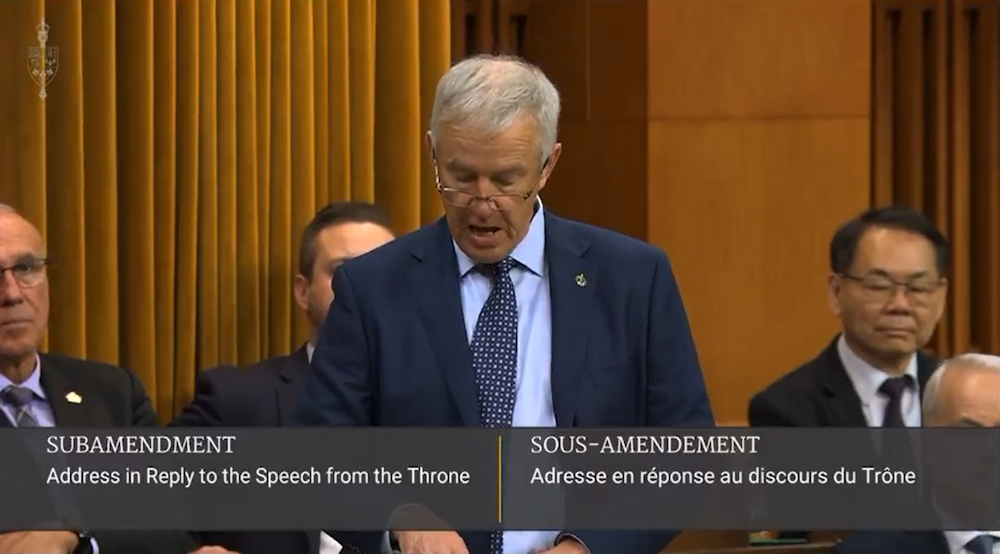
There was a brief flurry of drama in the United States this week that could have saved Canada a lot of trouble.
On Wednesday, the United States’ Court of International Trade ruled that U.S. President Donald Trump
did not have unilateral authority to impose international trade tariffs
. If the ruling had held, it would have instantaneously ended the Trump trade war with Canada — as well as its on-again, off-again trade war with basically everyone else. But it didn’t hold; the United States Court of Appeals restored Trump’s unilateral tariff powers the next day. And this is where we should mention that the U.S. Congress could rescind Trump’s tariff-making powers anytime it wants. It
.
Get all of these insights and more into your inbox by signing up for the First Reading newsletter.

