



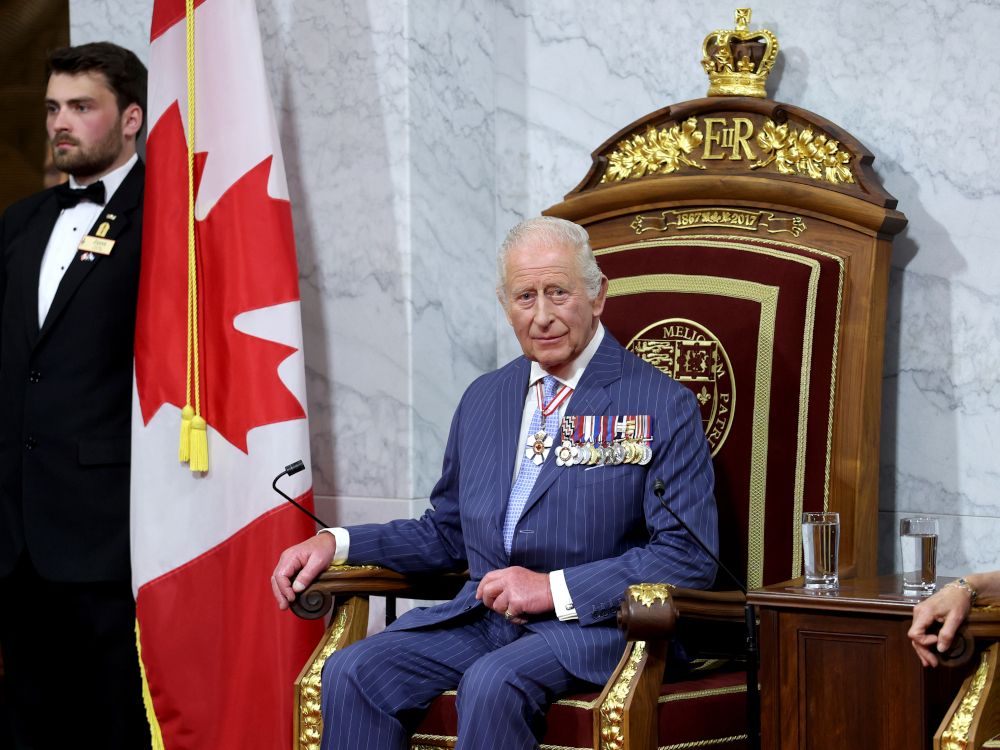
King Charles III successfully walked a diplomatic tightrope Tuesday morning, delivering the first
from a monarch since 1977 on his first official visit to Canada since his ascension. But for Prime Minister Mark Carney, the hard part is just beginning.
In the lead-up to Tuesday’s throne speech, the
and
were filled with stories about the competing interests that would be dissecting the King’s speech, trying to decipher hidden messages within.
Alberta Premier
a clear indication that the federal government is going to reverse course after a decade of trying to suppress the oil and gas industry.
Canadians wanted to know that the monarchy would have our backs in a time of crisis, while sources within the British government expressed concern that Ottawa may put words in the King’s mouth that would anger the orange bear to the south, hindering a relationship that U.K. Prime Minister Keir Starmer has desperately been trying to cultivate.
In the end, the “tightrope” King Charles was asked to walk proved to be no problem for a skilled diplomat such as himself. Throughout his speech, Charles made numerous references to Canada’s proud history, its sovereignty and its deep ties to the Crown, but refrained from making incendiary comments about the American president.
Following the now perfunctory land acknowledgement, the King referenced Canada’s efforts during the Second World War. He noted that in the nearly 70 years since Queen Elizabeth II first opened Parliament in 1957, Canada has patriated its Constitution and achieved “full independence.”
He talked about how the “Crown has for so long been a symbol of unity for Canada,” how it “represents stability and continuity from the past to the present,” and how it continues to stand “proudly as a symbol of Canada today.”
He acknowledged that Canada is now facing a “critical moment,” in which the “system of open global trade” and “Canada’s relationship with partners” is changing, and that we’re living in a “more dangerous and uncertain world” full of “challenges that are unprecedented in our lifetimes.”
And in clear recognition of our souring relationship with the United States, the King assured us that, “Canadians can give themselves far more than any foreign power on any continent can ever take away.”
Fears that the Sovereign would take a campaign-style swipe at U.S. President Donald Trump were always unfounded. As Prime Minister
when he visited the White House at the beginning of the month, and as Starmer has done in his dealings with Trump, the King emphasized that the bilateral relationship between Canada and the U.S. will continue to be “rooted in mutual respect and founded on common interests.”
Following a lengthy introduction that struck the right balance between upholding Canadian sovereignty and appeasing competing diplomatic interests, King Charles laid out the government’s agenda for the 45th Parliament.
In some respects, it was a breath of fresh air, as it offered more specific policy proposals than the typical Liberal throne speech, which are generally full of lofty goals but short on details. Yet the government’s agenda is ambitious and wide-ranging, and some of its plans seem to have been left intentionally vague.
There were promises to “introduce legislation to remove all remaining federal barriers to internal trade and labour mobility by Canada Day,” tighten border security, restore “balance” to the immigration system, rebuild the Canadian Armed Forces and “double the rate of home building.”
The government committed to work with the provinces to create a “one project, one review” system for new infrastructure developments within six months. It promised to remove “barriers that have held back our economy,” unleashing “a new era of growth that will ensure we don’t just survive ongoing trade wars, but emerge from them stronger than ever.” And in a clear break from the Trudeau era, it pledged that Canada will become “the world’s leading energy superpower in both clean and conventional energy.”
There was a lot in the throne speech that even conservatives should be able to get behind, but how many of the government’s goals will be realized remains an open question. Phrases such as “speed is of the essence” and assurances that the “government will be guided by a new fiscal discipline” already ring hollow given all the big-ticket promises the Liberals have made and the fact that after a short, three-week spring session, parliamentarians will take an
. They won’t get down to the business of passing legislation or tabling a budget until the fall.
And the Liberals don’t exactly have a great track record when it comes to meeting the goals laid out in a throne speech. After the 2021 election, Governor General Mary Simon spent a lot of time
reconciliation, growing the economy, fighting climate change, strengthening our health-care system, making communities safer, reducing the cost of living, building housing and spending wisely.
If these priorities sound familiar, it’s because Canada faces many of the same problems today. Though the context has shifted from pandemic recovery to dealing with Trump’s trade war, many of the government’s priorities remain the same, as the Liberals completely failed to fix the vast majority of problems they set out to address three and a half years ago.
Despite pledging to build “more housing units per year” and end “chronic homelessness,”
actually decreased 11.4 per cent between 2021 and 2024, while the number of people
skyrocketed. Despite all the carbon taxes and emissions caps, greenhouse gas
.
Despite promising to combat “hate and racism” and make our streets safer, antisemitic incidents jumped 122 per cent between
and
, according to B’nai Brith Canada, while the
and
both increased between 2021 and 2023.
Meanwhile, reconciliation is still a pipe dream and affordability is still a pressing concern. Inflation
from 3.4 per cent in 2021 to 6.8 per cent in 2022, before falling to 2.4 per cent in 2024. The
nearly
. And the average time it takes to receive treatment after getting a referral from a doctor rose to
in 2024, from
, according to the Fraser Institute.
In other words, by virtually every measure, the Liberals utterly failed at almost everything they set out to do.
Getting the King to come to Canada to assert our sovereignty and assure Canadians that the monarchy has their backs was nothing short of a coup for Carney, and Charles adeptly performed his duties. But now comes the hard part for the prime minister: succeeding where the previous government, which was largely made up of the same cast of characters, did not. Of this, Canadians would be right to be skeptical.
National Post
jkline@postmedia.com

