


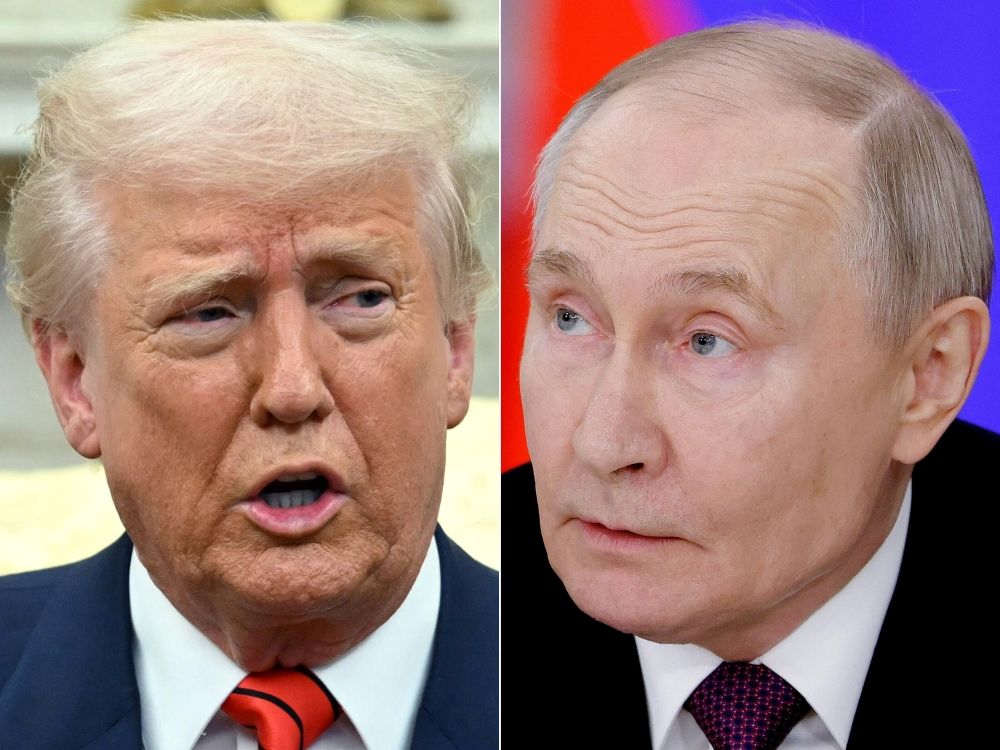
U.S. President Donald Trump
that Russia and Ukraine will “immediately” begin ceasefire talks after he had an “excellent”
with Russian President Vladimir Putin. This is not a positive development: Putin is playing Trump for a fool and has no interest in these Potemkin negotiations beyond undermining European-led sanctions.
From the outset of this war, it has been clear that Moscow’s idea of “peace” amounts to the dismantlement of Ukraine’s sovereignty and national identity.
Putin has steadfastly insisted —
for three long years
— that the war cannot end until its “root causes” are addressed, which is code for the installation of a
pro-Russian puppet regime in Kyiv. He has
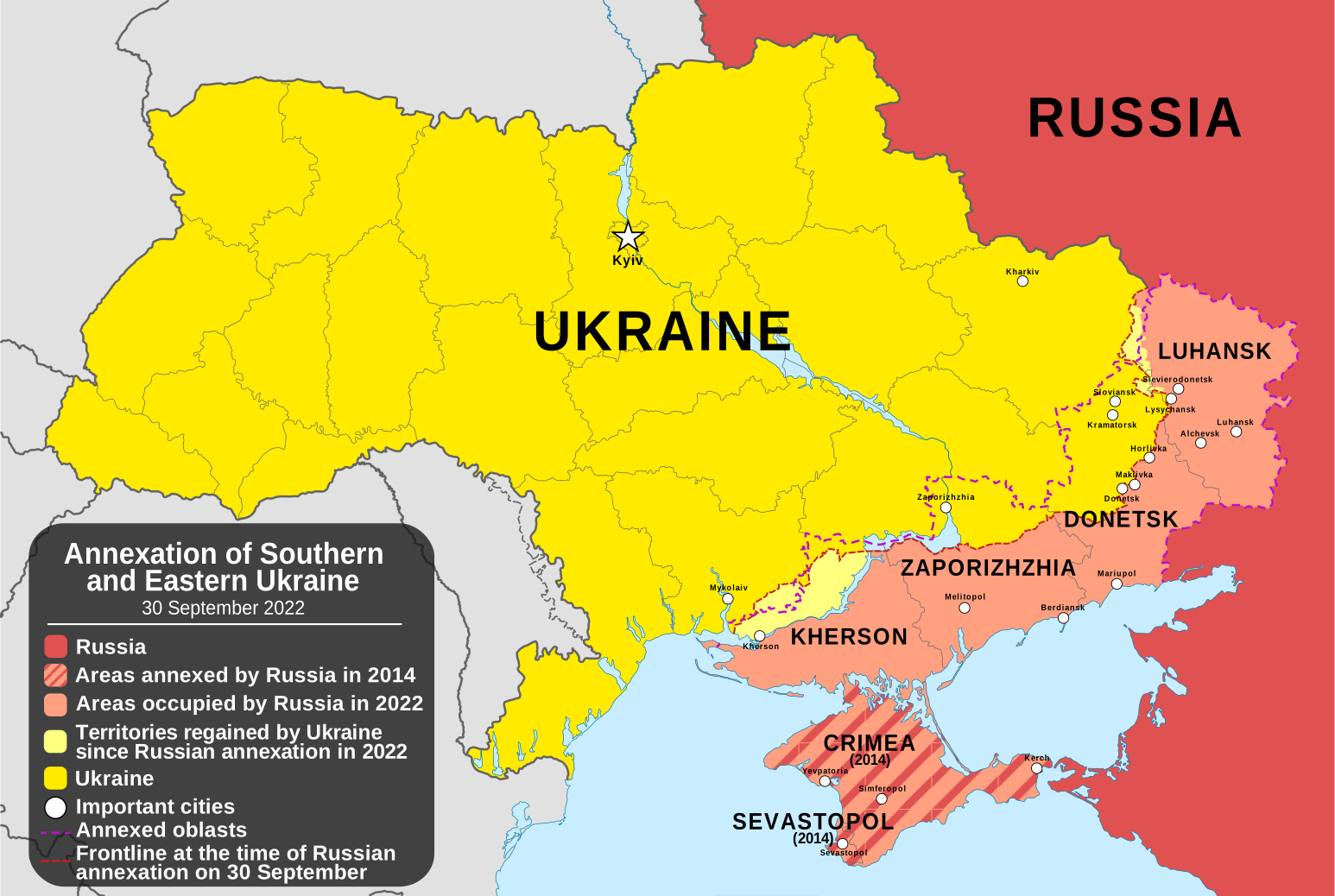
that Ukraine withdraw its troops from the four Ukrainian provinces Moscow “annexed” in late 2022, which Russian forces have managed to only partially occupy so far.
These provinces include
of territory west of the Dnipro River, a natural defensive barrier that has been crucial for containing Russia’s advances. Handing over these lands would not only condemn millions of additional Ukrainians to occupation, it would also give Moscow a bridgehead for the conquest of central Ukraine.
Regime change, sweeping land concessions and asymmetrical disarmament are not conditions of peace, but surrender. A precursor to full annexation, not co-existence. As long as Russia refuses to budge here, any negotiations to end the war will be an exercise in futility.
Putin must change his approach, but formidable ideological, political and economic factors dissuade him from doing so.
In the summer of 2021, just months before launching his full-scale invasion, he published a
arguing that Ukrainians are merely wayward Russians who must be reunited with their eastern “big brother.” Although this narrative is
rife with historical revisionism
, he seems to ardently believe it: the war is a righteous crusade for him, and crusaders are not easily discouraged.
Atop this moral dimension, Putin’s
arguably depends on the successful prosecution of this war. Should he deliver compromises instead of victories, there is a significant risk that he will be overthrown and potentially executed — something which the
Wagner Group’s uprising of 2023
illustrated well.
But even ending the war on relatively favourable terms could be dangerous.
Profligate wartime spending has created the
illusion of a Russian economic boom
, but, as with any government stimulus spree, the hangover eventually arrives. Russia’s economy is
, thanks to
high inflation and elevated interest rates
. Ending hostilities and abruptly terminating the associated public expenditures could trigger short-term stagnation or even a recession, which could threaten the legitimacy of Putin’s regime.
Russian officials also
that demobilizing hundreds of thousands of troops could lead to a wave of political instability, as happened in the Soviet Union following the 1989 withdrawal from Afghanistan. Russian veterans returning from Ukraine
a proclivity for violence and crime in their home communities — viciousness begets viciousness, it seems. If that aggression were to be multiplied, and funnelled into anti-government civil society groups, the consequences could be dire.
Because of these factors, security experts believe that Putin
until no other options are available. He must be bullied into compromise. Until that point is reached, Russia’s negotiations should be understood as a game of manipulation: delay, obfuscate, confuse, divide.
That’s why, earlier this month, Ukraine’s main European allies (the United Kingdom, France, Germany and Poland)
to the Kremlin: accept an unconditional 30-day ceasefire on May 12, followed by serious peace negotiations, or face far tighter sanctions.
Putin didn’t like that. He has always maintained that a long-term ceasefire should come after a peace deal, not before. Why stop the fighting when you can just mire everyone in a diplomatic quagmire and
press your military advantages
? So he ignored the ceasefire proposal and suggested direct peace talks in Istanbul instead.
Ukraine and its allies saw this as a delaying technique, but were forced to play along after Trump voiced his support for the initiative. Although Ukrainian President Volodymyr Zelenskyy
and challenged him to a face-to-face meeting in Istanbul, Russia sent only a
that proceeded to sabotage the talks by
demanding that Ukraine hand over
its aforementioned, partially occupied provinces.
The Istanbul fiasco should have been a victory for Ukraine. It confirmed that Russia is engaging in bad faith and that sanctions should be tightened immediately. But then Trump had a two-hour, reportedly very friendly, talk with Putin and declared the beginning of new peace talks. This, of course, meant
— just as the
.
The White House claims that sanctions against Russia are
and may be implemented if Moscow doesn’t negotiate in good faith. It is hard to take this seriously, though, when Istanbul illustrated —
just last week!
— that this is already happening. Trump is apparently willing to give the Russians as many chances as possible, and limitless do-overs, to protect them from real accountability.
Worse yet, his administration has signalled that it
with the Russians, and that, if these new negotiations don’t succeed, the United States
from negotiations, which only gives Russia fewer reasons to seriously pursue peace.
Trump’s naivety is prolonging this war, not ending it. His ignorance will cost the world dearly.
National Post