



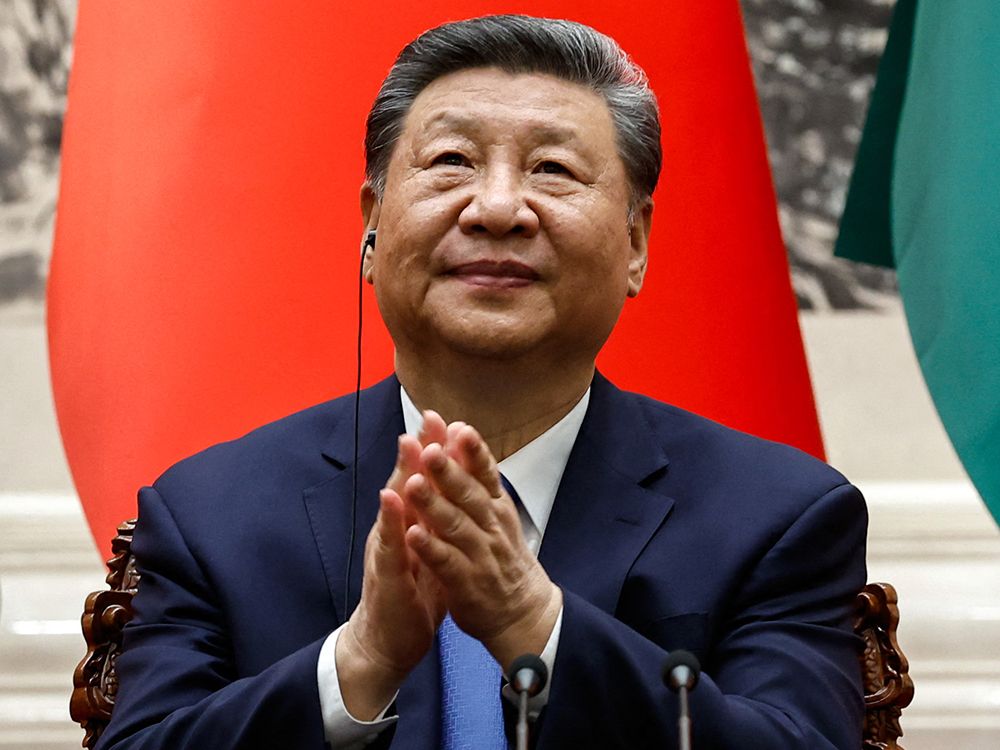
There was a curious, but telling, contrast of geopolitical images this week. While U.S. President Donald Trump was pursuing uber-opulence in Riyadh, traipsing along purple carpets, inspecting plans for glittering Saudi cities of the future and looking to collect the keys to the most decked-out private jet in history, his geopolitical opposite, China’s Xi Jinping, was speaking to the leaders of Latin America and the Caribbean in a very drab conference centre in Beijing.
It neatly sums up the continuing differences in geopolitical priorities between the two, and underlines a fundamental philosophical difference that will see strategic neglect on the part of this U.S. administration if it continues.
The fundamental priority for the U.S. in its competition with China should be to secure supply chains for the economies of the future. While high-tech billionaire and presidential adviser Elon Musk and OpenAI CEO Sam Altman were in tow with Trump on his Middle East shindig, doing deals for Saudi cash to buy U.S. computer chips (and weapons), Xi was quietly consolidating the supply side of the equation back in Beijing.
You can do all the deals for high-end product that you like, but if you haven’t got the ingredients to make the products, then you haven’t got a product.
The ingredients for semiconductor chips — the building blocks of the world’s technological future — are dependent upon two things: critical minerals and Rare Earth Elements (REE), and the processing capacity to refine them. The second part is an even bigger challenge than the first.
China currently has the entire global market in critical minerals and REE sewn up, and while the U.S. might feel great as it consolidates wealth in palaces in the desert, its Chinese rival is quietly strengthening its strategic base.
On the extractive side, China has for years been securing supply markets both through its Belt and Road Initiative (BRI) projects and the supply of much-needed liquidity to developing markets. While the U.S. has often had a difficult relationship with Africa and Latin America, China has worked ruthlessly to shore up what it sees as its leadership of “The Global South.” As Larry Summers, former U.S. Treasury Secretary, once quoted an unnamed foreign diplomat as saying, “What we get from China is an airport. What we get from the U.S. is a lecture.”
Under Trump, the U.S. perhaps no longer dolls out compliance lectures, but after cancelling most of its foreign aid program, it doesn’t doll out much else.
As of February 2025, China had Memorandums of Understanding (MOUs) to support BRI projects in more than 145 countries, including 53 in Africa and 21 in Latin America and the Caribbean. Total BRI support (since its launch in 2013) stands at US$1.175 trillion, with US$121.8 billion invested in 2024 alone.
On Tuesday, Xi pledged a US$9-billion credit line for Latin American and Caribbean markets, and a separate pledge of US$4.8 billion for Brazil including investment from Chinese EV maker Great Wall Motors and the purchase of a copper mine in north-eastern Brazil. So China both opens a further major market for its product at the same time as securing the supply chain for it.
The second and much overlooked problem for the U.S. (and the wider West) is the processing and refining part of the equation. Doing the real estate deals for source markets is the easy bit — this is the much harder and dirtier part.
More than 20 years ago, China gave up on trying to compete in the “old” internal combustion engine market. Instead, it decided long before Musk was even dreaming of Tesla that electric vehicles were the future. It built both the extractive supply chain via its BRI efforts, but also the domestic processing capability, which according to Barclays stands at 90 per cent of the world’s capacity.
Processing critical minerals is a dirty and expensive business, and Western miners lament that it’s almost impossible to compete dollar for dollar with China while trying to maintain environmental standards, let alone bottom-line cost competitiveness. This is key not just for EVs and giga-factories, but also for the much-cherished advanced semiconductor reshoring Trump is attempting to do.
It also hasn’t escaped folks’ attention that unpredictable tariffs will just wall up the U.S. while China presents itself as the more reliable trading partner — a consistent message delivered in Beijing this week.
Even before Trump, the U.S. had been debating a pivot to Asia not just from Europe, but with domestic energy production now secured, from the Middle East. While THE MIDEAST may have attractive sovereign wealth funds and ultra-wealthy consumers, the debate on its wider strategic relevance is moot, unless it becomes a willing critical minerals processing hub (there’s not much to offer on the extractive side).
So as the U.S. delegation flies home (still on the old Air Force One), it might want to ponder that while it’s posturing and threatening the folks in its own backyard, its strategic adversary is buying and eating lunch with them.
National Post
David Oliver is a geopolitical strategy expert and founder of Minerva Group. You can follow him on his Substack The Ultima Ratio.

