



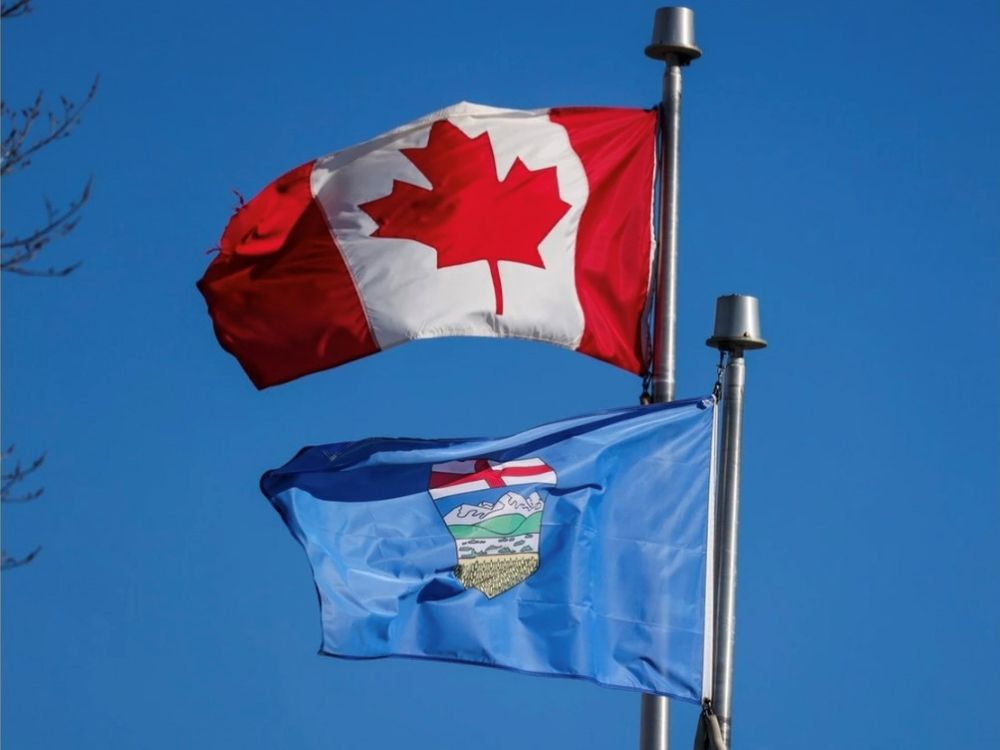
No matter where you stand on Alberta separation — whether you approve from afar, or oppose it from Edmonton — it’s important to remember how small it is. One key theme that continues to emerge from any polling on the issue is the movement’s minority status. It’s doomed, just from the numbers alone.
The best public opinion data we have yet, taking the temperature of the province, was released Thursday by Postmedia-Leger. In a weekend survey, it asked Albertans how they would feel about various separation scenarios and found that even the most popular form of secession — with Alberta, Saskatchewan, British Columbia and Manitoba forming its own country — was supported by only 35 per cent of the province.
The concept of an Alberta-Saskatchewan independent nation-state was supported by 30 per cent of Albertans, while 29 per cent supported the idea of an Alberta-alone nation-state. Only 17 per cent of Albertans supported joining the United States as a state. This is consistent with previous polling: in March, Mainstreet Research
support in Alberta for some form of independence at 37 per cent, while a May poll by Research Co.
that in Alberta, “29 per cent of voters would welcome separation from Canada, while 64 per cent would not.”
In Leger’s study, support also varied by demographic: men, whose support for secession ranged between 32 and 40 per cent depending on the scenario, were generally more in favour of leaving than women, whose support ranged from 23 to 30 per cent. Edmonton-based support for leaving ranged from 25 to 28 per cent, again, depending on the scenario, while in Calgary it ranged from 25 to 34 per cent; in the rest of the province, it was between 35 and 42 per cent.
That’s not to say the numbers can’t change, but it’s hard to anticipate them getting much better for the separatist camp. For one, they have to contend with the reality that a plurality of Albertans — 44 per cent, per the Leger survey — see themselves as primarily Canadian, and another 32 per cent see themselves as equally Albertan and Canadian. Only 21 per cent see themselves as mainly Albertan.
Which makes sense. Alberta is far more open to natural resource development and favours personal independence and limited government to a greater extent than the rest of the country, but when it comes to areas of provincial jurisdiction that have a greater impact in defining local identity, it follows the rest of Canada.
It doesn’t have its own unique film and television industry, exports pop and country stars to the United States. It directs much of its political energy at Ottawa instead of its own house. Its universities offer little different from those of Ontario because they’re deeply beholden to federal policy. Its schools continue to teach shallow curriculums heavily influenced by the progressive left. It isn’t leading the nation on crime either; like everywhere else in the country, it’s plagued with a lack of court transparency, keeping transcripts and judicial statistics from entering the public domain, where they’d actually be useful.
Major cultural overlap with the rest of Canada aside, the separatists also have a hurdle in each other. Some of their number favour American statehood; others, total independence; others, independence only if it includes all of the western provinces. Who is their leader? Unclear — there are multiple factions within the separatist faction.
The leader of the Alberta Republican Party, a separatist political party with People’s-Party-of-Canada-level irrelevance, is already
from independent media commentators for lacking conservative cred. Meanwhile, the Alberta Prosperity Project, a separate group organizing to put a separation question on a referendum ballot, is receiving
from some secessionists for not sufficiently considering the input of others. Of the minority of Albertans who want independence, it’s not clear at all who they want as leader, and how they’d like their new country to work — beyond of course having tax cuts. The Alberta Prosperity Project even
that its people would keep their Canadian passports.
As for what motivates the separatist crowd, most — 53 per cent — wanted to separate for economic, political and cultural reasons together. Another 30 per cent wanted to separate for economic reasons alone, which is a significant minority of the movement. They make up a weaker strut in the frame, as they’d logically withdraw support if the economic calculus doesn’t end up playing out in Alberta’s favour. And it probably doesn’t.
A lot of the big economic plans for Independent Alberta are based on fantasy math and imagined scenarios that blot out the cons while exaggerating the pros. Unless Alberta takes part or all of B.C. with it — and that’s incredibly unlikely, unless northern and interior B.C. are somehow conquered by the New Alberta Army or granted permission to split by their province’s urban political centre — it will be landlocked and only able to export its resources to the two countries it’s sandwiched between, resulting in worse-than-global-market revenues. Proponents point to Switzerland, a high-end manufacturing and banking fortress, as evidence that Alberta Alone could succeed — when in fact we’d be more comparable to mineral-heavy Mongolia.
And no, there is no United Nations treaty that would guarantee Alberta favourable access to B.C.’s coast; the UN’s treaty on ocean use at best
coastal nation-states to make agreements with landlocked neighbours to allow access on terms they both find agreeable.
Talk to a regular Costco-shopping Albertan and they’re most likely not going to favour independence. In fact, they’re probably not happy with the
increased level of investor uncertainty
that indulging separatist fantasies has almost certainly brought upon the province. When you talk about “Alberta separatism,” you are talking about a group that’s big enough to cause the province problems, but too small to ever achieve independence.
National Post

