



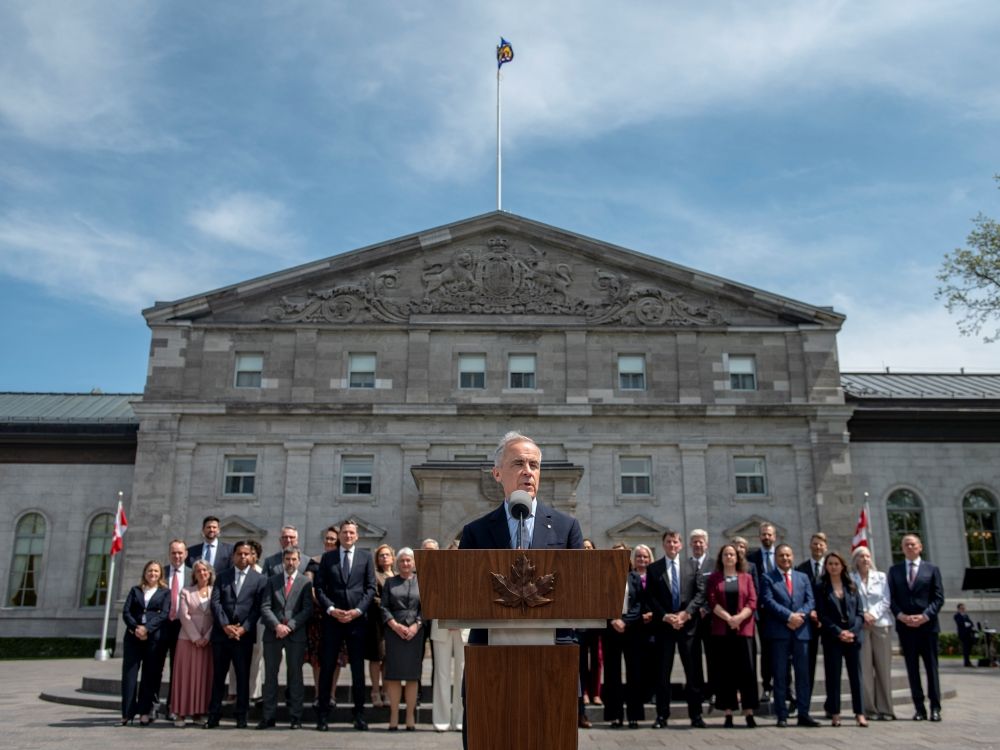
Well, Canada isn’t completely unchained from the worst of its deadweight Trudeau-era cabinet ministers, but at least Prime Minister Mark Carney had the sense to prune some of them.
The casualties of the cull were revealed Tuesday morning after an obligatory land acknowledgement, with the naming of Carney’s two-tier, 38-person cabinet
of 28 ministers and 10 junior ministers, dubbed “secretaries of state.”
Big names have been left off the list — such as Jonathan Wilkinson, former natural resources minister and thorn in Western Canada’s side — while elder ministers have largely been shuffled around and sometimes downgraded. Only 13 brand-new MPs have been
.
One big upgrade is newcomer and Energy and Natural Resources Minister Tim Hodgson, an Ontario MP who was once CEO of the Canadian offshoot of Goldman Sachs. He’s
numerous corporate board roles over the years, including chair of Ontario electric utility company Hydro One and board member of Alberta oilsands developer MEG Energy, and has worked as a sustainable finance adviser. Back when Carney was in charge of the Bank of Canada, he served as a special advisor to the governor.
Hodgson offers a light of hope. He’s still a Liberal, and bound to operate under the constraints set out by his team, but he at least has an understanding of energy and how money works at scale. That’s no guarantee of success — his predecessor in the role, Wilkinson, had also worked for energy companies earlier in his career, and still pushed for the
in its heyday and
its partial cancellation in Eastern Canada. But with Hodgson comes an opportunity for change.
That’s a potential olive branch for Alberta, which buzzed with anger in Steven Guilbeault’s environment minister years. That said, we’re not home free from the man, as he’s now the minister of “Canadian identity and culture” as well as official languages. The culture file is responsible for museums, film and media funds and much of the Liberal diversity-equity-inclusion push, and official languages department has been the means of suppressing Anglo participation in the civil service and more recently the judiciary. Guilbeault will continue having a means to antagonize Western Canada from his new seat.
Meanwhile, his heir, Environment Minister Julie Dabrusin, was previously the natural resources parliamentary secretary and has a past of excusing project delays and cancellations as matters of market force rather than government uncertainty. When the proposed Newfoundland and Labrador’s Baie du Nord offshore oil project was delayed back in 2023 due to “market conditions” — after being scrutinized for four years by federal climate screeners — she
. At other times, she’s
energy CEOs and
the Canadian potential to provide Europe with energy and
the now-cancelled Teck Frontier oilsands project in 2020. At least she’s not a
.
Elsewhere in cabinet, former CBC host and new MP Evan Solomon now sits as minister of artificial intelligence. Solomon was
from the broadcaster in 2015 for using his work contacts to make art deals. One client? Carney himself. Clearly Carney has enjoyed whatever piece he received into his collection via Solomon.
Then there’s the housing file, which will be taken over by another newcomer to Parliament, former Vancouver mayor Gregor Robertson. Robertson was on the front line of Canadian decline, leading his city into a housing crisis in the 2010s that has only gotten worse since. He has a history of spouting some of the worst Liberal positions: on the objectively observable impact of immigration on housing, he
in 2015 discussions out of fear of “dividing people”; on drugs, he
strongly for decriminalization in 2018. Ultimately, his great failures were housing, homelessness and drugs — and now, he gets a shot at a redo, this time from Ottawa.
As for the guy who took Canada’s immigration system on a catastrophic post-COVID nosedive, and later moved on to the disaster file of housing, well, he’s going to be justice minister now. Sean Fraser bodes poorly for general safety and order in Canada based on his record alone.
More interesting is the appointment of Joël Lightbound to cabinet as the minister of government transformation, public works and procurement. In the Trudeau era, Lightbound was on the margin, exiled to backbench status after publicly criticizing the Liberal brain trust for using COVID as a political wedge in the lead-up to the 2021 election. Clearly capable of independent thought, he might actually be useful in the area of procurement, which is a notorious festering ground for government inefficiency.
Cabinet demotions of note include Transport and Internal Trade Minister Chrystia Freeland, who’s taken a major downgrade from finance. She’s a cyclist, which does harm her transport cred, but she’s
been pulled over for going 132 km/h on the highway, which at least demonstrates that she values speed. Joining her in the discard pile is Mélanie Joly, once in foreign affairs, now the industry minister. Both were headliners under the rule of Justin Trudeau, and neither were particularly good at governing.
And lastly, some characters are out of the cast completely. Bill Blair, former minister of emergency preparedness (among other things) and thus one of the leads on Canada’s COVID response, was dropped. Also out is Ahmed Hussen, once the immigration minister and lead contributor to Canada’s overpopulation problem, later the diversity minister who answered for the granting of “anti-racism” funds to vicious antisemite Laith Marouf.
Not all deadwood has been thinned out, and many replacements come with the potential for disappointment. We’ll just have to wait and see.
National Post